Instant
01 · Ask
Ask the AI a follow-up
Got more questions about emergency Drain Clearance? Describe the bit you're unsure about — the AI explains options, sequencing and what to ask the drain specialist.

Same-day or out-of-hours — blockage cleared, drain tested, area cleaned up.
You've read the brief on emergency Drain Clearance. Now lean on us to find the right drain specialist — and stay in control of the job.
Got more questions about emergency Drain Clearance? Describe the bit you're unsure about — the AI explains options, sequencing and what to ask the drain specialist.
Costs, timelines, pitfalls and the right questions to ask before any drain specialist starts on emergency Drain Clearance.
Itemised quotes from up to 3 local drain specialists on emergency Drain Clearance — so you can compare like-for-like, not lump sums.
Ready when you are
Enter your postcode and get free quotes from local pros.
Four moves that separate a smooth job from a nightmare.
Cooking fats and oils solidify in the cold pipes, catching other debris and creating a concrete-like plug.
These do not break down like toilet paper and are the leading cause of modern UK blockages.
Tiny tree roots enter through small cracks or joints, expanding until they completely fill the pipe.
Older clay pipes can succumb to ground movement or heavy vehicle traffic above, requiring excavation or lining.
Indicative UK ranges and what affects price.
By job type
Quote spread is typically ± 18% — always get 3 quotes.
Drain Specialist quick-view
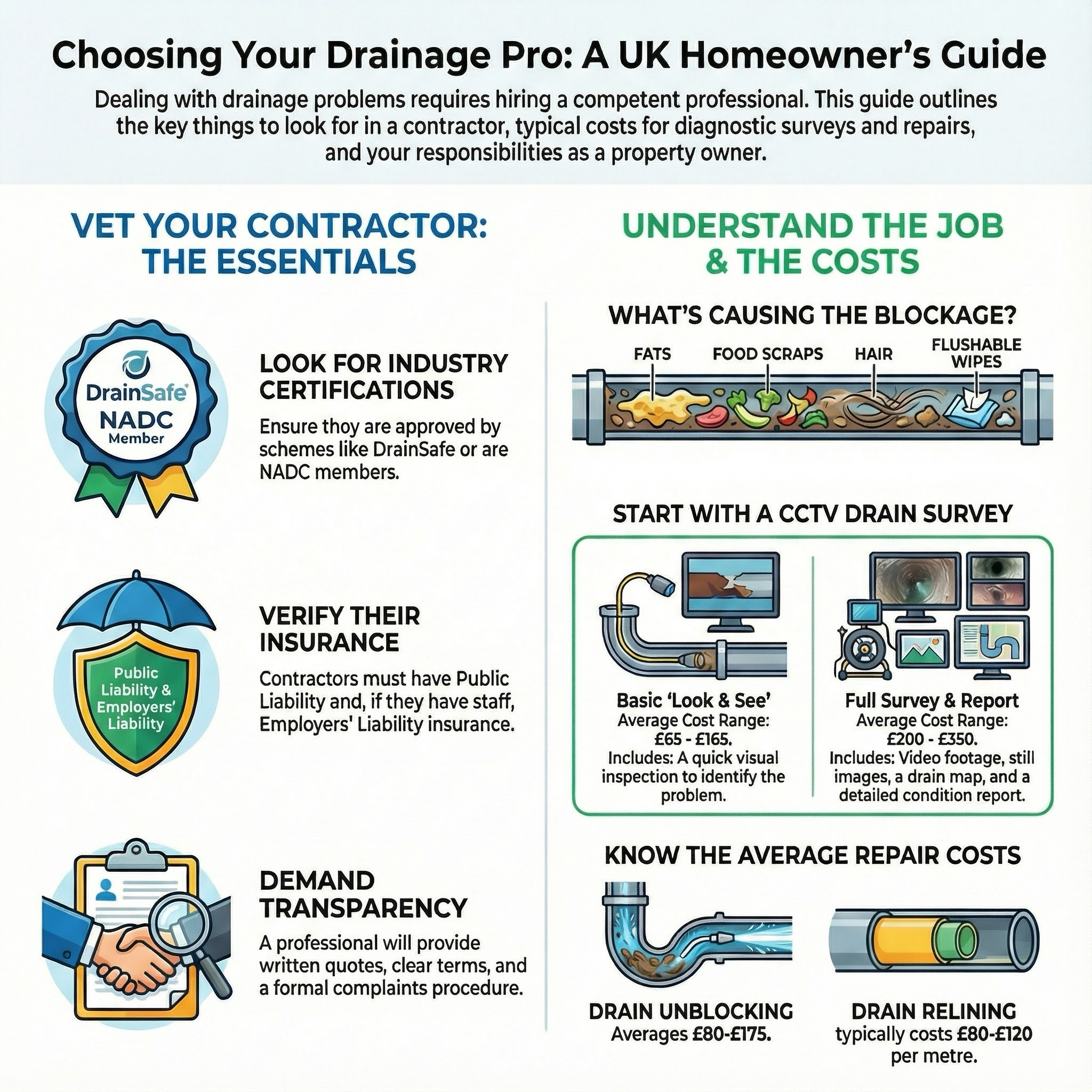
Drain Specialist explained
In the UK, our ageing Victorian infrastructure combined with modern "flushable" wipes often leads to sudden, stubborn blockages. This guide outlines what to expect when calling out a specialist and how to ensure you are paying a fair price for a professional job.
Prices for emergency drain clearance vary based on your location (London and the South East attract a premium) and the time of day. Most reputable UK companies offer a fixed-price for the first hour of work.
| Service Item | Low £ | High £ | Notes |
|---|---|---|---|
| Standard Call-out (Daytime) | £90 | £160 | Includes first hour of basic rodding. |
| Emergency/Out-of-Hours Call-out | £180 | £350 | Evenings, weekends, and bank holidays. |
| High-Pressure Water Jetting | £150 | £250 | Often a flat fee for a standard domestic run. |
| CCTV Drain Survey | £120 | £280 | Includes a digital report and footage. |
| Root Removal (Mechanical) | £250 | £500 | Requires specialist cutting heads. |
Note: Most prices include VAT. Always confirm if the quote includes the use of specialist equipment like jetters, as some "budget" firms charge these as hidden extras.
Homeowners can often clear minor sink or toilet clogs with a plunger or basic DIY rods. However, if the blockage is in the main external stack or involves raw sewage, professional intervention is essential.
Warning: Overusing chemical drain cleaners can damage older pitch-fibre pipes and create toxic fumes if they fail to clear the blockage, making it dangerous for a tradesperson to work on later.
Professional drainage engineers carry high-pressure equipment that reaches deep into the system where DIY tools fail. Furthermore, they can identify if the blockage is caused by a collapsed pipe, which no amount of rodding will fix.
Most standard policies cover "accidental damage" (like a pipe crushed by a tree root), but they rarely cover "maintenance issues" (like a blockage caused by grease or wipes). Check if you have "Home Emergency Cover" as an add-on, which usually covers the call-out fee.
If your neighbours are also experiencing issues, or if the blockage is in the road outside your boundary, it is likely the Water Company's problem. If only your toilets are backing up and the manhole on your driveway is full, it is usually your responsibility.
Rodding uses physical force to push through a blockage, which is good for local clogs. Jetting uses high-pressure water to scrub the pipe walls clean, removing grease and scale that rods might leave behind, providing a more long-term solution.
This is often a sign of a partial blockage or "trapped" debris rotting in the pipe. It could also indicate a dried-out U-bend or a faulty vent pipe (AAV) allowing sewer gases back into the house.
Unless you have a specific "drain kit" attachment and a machine with sufficient flow rate, a standard domestic pressure washer is rarely effective. It can also be dangerous if the hose kicks back out of the pipe toward the operator.
Only the "Three Ps" should be flushed: Pee, Poo, and Paper. Avoid wipes (even those labelled flushable), sanitary products, cotton buds, dental floss, and any fats, oils, or grease from the kitchen.
This guide was written with AI assistance and is intended for general information only. Prices are estimates based on UK averages and may vary by region. Always get at least three quotes and consult a qualified professional before starting any work.
Ask follow-ups in plain English. The AI explains options, sequencing and what to ask the drain specialist — so you walk in informed.
For many rural UK homeowners, a septic tank is an essential piece of infrastructure that remains out of sight and out of mind until something goes wrong. Howeve...
READ GUIDE →GuideA CCTV drain survey is the most effective way for UK homeowners to identify hidden issues within their drainage system without the need for disruptive excavatio...
READ GUIDE →GuideDrain relining, often called "no-dig" technology, is a modern method of repairing damaged pipes without the need for disruptive excavations. For UK homeowners, ...
READ GUIDE →GuideA drainage survey is often the only way to see what is happening beneath your property. Whether you are buying a new home or dealing with a stubborn blockage, a...
READ GUIDE →GuideA faulty drainage system is one of those household issues that remains invisible until it becomes a crisis. Whether it is a slow-draining sink, a persistent fou...
READ GUIDE →GuideA soakaway is a critical component of your property’s drainage system, designed to manage surface water by slowly dispersing it into the surrounding soil. When ...
READ GUIDE →