Instant
01 · Ask
Ask the AI a follow-up
Got more questions about stairlift installation? Describe the bit you're unsure about — the AI explains options, sequencing and what to ask the mobility aids.

Straight or curved stairlift — measured, supplied and fitted in a single day. Hired or bought.
You've read the brief on stairlift installation. Now lean on us to find the right mobility aids — and stay in control of the job.
Got more questions about stairlift installation? Describe the bit you're unsure about — the AI explains options, sequencing and what to ask the mobility aids.
Costs, timelines, pitfalls and the right questions to ask before any mobility aids starts on stairlift installation.
Itemised quotes from up to 3 local mobility aidss on stairlift installation — so you can compare like-for-like, not lump sums.
Ready when you are
Enter your postcode and get free quotes from local pros.
Four moves that separate a smooth job from a nightmare.
If the stairs are too narrow (less than 750mm), the user's knees may hit the opposite wall or banister. A "perch" seat may be required.
Stairlifts run on batteries charged by the mains. If the charger is accidentally switched off at the wall, the batteries will eventually fail and require replacement.
Items left on the stairs will trigger safety sensors. Modern lifts have "pressure sensitive" edges to stop the lift instantly if an object is detected.
If the rail ends near a doorway, it may create a trip hazard. A powered folding hinge is often needed to clear the walkway.
Indicative UK ranges and what affects price.
By job type
Quote spread is typically ± 18% — always get 3 quotes.
Mobility Aids quick-view
Mobility Aids explained
Modern stairlifts are sleek, quiet, and highly reliable, fitting onto the stairs rather than the wall. Whether your staircase is a simple straight run or a complex spiral, there is a solution designed to keep you independent in the home you love.
| Item | Low £ | High £ | Notes |
|---|---|---|---|
| New Straight Stairlift | £1,800 | £3,200 | Standard 13-step flight, no turns. |
| New Curved Stairlift | £4,500 | £9,000 | Bespoke rail for corners or landings. |
| Reconditioned Straight Unit | £900 | £1,500 | Includes installation and short warranty. |
| Removal of Old Unit | £100 | £250 | Safe disposal and electrical capping. |
| New Power Point (Electrician) | £150 | £300 | Required if no socket is near the stairs. |
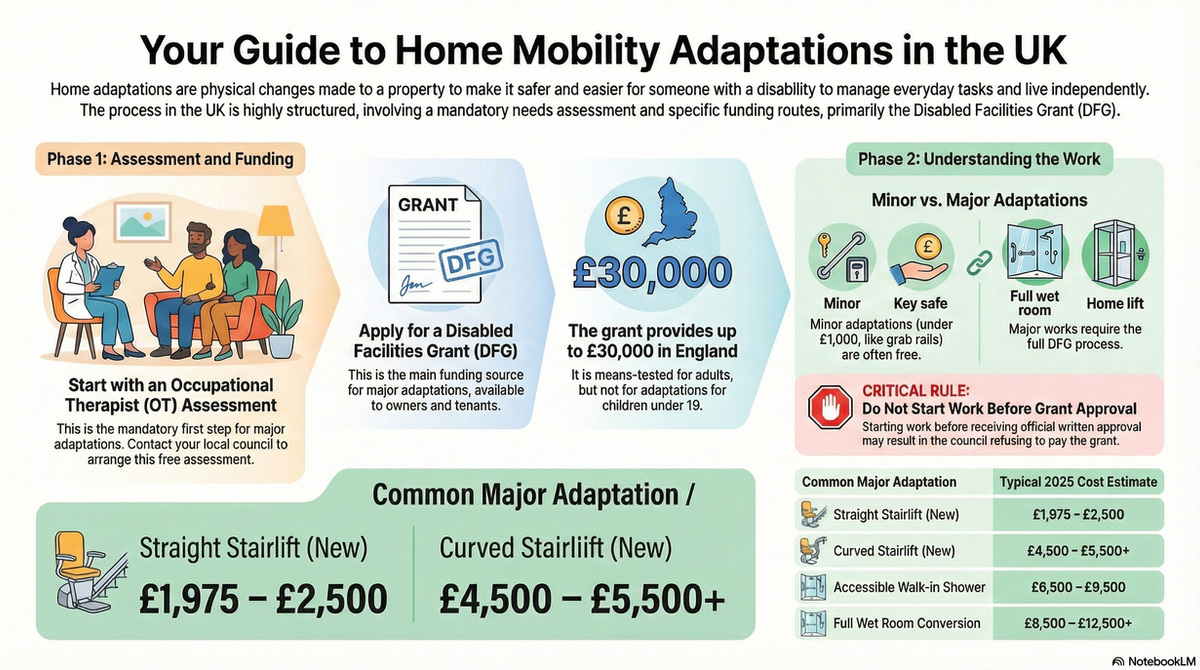
Pricing is primarily driven by the shape of your stairs; curved rails must be custom-manufactured to the millimetre, which significantly increases the cost. Note: If you have a long-term illness or disability, you may be eligible for 0% VAT on the purchase and installation, saving you 20%.
Stairlift installation is strictly a professional job. While second-hand units are often sold privately, modern stairlifts are complex pieces of machinery with safety sensors that must be calibrated precisely to prevent accidents.
Attempting a DIY install voids manufacturer warranties and can be dangerous if the rail is not secured correctly to the treads. Furthermore, any electrical work involving a new circuit must comply with Part P of the Building Regulations, requiring a certified electrician.
Always ask for a written breakdown of the "after-sales" service. A stairlift is a critical piece of equipment; you need to know how quickly they can attend if it breaks down while you are upstairs.
Questions to ask:
No. Stairlift rails are fixed to the stair treads (the steps themselves) using sturdy brackets. There is usually no contact with the wall at all, meaning your wallpaper and paintwork remain untouched.
Most modern stairlifts are battery-powered and are constantly charged by the mains. In the event of a power cut, the lift will still have enough charge for approximately 10–20 trips, ensuring you aren't stranded.
Yes. Stairlifts are designed with folding arms, seats, and footrests. When not in use, they fold up tightly against the wall, leaving enough room for others to walk up and down safely.
Standard stairlifts typically support up to 120kg–140kg (approx. 19–22 stone). Heavy-duty models are available that can accommodate users up to 190kg (30 stone), though these may require a wider staircase.
Yes, rental is a popular option for short-term recovery (e.g., after surgery). It usually involves a one-off setup fee followed by a monthly rental charge. This is typically only available for straight staircases.
This guide was written with AI assistance and is intended for general information only. Prices are estimates based on UK averages and may vary by region. Always get at least three quotes and consult a qualified professional before starting any work.
Ask follow-ups in plain English. The AI explains options, sequencing and what to ask the mobility aids — so you walk in informed.
Recliner Chair Repair Guide Scope of Works Verify proof of ownership and carry out a brief fault interview. Remove base‑cover and inspect mechanism, cabling, mo...
READ GUIDE →GuideFor many UK homeowners, a mobility scooter is more than just a vehicle; it is a lifeline to independence and the local community. Ensuring your scooter is profe...
READ GUIDE →GuideFlat-pack furniture has become a staple of UK homes, offering stylish designs at accessible price points. However, the complexity of modern assembly—often invol...
READ GUIDE →GuideWheelchair Tyre Replacement Costs Scope of Works Initial inspection & sizing – confirm wheel diameter, tyre type (pneumatic, solid, puncture‑proof), hand‑ri...
READ GUIDE →GuideA stairlift is a vital piece of equipment for maintaining independence in your home. Regular servicing ensures the unit remains reliable, safe, and whisper-quie...
READ GUIDE →GuideWheelchair Repair Costs Scope of Works Fault assessment & safety check – inspect frame, seating, wheels, brakes and electronics; run controller diagnostics ...
READ GUIDE →