Instant
01 · Ask
Project, support or strategy?
One-off fix, ongoing support, or full IT roadmap? Describe the business and the AI tells you which engagement model fits.

Half-day or one-day cyber security training — for small businesses, charities and family offices.
Read the brief on MSP vs ad-hoc, Cyber Essentials and exit clauses — then let Three local consultants quote.
One-off fix, ongoing support, or full IT roadmap? Describe the business and the AI tells you which engagement model fits.
MSP contracts, SLA tiers, Cyber Essentials, backup-restore testing. Know what to ask before signing.
Three local IT consultants quote on the same scope — included hours, response SLA, exit terms — so cheapest isn't accidentally tied-in.
Ready when you are
Enter your postcode and get free quotes from local pros.
Four moves that separate a smooth job from a nightmare.
MSP (managed service provider) gives you ongoing support for a monthly fee. Ad-hoc consultants charge per visit. Match the engagement to your need.
Cyber Essentials / Cyber Essentials Plus is the UK government's basic security standard. Any IT provider not certified themselves is a red flag.
Some IT firms lock you into their stack. Insist on documentation, admin access and exit procedures — so switching providers doesn't take 3 months.
Backups that haven't been restored aren't backups. A reputable IT firm tests recovery quarterly — ask how.
Indicative UK ranges and what affects price.
By job type
Quote spread is typically ± 18% — always get 3 quotes.
IT & Consultancy quick-view
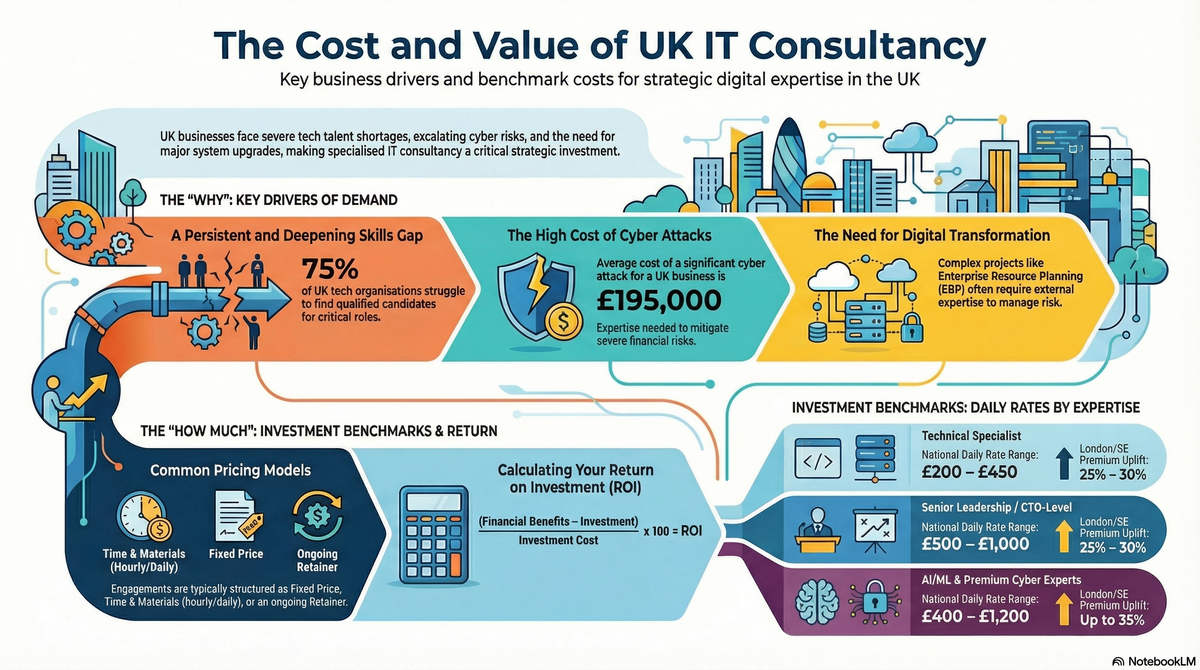
IT & Consultancy explained
Cyber security training in the UK ranges from free online courses to £3,500+ certifications, depending on level and accreditation. Most homeowners and small business owners need only basic awareness courses (£0-£200); IT professionals seeking career progression typically pursue CompTIA Security+, CISSP, or CEH certifications (£300-£3,500 including exam fees).
For SMEs, free courses from the National Cyber Security Centre (NCSC) and Cyber Aware are usually a sensible starting point. Paid courses make sense when you need formal certification for compliance or career reasons.
| Course / certification | Cost | Audience |
|---|---|---|
| NCSC Cyber Aware (online) | Free | Individuals / SMEs |
| NCSC Cyber Essentials (basic) | £300–£500 certification | Small businesses |
| NCSC Cyber Essentials Plus | £800–£2,500 | Mid-size businesses |
| CompTIA Security+ training + exam | £300–£1,500 | Entry-level IT pros |
| Certified Ethical Hacker (CEH) | £800–£3,500 | Penetration testers |
| CISSP (ISC²) training + exam | £1,500–£3,500 | Senior security pros |
| SANS GIAC certifications | £3,000–£8,000 | Specialist roles |
| University-level MSc cyber security | £8,000–£25,000 | Career changers |
Cyber Essentials is the UK government's basic cyber-security certification. Achieving it covers:
Required by the UK government for many supplier contracts. Cost £300-£500 for self-assessment certification; £800-£2,500 for Cyber Essentials Plus (independent technical audit).
For IT professionals progressing into security:
For absolute beginners with no IT background: NCSC Cyber Aware (free) and Open University's free intro module. For aspiring IT-security professionals: CompTIA Security+ training is the standard entry certification.
Often yes — required for many UK government contracts, covers basic cyber hygiene that materially reduces risk, and demonstrates due diligence to insurers and clients. £300-£500 is a small cost vs the alternative of being uninsurable or non-compliant.
3-6 months of evening study for someone with relevant IT experience. The exam is broad — eight domains covering management, technical, and operational security. Plan 6 months part-time or 6 weeks full-time training.
Yes — extensive free resources from NCSC, Open University, Coursera (some courses free without certification), Cybrary, and YouTube channels. For practical skills, TryHackMe and HackTheBox have free tiers.
No — many successful cyber security professionals come from IT backgrounds via certifications and experience rather than degree routes. Apprenticeships and conversion bootcamps are increasingly common entry paths.
CEH (Certified Ethical Hacker) is broader and more knowledge-test focused. OSCP (Offensive Security Certified Professional) is hands-on, requiring you to actually compromise systems in an exam environment. OSCP is generally more highly regarded by experienced practitioners.
Want a local pro to handle this? For SME cyber security, an IT consultancy familiar with your industry will help you navigate Cyber Essentials and beyond — usually more cost-effective than building the expertise in-house unless you're a large organisation.
This guide was written with AI assistance and is intended for general information only. Prices are estimates based on UK averages and may vary by region. Always get at least three quotes and consult a qualified professional before starting any work.
Ask follow-ups in plain English. The AI explains options, sequencing and what to ask the it & consultancy — so you walk in informed.
Setting up a new home office or upgrading a family workstation is no longer just about plugging in a power lead. With the rise of remote working and high-perfor...
READ GUIDE →GuideSmartphones are the central hub of the modern UK home, managing everything from smart heating and security cameras to mobile banking and work communications. Wh...
READ GUIDE →GuideRegular computer maintenance is the digital equivalent of a boiler service or a car MOT. For UK homeowners, a well-maintained PC or laptop ensures longevity, pr...
READ GUIDE →GuideLosing access to precious family photos, critical financial documents, or years of work files is a distressing experience for any UK homeowner. Whether it is a ...
READ GUIDE →GuideLaptops are essential tools for modern life, serving as our offices, entertainment hubs, and connection to the world. When they fail, the disruption to your wor...
READ GUIDE →GuideSmart home integration has evolved from a luxury novelty to a practical investment for UK homeowners. Beyond the convenience of voice-activated lighting, a prof...
READ GUIDE →