Instant
01 · Ask
Ask the AI a follow-up
Got more questions about data Recovery Process Overview? Describe the bit you're unsure about — the AI explains options, sequencing and what to ask the it & consultancy.

Crashed drive, deleted files or corrupted database — data recovery by specialists with cleanroom facilities.
You've read the brief on data Recovery Process Overview. Now lean on us to find the right it & consultancy — and stay in control of the job.
Got more questions about data Recovery Process Overview? Describe the bit you're unsure about — the AI explains options, sequencing and what to ask the it & consultancy.
Costs, timelines, pitfalls and the right questions to ask before any it & consultancy starts on data Recovery Process Overview.
Itemised quotes from up to 3 local it & consultancys on data Recovery Process Overview — so you can compare like-for-like, not lump sums.
Ready when you are
Enter your postcode and get free quotes from local pros.
Four moves that separate a smooth job from a nightmare.
This indicates the read/write heads have failed. Repeatedly powering the drive on to "see if it works" will eventually scrape the data off the platters.
If your drive was encrypted (e.g., BitLocker or FileVault), recovery is significantly harder and requires your recovery keys or passwords.
When data is deleted, the space is marked as "available." If you keep using the computer, new data (like browser cache) will overwrite the lost files, making them gone forever.
Be wary of firms quoting a flat £99 for everything. Genuine mechanical recovery requires expensive parts and hours of lab time that cannot be sustained at that price.
Indicative UK ranges and what affects price.
By job type
Quote spread is typically ± 18% — always get 3 quotes.
IT & Consultancy quick-view
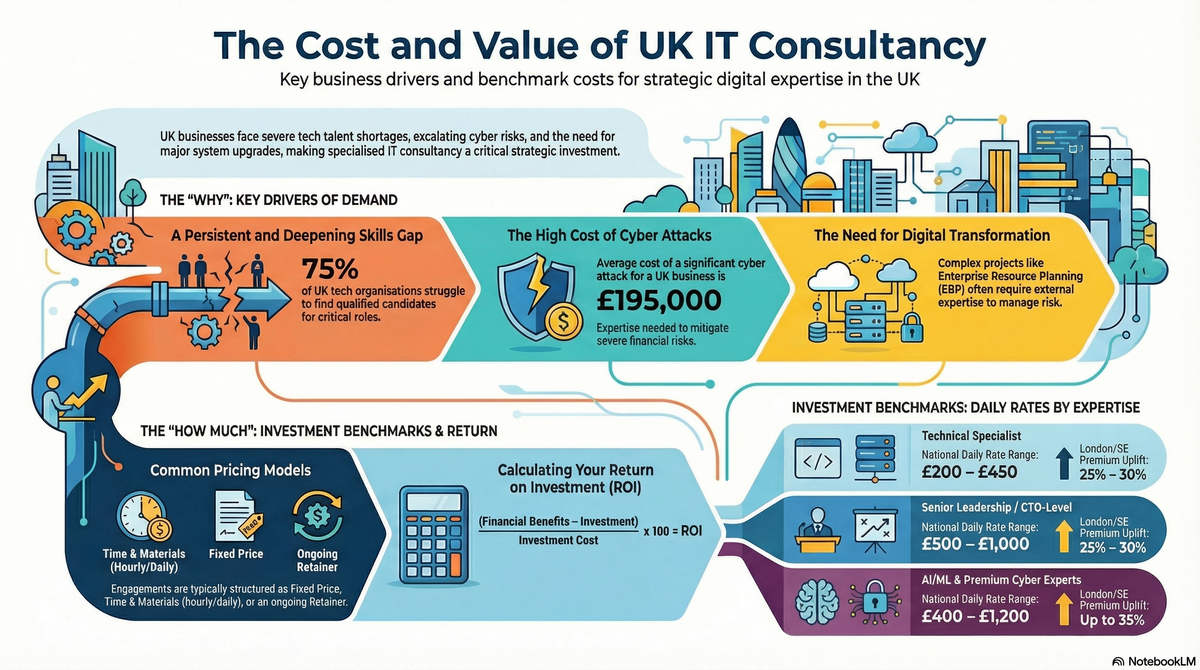
IT & Consultancy explained
Professional data recovery goes far beyond simple "undelete" software. It involves a combination of hardware engineering and forensic software techniques to bypass damaged components and reconstruct fragmented data in a secure environment.
Data recovery pricing is rarely "per GB" and instead depends on the complexity of the failure and the time required on the workbench. Physical mechanical failures are significantly more expensive due to the need for donor parts and cleanroom facilities.
| Item | Low £ | High £ | Notes |
|---|---|---|---|
| Initial Diagnostic Fee | £0 | £90 | Often waived if you proceed with the recovery. |
| Logical Recovery (Software) | £150 | £450 | Accidental deletion, formatting, or minor corruption. |
| Physical Recovery (Mechanical) | £500 | £1,500 | Requires cleanroom and donor parts for HDD/SSD. |
| SSD/Flash Media Recovery | £250 | £800 | Complex controller chip failures or NAND degradation. |
| Emergency/Priority Service | £200 | £500 | Additional surcharge for 24/48-hour turnaround. |
Factors affecting the final bill include the cost of "donor" drives (matching parts for old or rare models), the severity of platter damage, and the urgency of the request. Most reputable UK firms operate on a "No Data, No Fee" basis, though a small non-refundable diagnostic or parts fee may apply.
If you have accidentally deleted a file but the drive is healthy, DIY software may work—provided you do not install the software onto the same drive. However, if the drive is making a clicking, grinding, or beeping sound, DIY attempts will likely lead to permanent data loss.
Never open a hard drive casing yourself. Even a single microscopic dust particle landing on a platter can cause a "head crash," scratching the surface and making the data unrecoverable even for professionals.
Professional recovery is essential for physical damage. In the UK, look for specialists with a physical lab address rather than just a "drop-off" point or a post box. Genuine specialists will have thousands of pounds worth of equipment like PC-3000 flash extractors and laminar flow benches.
Yes, but time is of the essence. Do not try to dry it out with a hairdryer or rice, as this causes corrosion. Keep it in a sealed bag with a damp cloth and send it to a professional immediately.
Yes, SSDs use flash memory chips and complex controllers. When they fail, it is often an electronic or firmware issue rather than mechanical. It requires specialist "chip-off" recovery equipment which is highly technical.
It requires a highly controlled environment, expensive forensic tools, and the purchase of an identical "donor" drive for parts, which the technician must then manually transplant with surgical precision.
Technicians usually see file names and may need to open a few files to verify the recovery is successful. However, professional labs have strict privacy protocols and background-checked staff to ensure confidentiality.
This means if the technician cannot recover the specific files you need, you don't pay the recovery fee. Note that you may still be liable for any agreed-upon diagnostic or parts costs.
This guide was written with AI assistance and is intended for general information only. Prices are estimates based on UK averages and may vary by region. Always get at least three quotes and consult a qualified professional before starting any work.
Ask follow-ups in plain English. The AI explains options, sequencing and what to ask the it & consultancy — so you walk in informed.
Setting up a new home office or upgrading a family workstation is no longer just about plugging in a power lead. With the rise of remote working and high-perfor...
READ GUIDE →GuideSmartphones are the central hub of the modern UK home, managing everything from smart heating and security cameras to mobile banking and work communications. Wh...
READ GUIDE →GuideRegular computer maintenance is the digital equivalent of a boiler service or a car MOT. For UK homeowners, a well-maintained PC or laptop ensures longevity, pr...
READ GUIDE →GuideLaptops are essential tools for modern life, serving as our offices, entertainment hubs, and connection to the world. When they fail, the disruption to your wor...
READ GUIDE →GuideSmart home integration has evolved from a luxury novelty to a practical investment for UK homeowners. Beyond the convenience of voice-activated lighting, a prof...
READ GUIDE →GuideHigh-quality digital assets serve as the virtual shop front for any modern UK home business or side hustle. Whether you are launching a new venture or refreshin...
READ GUIDE →