Instant
01 · Ask
Ask the AI a follow-up
Got more questions about mobility Aid Installation? Describe the bit you're unsure about — the AI explains options, sequencing and what to ask the mobility aids.

Stairlifts, ramps, grab rails and accessible bathrooms — by mobility specialists. DFG-aware.
You've read the brief on mobility Aid Installation. Now lean on us to find the right mobility aids — and stay in control of the job.
Got more questions about mobility Aid Installation? Describe the bit you're unsure about — the AI explains options, sequencing and what to ask the mobility aids.
Costs, timelines, pitfalls and the right questions to ask before any mobility aids starts on mobility Aid Installation.
Itemised quotes from up to 3 local mobility aidss on mobility Aid Installation — so you can compare like-for-like, not lump sums.
Ready when you are
Enter your postcode and get free quotes from local pros.
Four moves that separate a smooth job from a nightmare.
Using standard wall plugs in hollow stud walls. Mobility aids require heavy-duty toggles or timber patressing to be safe.
Placing rails too high or too low, which can cause shoulder strain or fail to provide enough leverage during a fall.
Installing rails or ramps that impede the "clear opening width" of a doorway, making it difficult for wheelchairs or walkers to pass.
External ramps installed without proper drainage can become ice rinks in winter or cause damp issues against the house wall.
Indicative UK ranges and what affects price.
By job type
Quote spread is typically ± 18% — always get 3 quotes.
Mobility Aids quick-view
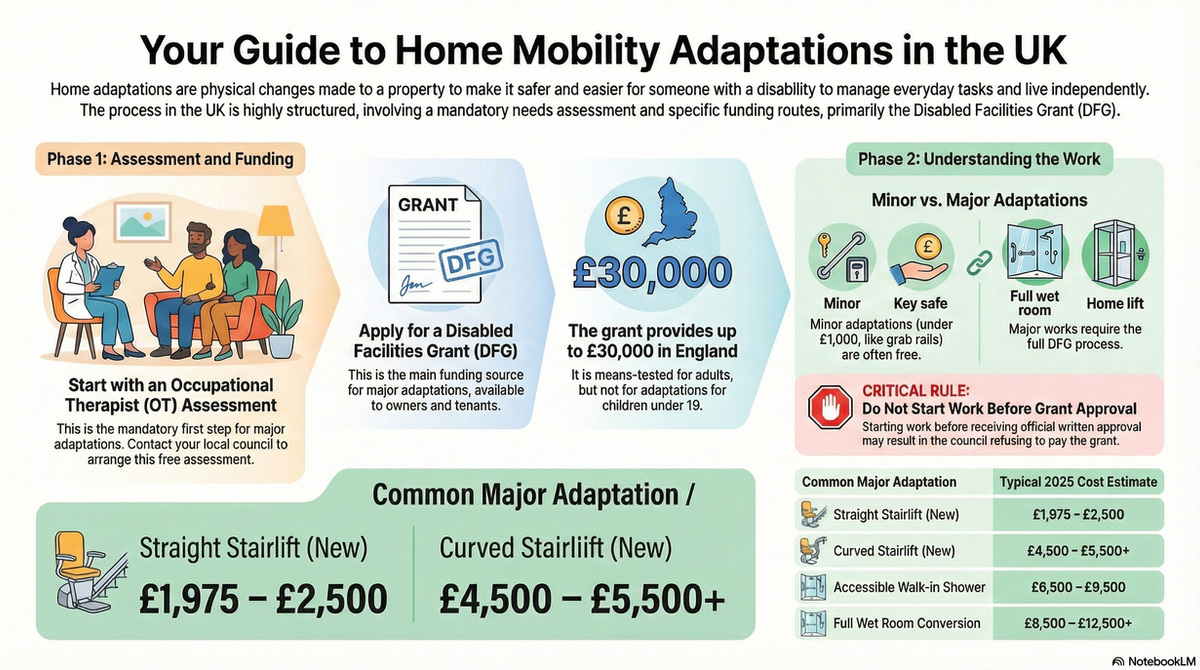
Mobility Aids explained
For many UK homeowners, these modifications are not just about convenience; they are essential for preventing falls and enabling "aging in place." Professional installation is critical to ensure that every aid is securely anchored and positioned correctly for the specific needs of the user.
| Item / Service | Low £ | High £ | Notes |
|---|---|---|---|
| Grab Rail Installation (per rail) | £70 | £130 | Includes basic rail and labour. |
| Modular Threshold Ramp | £150 | £450 | Depends on material (rubber vs. aluminium). |
| External Handrails (per metre) | £120 | £250 | Includes weather-resistant fixings. |
| Wall-Mounted Shower Seat | £200 | £450 | Requires reinforced wall fixings. |
| Straight Stairlift (Reconditioned) | £1,200 | £2,000 | Fully installed with warranty. |
| Labour (Hourly Rate) | £50 | £85 | Regional variations apply. |
Prices vary based on the complexity of the installation and the quality of the materials chosen. Crucially, many UK homeowners are eligible for VAT relief on mobility aid installations, which can reduce the total cost by 20% if you meet the HMRC criteria for chronic illness or disability.
While fitting a basic suction-cup rail might seem like a DIY task, any permanent, weight-bearing mobility aid should be installed by a professional. Incorrectly fitted rails can pull out of the wall under pressure, leading to serious injury.
Professionals understand "blocking" (reinforcing walls) and the specific torque required for different substrates. Furthermore, if you are applying for a Disabled Facilities Grant (DFG), the work must usually be completed by an approved contractor to meet funding requirements.
Always consult an Occupational Therapist (OT) before installation to ensure the aids are positioned correctly for your height and specific physical requirements.
You are eligible if you have a physical or mental impairment that has a long-term effect on your ability to carry out everyday activities, or if you are terminally ill. The work must be for your personal use in your domestic home.
A DFG is a local council grant to help towards the cost of adapting your home. It is means-tested in England and Wales and can cover everything from ramps to walk-in showers.
Yes, but they cannot be fixed to the plasterboard alone. They must be screwed directly into the timber studs or have a reinforcing "pattress" board installed behind the wall surface.
The ideal gradient is 1:15 (a 1cm rise for every 15cm of length). A 1:12 gradient is the absolute maximum steepness recommended for independent use in the UK.
Usually, no. Most ramps fall under "Permitted Development." However, if your home is a Listed Building or in a Conservation Area, you should check with your local planning office first.
This guide was written with AI assistance and is intended for general information only. Prices are estimates based on UK averages and may vary by region. Always get at least three quotes and consult a qualified professional before starting any work.
Ask follow-ups in plain English. The AI explains options, sequencing and what to ask the mobility aids — so you walk in informed.
A stairlift is a transformative investment for UK homeowners facing mobility challenges. It restores full access to the home, provides peace of mind for family ...
READ GUIDE →GuideRecliner Chair Repair Guide Scope of Works Verify proof of ownership and carry out a brief fault interview. Remove base‑cover and inspect mechanism, cabling, mo...
READ GUIDE →GuideFor many UK homeowners, a mobility scooter is more than just a vehicle; it is a lifeline to independence and the local community. Ensuring your scooter is profe...
READ GUIDE →GuideFlat-pack furniture has become a staple of UK homes, offering stylish designs at accessible price points. However, the complexity of modern assembly—often invol...
READ GUIDE →GuideWheelchair Tyre Replacement Costs Scope of Works Initial inspection & sizing – confirm wheel diameter, tyre type (pneumatic, solid, puncture‑proof), hand‑ri...
READ GUIDE →GuideA stairlift is a vital piece of equipment for maintaining independence in your home. Regular servicing ensures the unit remains reliable, safe, and whisper-quie...
READ GUIDE →