Instant
01 · Ask
Stairlift, shower or full adaptation?
Describe the need and the AI tells you which specialist, and whether DFG might cover it.

Wheelchair, walker, scooter or riser-chair fault — diagnosed and repaired by a mobility engineer.
Read the brief on OT assessments, DFG grants and aftercare — then let Three local installers quote.
Describe the need and the AI tells you which specialist, and whether DFG might cover it.
OT assessments, DFG application route, BHTA standards, aftercare contracts. Know your entitlements.
Three local installers quote on the same need — equipment, install, aftercare — so the cheapest isn't accidentally unsupported.
Ready when you are
Enter your postcode and get free quotes from local pros.
Four moves that separate a smooth job from a nightmare.
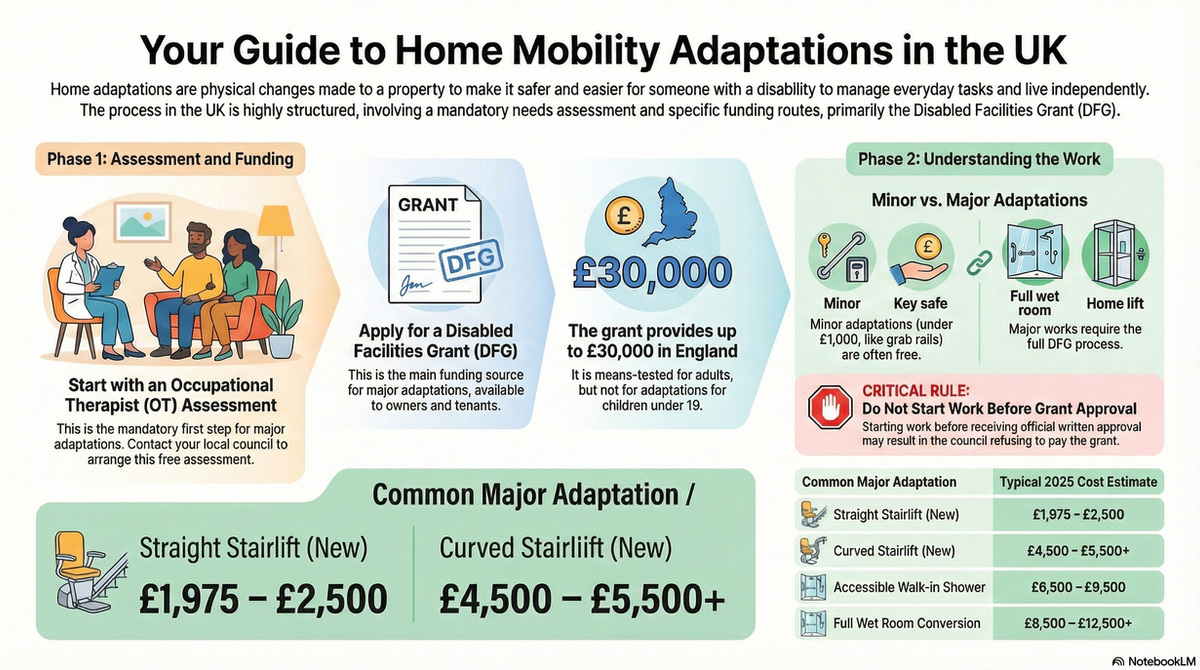
An occupational therapist (often free via the local authority) assesses needs before installers quote. Their letter unlocks Disabled Facilities Grants.
Disabled Facilities Grant covers up to £30k of mobility adaptations. Application is lengthy — start early via the council.
British Healthcare Trades Association membership means vetted, insured and code-compliant work. Cowboys flourish in mobility — insist on the badge.
Stairlifts, hoists, level-access showers — these need responsive servicing. Check the 24-hour callout policy before signing.
Indicative UK ranges and what affects price.
By job type
Quote spread is typically ± 18% — always get 3 quotes.
Mobility Aids quick-view
Mobility Aids explained
Repairing mobility equipment in the UK — wheelchairs, mobility scooters, stairlifts, walking frames, hoists — typically costs £60–£500 depending on the item and fault. Most independent mobility specialists offer fixed-price quotes after diagnosis; main dealers (e.g., Stannah, Acorn, Drive Medical) charge premium rates for branded service.
For users on Motability schemes or with NHS-supplied equipment, repair is typically arranged through the original supplier — often free or heavily subsidised. For privately-purchased equipment, independent repair specialists are usually cheaper and equally competent.
| Equipment / repair | Typical price |
|---|---|
| Wheelchair tyre / wheel replacement | £40–£120 |
| Mobility scooter battery (per battery) | £60–£180 |
| Mobility scooter motor / drive system | £200–£600 |
| Mobility scooter charger replacement | £40–£120 |
| Stairlift service / annual maintenance | £80–£180 |
| Stairlift battery replacement | £90–£250 |
| Stairlift gearbox / motor repair | £250–£700 |
| Walking frame / Zimmer brake or wheel repair | £30–£80 |
| Hoist sling replacement | £60–£200 |
| Hoist motor repair | £200–£600 |
| Bath lift repair | £90–£280 |
1.5-3 years with daily use, 3-5 years with weekly use. Premium gel batteries last longer than standard sealed lead-acid. Replace in pairs to maintain balance — single battery replacement on a 12V/24V system can shorten the new battery's life.
Strongly recommended. £80-£180 annual service prevents £500+ emergency callouts and maintains manufacturer warranty (where applicable). Many companies offer service plans that include annual visits and discounted callouts.
Branded straight stairlifts (Stannah, Acorn): 10-15 years with regular service. Curved stairlifts: 8-12 years. Rechargeable battery models last longer than mains-only because the motor isn't running continuously.
Manufacturer defects within warranty period: yes (typically 1-3 years). Wear and tear, accident damage, normal use deterioration: not covered. Read your warranty terms carefully.
Basic checks (tyre pressure, brake adjustment, battery charging routine) — yes, and recommended monthly. Internal motor work, gearbox service, electrical fault diagnosis: specialist territory; DIY risks personal injury and voiding warranty.
British Healthcare Trades Association (BHTA) members are vetted and reputable. Local Disability Information Service offices recommend trusted suppliers. Word of mouth from local Citizens Advice, GP surgeries, and Age UK branches.
Want a local pro to handle this? A BHTA-member mobility specialist provides quality and reliability. For NHS or Motability equipment, always go through the original supplier first — repairs are often free.
This guide was written with AI assistance and is intended for general information only. Prices are estimates based on UK averages and may vary by region. Always get at least three quotes and consult a qualified professional before starting any work.
Ask follow-ups in plain English. The AI explains options, sequencing and what to ask the mobility aids — so you walk in informed.
A stairlift is a transformative investment for UK homeowners facing mobility challenges. It restores full access to the home, provides peace of mind for family ...
READ GUIDE →GuideRecliner Chair Repair Guide Scope of Works Verify proof of ownership and carry out a brief fault interview. Remove base‑cover and inspect mechanism, cabling, mo...
READ GUIDE →GuideFor many UK homeowners, a mobility scooter is more than just a vehicle; it is a lifeline to independence and the local community. Ensuring your scooter is profe...
READ GUIDE →GuideFlat-pack furniture has become a staple of UK homes, offering stylish designs at accessible price points. However, the complexity of modern assembly—often invol...
READ GUIDE →GuideWheelchair Tyre Replacement Costs Scope of Works Initial inspection & sizing – confirm wheel diameter, tyre type (pneumatic, solid, puncture‑proof), hand‑ri...
READ GUIDE →GuideA stairlift is a vital piece of equipment for maintaining independence in your home. Regular servicing ensures the unit remains reliable, safe, and whisper-quie...
READ GUIDE →