Instant
01 · Ask
Ask the AI a follow-up
Got more questions about tree trimming and tidying? Describe the bit you're unsure about — the AI explains options, sequencing and what to ask the tree surgeon.

Tree trim plus general tidy — annual shape-up of garden trees by a tree surgeon.
You've read the brief on tree trimming and tidying. Now lean on us to find the right tree surgeon — and stay in control of the job.
Got more questions about tree trimming and tidying? Describe the bit you're unsure about — the AI explains options, sequencing and what to ask the tree surgeon.
Costs, timelines, pitfalls and the right questions to ask before any tree surgeon starts on tree trimming and tidying.
Itemised quotes from up to 3 local tree surgeons on tree trimming and tidying — so you can compare like-for-like, not lump sums.
Ready when you are
Enter your postcode and get free quotes from local pros.
Four moves that separate a smooth job from a nightmare.
Removing too much internal foliage, leaving weight only at the ends of branches. This makes limbs prone to snapping in high winds.
Falling branches hitting fences, sheds, or conservatories. Professional rigging prevents this.
Removing more than 30% of the canopy at once can shock a tree, leading to "epicormic" growth (weak, spindly shoots) or death.
While you have a right to prune overhanging branches back to the boundary, you must offer the "arisings" (the cut wood) back to the neighbour.
Indicative UK ranges and what affects price.
By job type
Quote spread is typically ± 18% — always get 3 quotes.
Tree Surgeon quick-view
Tree Surgeon explained
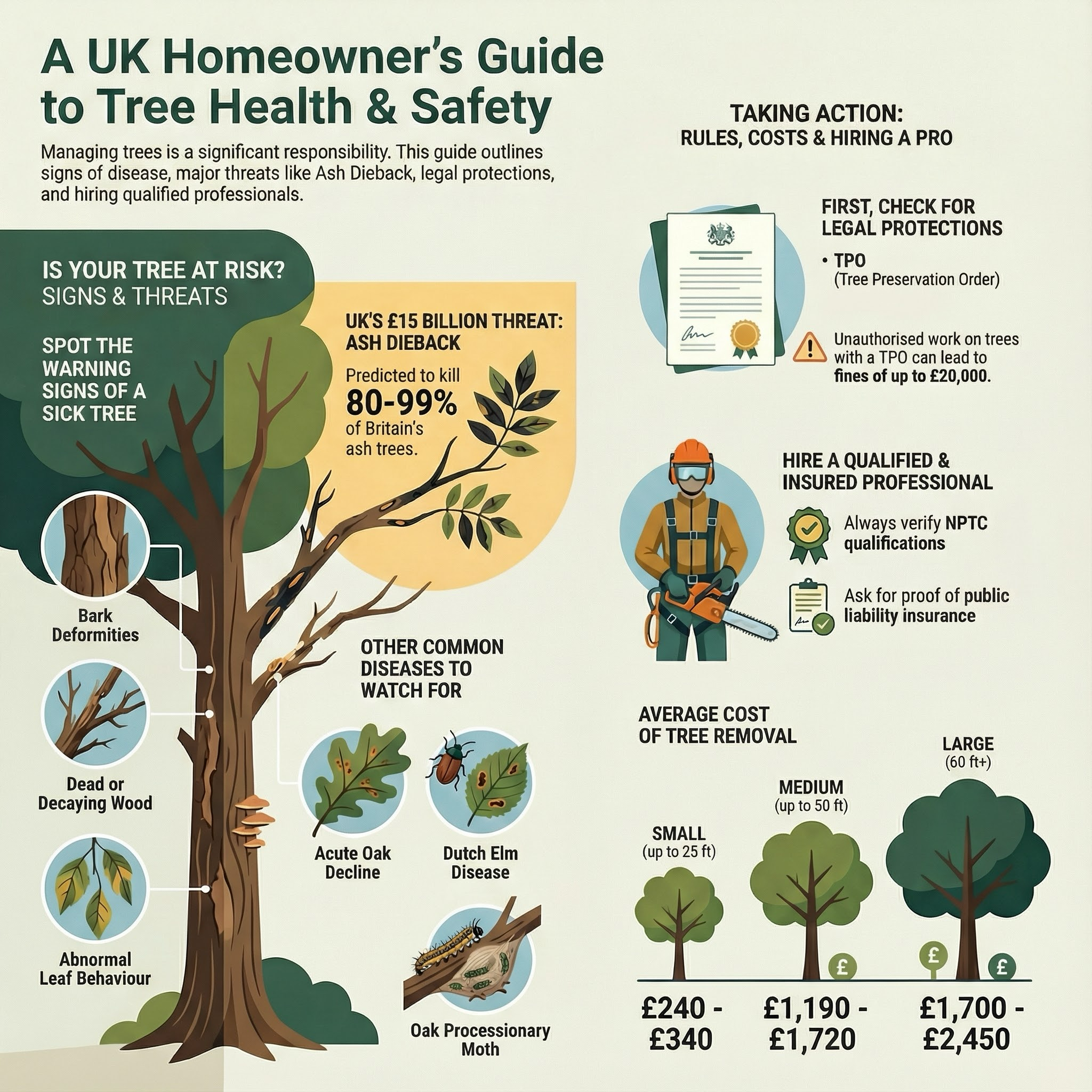
Professional tree trimming, often referred to as arboriculture, involves precise pruning techniques that go far beyond simple "lopping and topping." Engaging a qualified tree surgeon ensures your trees remain structural sound while complying with local planning laws and environmental protections.
Tree surgery costs are primarily driven by the size of the tree, its location, and the volume of waste that needs to be removed. Prices in 2025/26 reflect increased fuel and disposal costs, alongside the high insurance premiums required for this high-risk trade.
| Item | Low £ | High £ | Notes |
|---|---|---|---|
| Small Tree (e.g., Fruit Tree/Silver Birch) | £250 | £500 | Basic prune and shape; includes waste removal. |
| Medium Tree (e.g., Mature Rowan/Cherry) | £500 | £950 | Crown reduction and thinning; 2-man crew. |
| Large Tree (e.g., Oak/Beech/Ash) | £1,000 | £2,500+ | Complex rigging or cherry picker access required. |
| Full Day Rate (Team of 2-3) | £800 | £1,200 | Best value for multiple trees or large-scale tidying. |
| Stump Grinding | £150 | £400 | Price depends on diameter and depth of the root ball. |
| TPO Application/Council Liaison | £75 | £150 | Admin fee if the surgeon handles the paperwork. |
Factors that will push your quote toward the higher end include restricted access (e.g., carrying wood through a terraced house), proximity to public highways requiring traffic management, or work near "live" utility cables.
While basic hedge trimming can be a DIY task, tree surgery is one of the most dangerous domestic trades. Working at height with chainsaws requires specialist training and high-level safety equipment.
Warning: Never attempt to prune branches near power lines or use a chainsaw on a ladder. Professional arborists use "climbing and rigging" techniques to ensure limbs fall safely and controlled.
In the UK, you must also consider legal restrictions. Pruning a tree protected by a Tree Preservation Order (TPO) or one within a Conservation Area without permission is a criminal offence that can lead to substantial fines for both the homeowner and the contractor.
Questions to ask:
For most species, the dormant season (late autumn to late winter) is ideal as the tree is less stressed and the structure is visible. However, some species like Cherry or Plum should be pruned in mid-summer to avoid Silver Leaf disease.
Yes, under UK Common Law, you can prune branches back to your property boundary line. However, you must not enter their land to do so, and you should not prune in a way that makes the tree unstable or dead.
The terms are often used interchangeably. Generally, a tree surgeon focuses on the physical work (climbing and cutting), while an arborist has more academic training in the science of tree health and pathology.
Most quotes include chipping smaller branches and removing the timber. If you want to keep the wood for a log burner, let them know in advance so they can cut it into manageable "rings" for you.
You can check your local council's website; most have an interactive map showing protected trees. Alternatively, you can call the planning department. A professional tree surgeon will usually do this for you.
This guide was written with AI assistance and is intended for general information only. Prices are estimates based on UK averages and may vary by region. Always get at least three quotes and consult a qualified professional before starting any work.
Ask follow-ups in plain English. The AI explains options, sequencing and what to ask the tree surgeon — so you walk in informed.
Products & Services • Supply a wide range of premium timber products including softwood, hardwood, and treated timber • Custom cutting and sizing services t...
READ GUIDE →GuideProfessional tree and bush maintenance is essential for more than just a tidy garden. In the UK, proper arboriculture ensures the safety of your property, the h...
READ GUIDE →GuideTree felling is a high-risk task that requires precision, specialist equipment, and a deep understanding of tree biology. Whether you are removing a dead tree f...
READ GUIDE →GuideMaintaining the trees on your property is about more than just aesthetics; it is a critical part of property safety and health. Whether you have a towering oak ...
READ GUIDE →GuideCrown thinning is a precise arboricultural technique designed to improve a tree's structure without altering its overall size or shape. By selectively removing ...
READ GUIDE →GuideProper tree maintenance is essential for the safety, health, and aesthetic value of your UK property. Whether you are dealing with an overgrown oak, a storm-dam...
READ GUIDE →