Instant
01 · Ask
Ask the AI a follow-up
Got more questions about air-conditioning assessment? Describe the bit you're unsure about — the AI explains options, sequencing and what to ask the air conditioning.

On-site survey of your existing AC — load calc, refrigerant lines, controls and energy efficiency.
You've read the brief on air-conditioning assessment. Now lean on us to find the right air conditioning — and stay in control of the job.
Got more questions about air-conditioning assessment? Describe the bit you're unsure about — the AI explains options, sequencing and what to ask the air conditioning.
Costs, timelines, pitfalls and the right questions to ask before any air conditioning starts on air-conditioning assessment.
Itemised quotes from up to 3 local air conditionings on air-conditioning assessment — so you can compare like-for-like, not lump sums.
Ready when you are
Enter your postcode and get free quotes from local pros.
Four moves that separate a smooth job from a nightmare.
Often caused by vibration or poor initial installation; results in the unit blowing warm air.
Sludge or mould buildup can cause water to leak from the indoor unit down your walls.
A common electrical failure that prevents the outdoor compressor from starting up.
Dust buildup on the outdoor coils forces the system to work harder, significantly increasing your electricity bills.
Indicative UK ranges and what affects price.
By job type
Quote spread is typically ± 18% — always get 3 quotes.
Air Conditioning quick-view
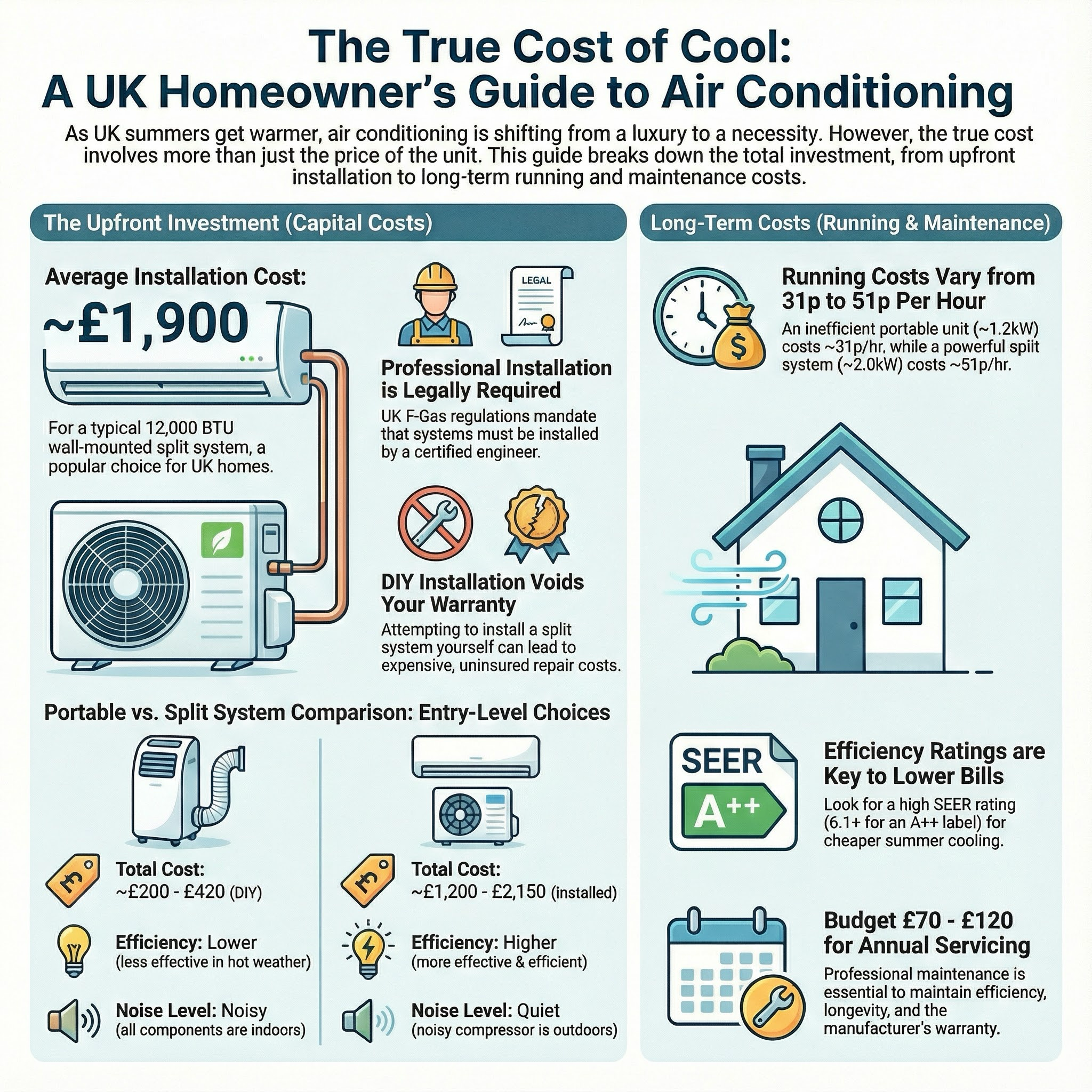
Air Conditioning explained
Whether you have a single wall-mounted "split" unit or a multi-room system, regular assessments are often a condition of your manufacturer’s warranty. This guide covers what to expect when a qualified engineer visits your home and the typical costs involved in 2025.
| Item | Low £ | High £ | Notes |
|---|---|---|---|
| Call-out / Initial Assessment | £90 | £150 | Covers travel and the first 60 minutes on site. |
| Labour (per hour) | £50 | £90 | Applicable if the assessment takes longer than an hour. |
| Consumables & Filters | £20 | £70 | Standard antimicrobial sprays and basic filter replacements. |
| Specialist Access | £0 | £150 | Required for high-level outdoor units needing scaffolding or long ladders. |
| Total Average Cost | £140 | £420 | Dependent on the number of units and system complexity. |
Prices vary based on your location in the UK, with London and the South East typically seeing higher labour rates. The age of your system also impacts cost, as older units using obsolete refrigerants may require more specialist testing equipment.
While you can safely clean the external plastic casing and dust the reachable filters yourself, all technical assessments must be carried out by a professional. It is illegal in the UK for an unqualified person to work on the refrigerant circuit of an air conditioning system.
Only hire engineers who are F-Gas certified. Handling fluorinated gases without the correct credentials is a criminal offence and will void your home insurance.
Questions to ask:
For most UK homes, an annual assessment is sufficient. However, if you use your system for heating in the winter as well as cooling in the summer, a bi-annual check is recommended.
This usually indicates a blockage in the condensate drain line or, more seriously, a leak in the refrigerant pipework. An assessment will identify the exact cause before it leads to a total system failure.
Yes. An inefficient system can use up to 30% more electricity. Cleaning the coils and ensuring the correct gas pressure allows the system to reach the desired temperature much faster.
This is often "Dirty Sock Syndrome," caused by bacteria and mould growing on the indoor evaporator coils. A professional assessment includes a deep clean with specialist antimicrobial chemicals to kill the odour.
An assessment is a diagnostic health check to find faults. A service usually includes the assessment plus proactive maintenance, such as deep-cleaning filters and chemical flushes of the drainage system.
This guide was written with AI assistance and is intended for general information only. Prices are estimates based on UK averages and may vary by region. Always get at least three quotes and consult a qualified professional before starting any work.
Ask follow-ups in plain English. The AI explains options, sequencing and what to ask the air conditioning — so you walk in informed.
As UK summers become increasingly warmer, air conditioning has transitioned from a high-end luxury to a common feature in many British homes. Whether you have a...
READ GUIDE →GuideAs UK summers become increasingly intense, domestic air conditioning has shifted from a luxury to a necessity for many homeowners. When a system fails, prompt r...
READ GUIDE →GuideMaintaining a commercial air conditioning system is essential for business continuity, energy efficiency, and legal compliance. In the UK, businesses are bound ...
READ GUIDE →GuidePortable air conditioners are a popular choice for UK homeowners looking to combat increasingly hot summers without the permanence or expense of a fixed split-s...
READ GUIDE →GuideAir conditioning is rapidly transitioning from a luxury to a necessity for many UK homeowners. As summer heatwaves become more frequent, these systems—technical...
READ GUIDE →GuideInstalling air conditioning tubing—often referred to as the "line set"—is the most critical phase of any AC installation. These copper pipes act as the circulat...
READ GUIDE →