Instant
01 · Ask
Ask the AI a follow-up
Got more questions about commercial Air Conditioning Service? Describe the bit you're unsure about — the AI explains options, sequencing and what to ask the air conditioning.

Office, shop and restaurant AC servicing — F-Gas logs, statutory leak checks and out-of-hours visits.
You've read the brief on commercial Air Conditioning Service. Now lean on us to find the right air conditioning — and stay in control of the job.
Got more questions about commercial Air Conditioning Service? Describe the bit you're unsure about — the AI explains options, sequencing and what to ask the air conditioning.
Costs, timelines, pitfalls and the right questions to ask before any air conditioning starts on commercial Air Conditioning Service.
Itemised quotes from up to 3 local air conditionings on commercial Air Conditioning Service — so you can compare like-for-like, not lump sums.
Ready when you are
Enter your postcode and get free quotes from local pros.
Four moves that separate a smooth job from a nightmare.
Gradual loss of gas causes the compressor to work harder, spiking energy bills before the system eventually fails.
Dirt build-up leads to water leaks from ceiling units, potentially damaging office equipment or stock.
Dust-clogged outdoor coils prevent heat transfer, leading to "high pressure" trips and system shutdowns during summer peaks.
Faulty thermistors can cause a room to be over-cooled or under-heated, wasting energy and causing occupant discomfort.
Indicative UK ranges and what affects price.
By job type
Quote spread is typically ± 18% — always get 3 quotes.
Air Conditioning quick-view
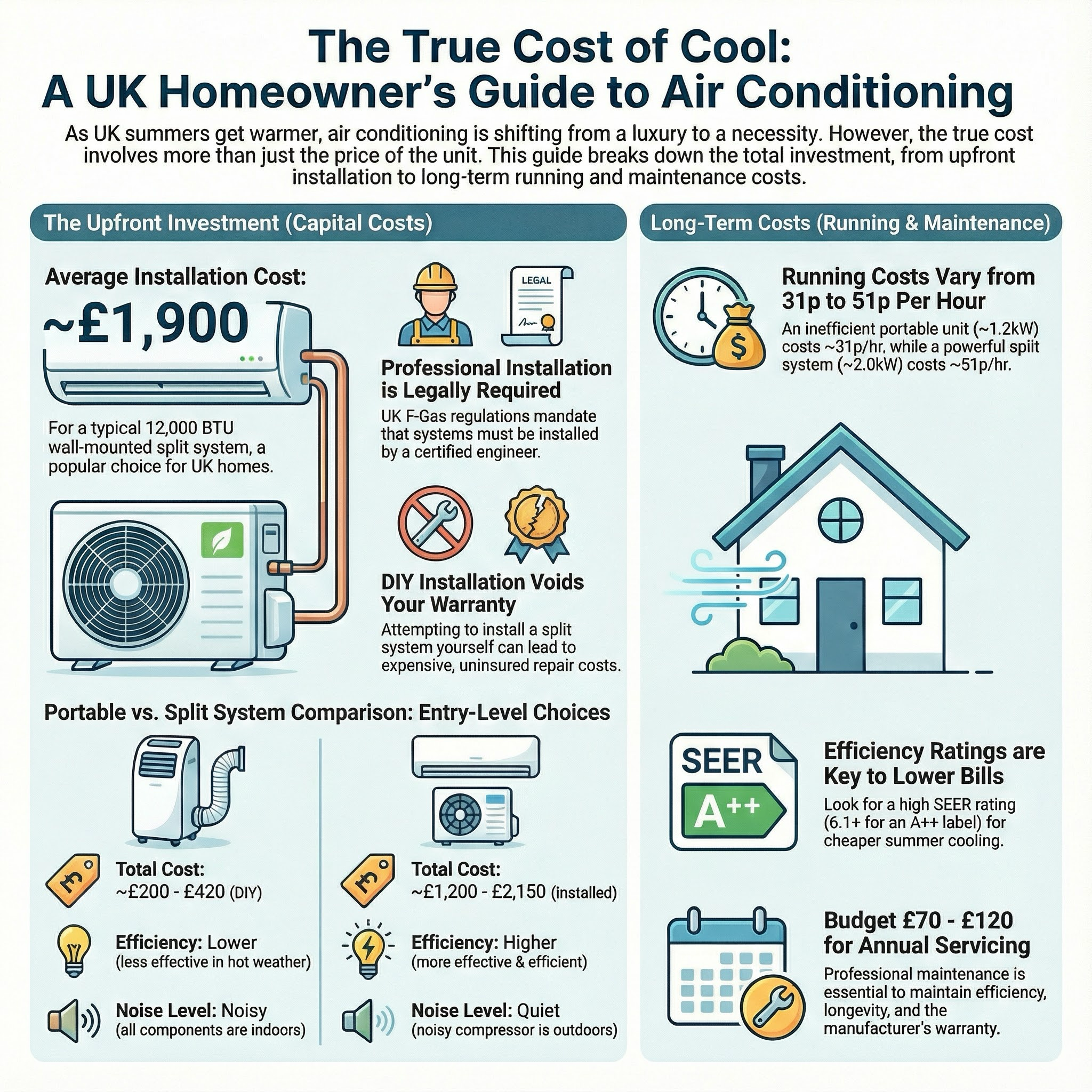
Air Conditioning explained
A well-serviced system doesn't just lower your monthly energy bills; it also prevents the "sick building syndrome" that can affect employee productivity. Whether you manage a small retail unit or a large office block, professional servicing is the only way to protect your investment and remain on the right side of the law.
The cost of commercial AC servicing depends heavily on the number of units and the complexity of the system. For 2025/26, expect the following average prices including VAT.
| Item | Low £ | High £ | Notes |
|---|---|---|---|
| Call-out / Initial Hour | 95 | 150 | Covers travel and first unit inspection. |
| Labour (per hour thereafter) | 50 | 80 | Higher for two-person teams on rooftops. |
| Consumables & Materials | 25 | 130 | Includes filters, biocide, and cleaning chemicals. |
| Hazardous Waste Disposal | 20 | 50 | Safe disposal of old filters and oil. |
| Total (Small Office 4-6 Units) | 275 | 650 | Standard bi-annual service visit. |
Prices vary based on geographical location—London and the South East typically command a 20% premium. Access equipment, such as cherry pickers or scaffolding for high-level condensers, will add significantly to the final invoice.
Commercial air conditioning servicing is strictly a professional task. Under UK law (The Ozone-Depleting Substances Regulations), it is illegal for anyone without a valid F-Gas Category 1 certificate to work on the refrigerant circuit of these systems.
While you can safely clean external filters or wipe down vents, any work involving the internal components, electrical terminals, or refrigerant levels must be performed by a certified engineer to maintain your warranty and legal standing.
Most manufacturers recommend a service every six months. High-use environments like server rooms or kitchens may require quarterly visits to prevent dust build-up and component failure.
It is a legal record of the refrigerant type and quantity in your system, along with a history of any leaks or additions. If your system exceeds 5 tonnes of CO2 equivalent, you are legally required to maintain this log.
Yes. A system with clean coils and correct refrigerant levels can be up to 30% more efficient than a neglected one. Regular servicing ensures the system isn't drawing excessive current to reach its set-point.
This is usually caused by bacteria or mould growing on the indoor coil or in the drain pan. A professional service includes a biocide treatment that kills these microbes and removes the odour.
Absolutely. Modern filters trap pollen, dust, and pollutants. During a service, these are either deep-cleaned or replaced, significantly improving the indoor air quality for your staff and customers.
This guide was written with AI assistance and is intended for general information only. Prices are estimates based on UK averages and may vary by region. Always get at least three quotes and consult a qualified professional before starting any work.
Ask follow-ups in plain English. The AI explains options, sequencing and what to ask the air conditioning — so you walk in informed.
As UK summers become increasingly warmer, air conditioning has transitioned from a high-end luxury to a common feature in many British homes. Whether you have a...
READ GUIDE →GuideAn air conditioning assessment is a vital health check for your home's climate control system. Beyond ensuring you stay cool during a UK heatwave, a professiona...
READ GUIDE →GuideAs UK summers become increasingly intense, domestic air conditioning has shifted from a luxury to a necessity for many homeowners. When a system fails, prompt r...
READ GUIDE →GuidePortable air conditioners are a popular choice for UK homeowners looking to combat increasingly hot summers without the permanence or expense of a fixed split-s...
READ GUIDE →GuideAir conditioning is rapidly transitioning from a luxury to a necessity for many UK homeowners. As summer heatwaves become more frequent, these systems—technical...
READ GUIDE →GuideInstalling air conditioning tubing—often referred to as the "line set"—is the most critical phase of any AC installation. These copper pipes act as the circulat...
READ GUIDE →