Instant
01 · Ask
Ask the AI a follow-up
Got more questions about air Conditioning Installation? Describe the bit you're unsure about — the AI explains options, sequencing and what to ask the air conditioning.

What kit suits your room, where the outdoor unit goes, and what the install actually costs in 2026.
You've read the brief on air Conditioning Installation. Now lean on us to find the right air conditioning — and stay in control of the job.
Got more questions about air Conditioning Installation? Describe the bit you're unsure about — the AI explains options, sequencing and what to ask the air conditioning.
Costs, timelines, pitfalls and the right questions to ask before any air conditioning starts on air Conditioning Installation.
Itemised quotes from up to 3 local air conditionings on air Conditioning Installation — so you can compare like-for-like, not lump sums.
Ready when you are
Enter your postcode and get free quotes from local pros.
Four moves that separate a smooth job from a nightmare.
Often caused by a blocked condensate pipe or a failed condensate pump. Regular cleaning of filters helps prevent this.
If the unit is too small for the room, it will run constantly at maximum power, increasing your bills and shortening the system's lifespan.
Usually the result of poor "flaring" of the copper pipes during installation. A loss of cooling performance is the first sign.
Caused by placing the indoor unit too close to the ceiling or behind furniture, preventing the thermostat from getting an accurate reading.
Indicative UK ranges and what affects price.
By job type
Quote spread is typically ± 18% — always get 3 quotes.
Air Conditioning quick-view
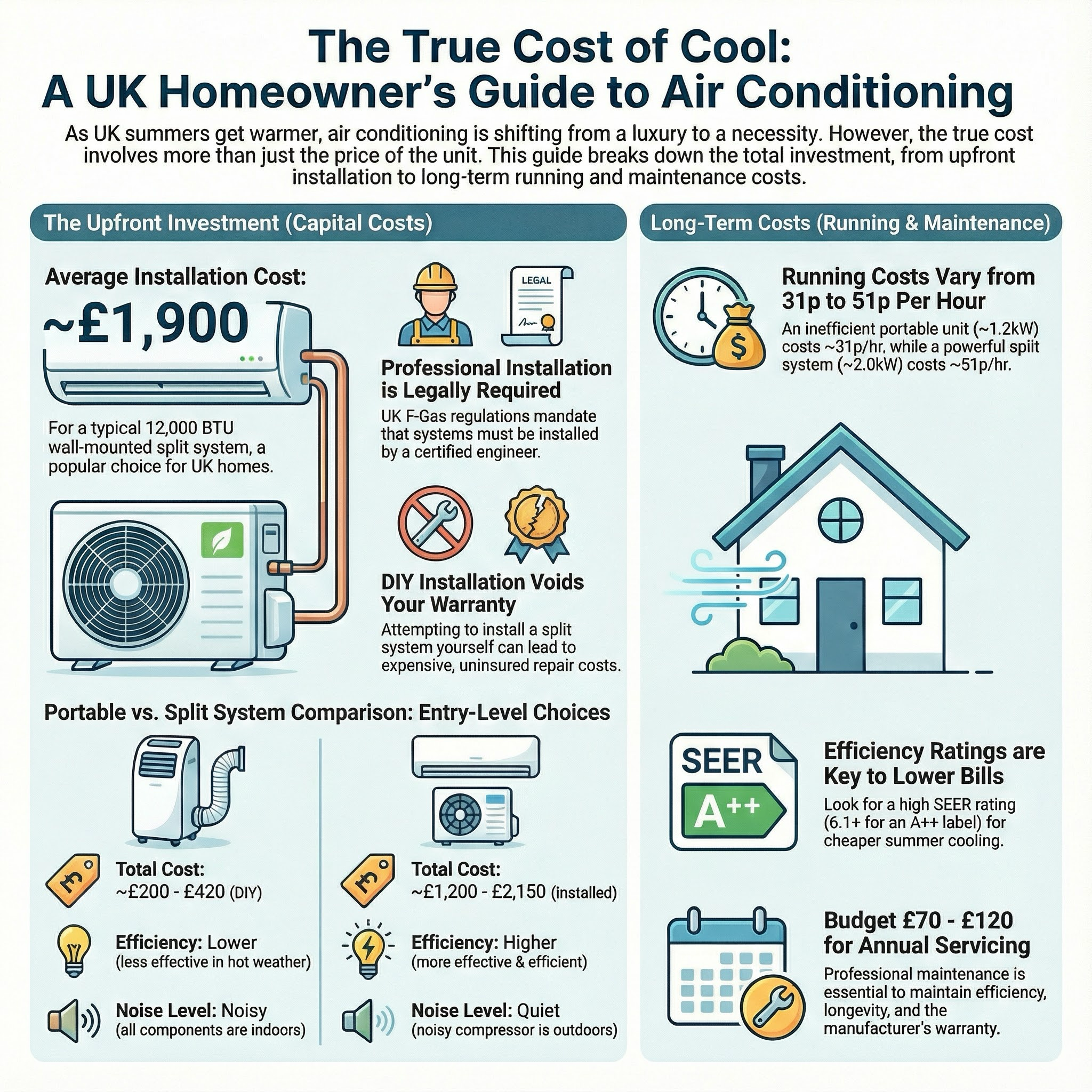
Air Conditioning explained
A professional installation ensures your system operates at peak efficiency while remaining compliant with strict UK environmental and electrical safety laws. This guide breaks down everything you need to know about the process, from initial site surveys to the final F-Gas certification.
The cost of air conditioning installation in the UK depends heavily on the brand of the unit (e.g., Daikin or Mitsubishi vs. budget brands) and the complexity of the pipe run. Prices below include 20% VAT and professional labour.
| Item | Low £ | High £ | Notes |
|---|---|---|---|
| Single Split Unit (Small Room) | £1,750 | £2,400 | Includes 2.5kW-3.5kW unit and standard back-to-back install. |
| Multi-Split System (2 Rooms) | £3,200 | £4,800 | One outdoor condenser serving two indoor units. |
| Multi-Split System (3-4 Rooms) | £5,500 | £8,500+ | Dependent on total pipe length and unit capacities. |
| Electrical Fused Spur/Circuit | £150 | £400 | Required for safe power supply from the consumer unit. |
| Condensate Pump | £120 | £250 | Only needed if gravity drainage isn't possible. |
| Annual Service/Maintenance | £80 | £160 | Vital for maintaining the manufacturer's warranty. |
Factors that push costs toward the higher end include "long-run" installations where the outdoor unit is far from the indoor unit, the need for scaffolding for high-level work, or choosing designer "low-profile" indoor units.
Professional installation is mandatory. In the UK, it is a legal requirement under F-Gas regulations for anyone installing or servicing air conditioning equipment to be REFCOM or F-Gas certified. Handling fluorinated greenhouse gases without a licence can result in heavy fines.
Furthermore, the electrical side of the installation must comply with Part P of the Building Regulations, which usually requires a certified electrician or an AC engineer with the relevant electrical qualifications.
In most UK residential cases, you do not need planning permission as it falls under Permitted Development. However, if you live in a flat, a listed building, or a conservation area, you should always check with your local authority first. Leaseholders will also need written "Licence to Alter" from their freeholder.
Modern inverter-driven units are very efficient. Cooling a standard bedroom typically costs between 15p and 30p per hour, depending on your electricity tariff. Using the unit for heating in winter is often cheaper than a gas boiler because the system moves heat rather than generating it.
A split system consists of one indoor unit connected to one outdoor condenser. A multi-split system allows you to connect up to five indoor units to a single, larger outdoor condenser, saving space in your garden or on your wall.
For residential use, an annual service is recommended. This involves cleaning the coils, checking refrigerant levels, testing the drainage, and sanitising the filters to prevent odours and bacteria growth.
Yes, almost all modern split systems are "reverse cycle" heat pumps. They are incredibly efficient at heating and can provide 3kW to 4kW of heat for every 1kW of electricity used, making them a great backup or alternative to central heating.
Modern outdoor units are very quiet, typically operating at 45–55 decibels (similar to a quiet fridge or light rain). As long as the unit is mounted on high-quality anti-vibration mounts and not placed directly under a neighbour's bedroom window, noise is rarely an issue.
This guide was written with AI assistance and is intended for general information only. Prices are estimates based on UK averages and may vary by region. Always get at least three quotes and consult a qualified professional before starting any work.
Ask follow-ups in plain English. The AI explains options, sequencing and what to ask the air conditioning — so you walk in informed.
As UK summers become increasingly warmer, air conditioning has transitioned from a high-end luxury to a common feature in many British homes. Whether you have a...
READ GUIDE →GuideAn air conditioning assessment is a vital health check for your home's climate control system. Beyond ensuring you stay cool during a UK heatwave, a professiona...
READ GUIDE →GuideAs UK summers become increasingly intense, domestic air conditioning has shifted from a luxury to a necessity for many homeowners. When a system fails, prompt r...
READ GUIDE →GuideMaintaining a commercial air conditioning system is essential for business continuity, energy efficiency, and legal compliance. In the UK, businesses are bound ...
READ GUIDE →GuidePortable air conditioners are a popular choice for UK homeowners looking to combat increasingly hot summers without the permanence or expense of a fixed split-s...
READ GUIDE →GuideInstalling air conditioning tubing—often referred to as the "line set"—is the most critical phase of any AC installation. These copper pipes act as the circulat...
READ GUIDE →