Instant
01 · Ask
Ask the AI a follow-up
Got more questions about asbestos Remediation Cost? Describe the bit you're unsure about — the AI explains options, sequencing and what to ask the asbestos services.

Survey to disposal — what each stage costs in 2026 and where money disappears if you rush it.
You've read the brief on asbestos Remediation Cost. Now lean on us to find the right asbestos services — and stay in control of the job.
Got more questions about asbestos Remediation Cost? Describe the bit you're unsure about — the AI explains options, sequencing and what to ask the asbestos services.
Costs, timelines, pitfalls and the right questions to ask before any asbestos services starts on asbestos Remediation Cost.
Itemised quotes from up to 3 local asbestos servicess on asbestos Remediation Cost — so you can compare like-for-like, not lump sums.
Ready when you are
Enter your postcode and get free quotes from local pros.
Four moves that separate a smooth job from a nightmare.
Asbestos is often found behind newer plasterboard or under modern laminate flooring. A "Management Survey" may miss these unless you opt for a more intrusive "Refurbishment Survey."
Rogue traders who do not use proper enclosures can spread dust through your HVAC system or carpets, leading to massive decontamination costs later.
Ensure your contractor is legitimate; if your asbestos is found fly-tipped, you could be held legally responsible as the "producer" of the waste.
Asbestos adhesive (bitumen) is often left on floor slabs. This must be properly ground off or sealed if you plan to lay new flooring.
Indicative UK ranges and what affects price.
By job type
Quote spread is typically ± 18% — always get 3 quotes.
Asbestos Services quick-view
Asbestos Services explained
Asbestos remediation is the process of identifying, managing, or safely removing these materials to ensure your living environment is 100% safe. Whether you are planning a renovation or have discovered damaged materials, understanding the costs and safety protocols is essential for protecting both your family and your investment.
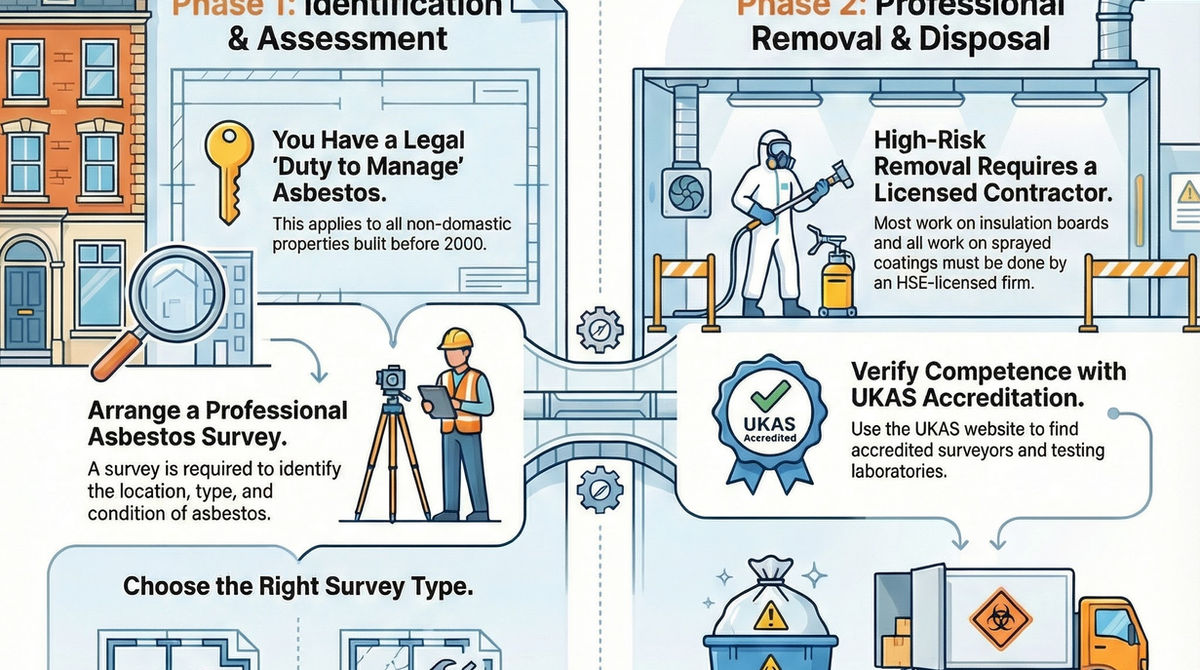
Asbestos remediation is a highly regulated process that follows a strict sequence to prevent the release of dangerous fibres into the air.
The cost of asbestos services depends on the volume of material, its "friability" (how easily it crumbles), and the difficulty of access. Prices in the UK have risen recently due to increased hazardous waste disposal levies and insurance premiums.
| Item / Service | Low £ | High £ | Notes |
|---|---|---|---|
| Management Survey (Standard House) | £250 | £450 | Visual inspection and sampling. |
| Refurbishment/Demolition Survey | £400 | £850 | More intrusive for renovation projects. |
| Garage Roof Removal (Single) | £500 | £900 | Cement-bonded sheets; usually non-licensed. |
| Artex Ceiling Removal (Per Room) | £450 | £1,200 | Varies by size and removal method. |
| Floor Tile Removal (Small Kitchen) | £300 | £700 | Includes bitumen adhesive scraping. |
| Loose Fill Insulation Removal | £2,500 | £5,000+ | High risk; requires full licensed enclosure. |
| Air Clearance Certificate | £200 | £400 | Independent laboratory testing. |
Factors that will increase your quote include the presence of blue or brown asbestos (more hazardous than white), work in confined spaces like lofts, or the need for extensive scaffolding to reach soffits and gutters.
The duration of the project depends on the scale of the contamination and the required cooling-off periods for air testing.
While UK law does not strictly forbid homeowners from removing some "non-licensed" asbestos (like cement sheets) themselves, it is strongly discouraged. The risks of improper handling are severe, potentially contaminating your entire home with microscopic fibres that remain airborne for days.
Professional remediation ensures that hazardous waste is tracked legally and that your home is certified safe for your family to return to.
Furthermore, standard household bins cannot be used for asbestos. Illegal disposal carries heavy fines and criminal prosecution. Professionals provide a Waste Transfer Note, which is vital when you eventually come to sell your property.
Not all asbestos contractors are equal. You must ensure they are specifically insured and trained for the type of asbestos you have.
Questions to ask:
The primary legislation governing this work is the Control of Asbestos Regulations 2012 (CAR 2012). This dictates how asbestos must be identified, handled, and disposed of.
Generally, no. Asbestos is only a significant health risk when it is disturbed or damaged, releasing fibres into the air. If it is in good condition and in a location where it won't be knocked, it is often safer to leave it alone or encapsulate it.
Yes, this is a form of encapsulation. As long as the Artex is not crumbling or peeling, painting it seals the fibres. However, you must never sand or scrape the ceiling before painting, as this releases the asbestos.
You cannot identify asbestos by sight alone. If your home was built before 1999, it is highly likely to contain some asbestos. The only way to be sure is to have a professional take a small sample for laboratory analysis.
For small, external jobs like a garage roof, you can usually stay inside. For internal removals involving enclosures, it is often recommended to vacate the property for the duration of the work and until the final air clearance certificate is issued.
Friable asbestos (like pipe insulation) can be easily crumbled by hand, making it extremely dangerous as it releases fibres easily. Non-friable asbestos (like cement sheets or floor tiles) is bonded in a hard matrix and is lower risk unless it is cut, sanded, or broken.
This guide was written with AI assistance and is intended for general information only. Prices are estimates based on UK averages and may vary by region. Always get at least three quotes and consult a qualified professional before starting any work.
Ask follow-ups in plain English. The AI explains options, sequencing and what to ask the asbestos services — so you walk in informed.
If your UK home was built or renovated before the year 2000, there is a high probability it contains asbestos. While harmless if left undisturbed, these microsc...
READ GUIDE →GuideIf your UK home was built or renovated before the year 2000, there is a significant chance it contains asbestos-containing materials (ACMs). While harmless if l...
READ GUIDE →GuideAsbestos remains a significant concern for UK homeowners, particularly those living in properties built or renovated before the year 2000. While it was once a "...
READ GUIDE →GuideIf your UK home was built or renovated before the year 2000, there is a high probability that asbestos was used in your pipework insulation. While undisturbed a...
READ GUIDE →GuideAsbestos survey services. UK costs.
READ GUIDE →GuideAsbestos removal services. UK costs.
READ GUIDE →