Instant
01 · Ask
Ask the AI a follow-up
Got more questions about asbestos Removal Assistant? Describe the bit you're unsure about — the AI explains options, sequencing and what to ask the asbestos services.

What an HSE-licensed removal team actually does on-site — and what an asbestos assistant's role looks like.
You've read the brief on asbestos Removal Assistant. Now lean on us to find the right asbestos services — and stay in control of the job.
Got more questions about asbestos Removal Assistant? Describe the bit you're unsure about — the AI explains options, sequencing and what to ask the asbestos services.
Costs, timelines, pitfalls and the right questions to ask before any asbestos services starts on asbestos Removal Assistant.
Itemised quotes from up to 3 local asbestos servicess on asbestos Removal Assistant — so you can compare like-for-like, not lump sums.
Ready when you are
Enter your postcode and get free quotes from local pros.
Four moves that separate a smooth job from a nightmare.
Some contractors may remove the main sheets but leave "ghosting" (residue) on timber joists or in the soil.
Failing to get a disposal certificate can cause your house sale to fall through years later.
Rogue traders may dump asbestos to avoid high landfill fees, leaving you potentially liable as the waste producer.
Using standard vacuum cleaners instead of H-Class models, which actually exhausts asbestos fibres back into the room.
Indicative UK ranges and what affects price.
By job type
Quote spread is typically ± 18% — always get 3 quotes.
Asbestos Services quick-view
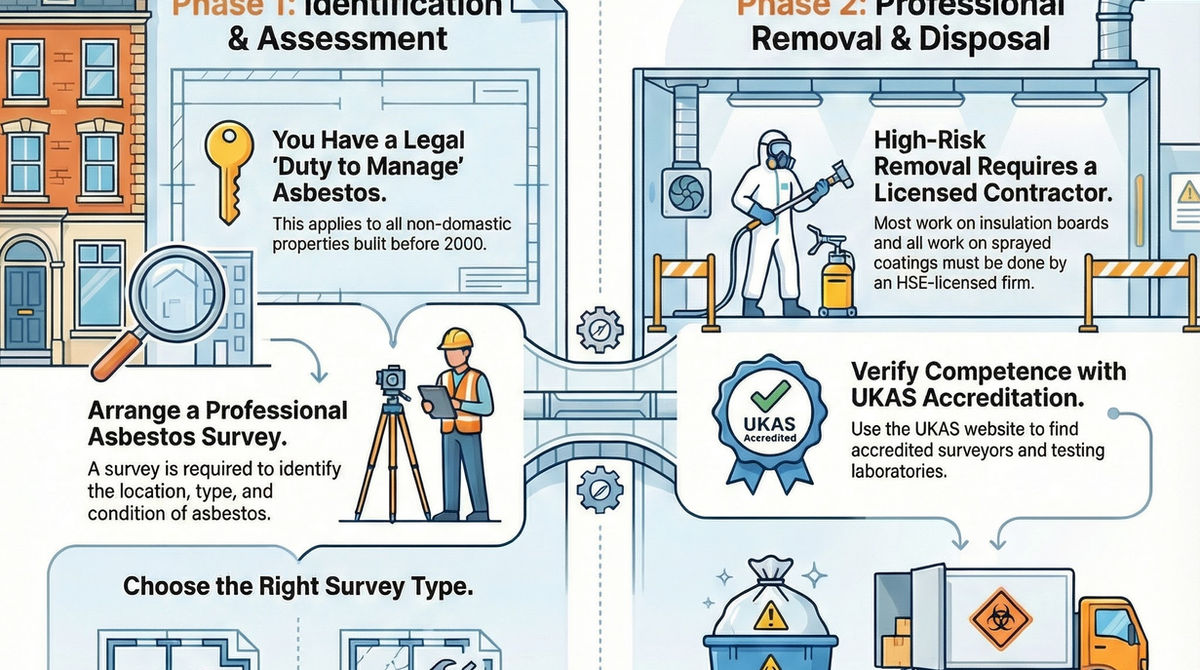
Asbestos Services explained
Managing asbestos is not just about safety; it is a legal and financial necessity when selling a home or planning renovations. Professional asbestos services ensure that these hazardous materials are identified, contained, and removed without contaminating your living space.
Asbestos removal costs vary significantly based on the type of asbestos (chrysotile, amosite, or crocidolite) and whether the work requires a HSE-licensed contractor.
| Service Item | Low £ | High £ | Notes |
|---|---|---|---|
| Management Survey (Standard Home) | £250 | £450 | Includes sampling and report. |
| Refurbishment/Demolition Survey | £400 | £750 | More intrusive, required before building work. |
| Garage Roof Removal (Single) | £450 | £900 | Cement sheets; includes disposal. |
| Floor Tile Removal (Per Room) | £200 | £500 | Vinyl tiles and bitumen adhesive. |
| Artex Ceiling Removal (Per Room) | £500 | £1,200 | Often requires scraping or overboarding. |
| Waste Collection Only | £100 | £250 | Small quantities of pre-wrapped waste. |
Prices are influenced by the ease of access, the quantity of material, and your geographic location (London and the SE typically command a 20% premium). Always ensure the quote includes the mandatory Hazardous Waste Consignment Note.
Professional intervention is strongly recommended for all asbestos-related tasks. While some "non-licensed" work (like removing intact cement sheets) is technically legal for a homeowner, the risk of cross-contamination is extremely high without specialist equipment.
Any work involving "friable" asbestos—materials that can be easily crumbled by hand, such as pipe lagging or loose-fill insulation—must legally be performed by an HSE-licensed contractor.
Attempting DIY removal can lead to expensive decontamination bills if fibres are released into your carpets, upholstery, and ventilation systems. Furthermore, standard household insurance rarely covers DIY asbestos incidents.
No. If asbestos-containing materials are in good condition and left undisturbed, they pose a very low risk. The danger arises only when the material is damaged, sanded, or drilled, releasing microscopic fibres into the air.
You cannot identify asbestos by sight alone. If your home was built before 1999, you should assume it contains asbestos in areas like ceilings (Artex), floor tiles, or roofing. Only a lab analysis of a physical sample can confirm its presence.
Yes, but you must be honest on the Property Information Form (TA6). Having a professional survey and a management plan in place can reassure buyers and prevent them from demanding large price reductions.
Licensed work involves high-risk materials (lagging, insulation board) and must be notified to the HSE. Non-licensed work involves lower-risk materials (cement, vinyl tiles) that are less likely to release fibres, though safety protocols must still be strictly followed.
Absolutely not. This is illegal and carries heavy fines or even imprisonment. Asbestos must be disposed of at a designated hazardous waste site and tracked with a Consignment Note.
This guide was written with AI assistance and is intended for general information only. Prices are estimates based on UK averages and may vary by region. Always get at least three quotes and consult a qualified professional before starting any work.
Ask follow-ups in plain English. The AI explains options, sequencing and what to ask the asbestos services — so you walk in informed.
Finding asbestos in your home can be a daunting discovery for any UK homeowner. Common in properties built or renovated before the year 2000, this hazardous mat...
READ GUIDE →GuideIf your UK home was built or renovated before the year 2000, there is a high probability it contains asbestos. While harmless if left undisturbed, these microsc...
READ GUIDE →GuideIf your UK home was built or renovated before the year 2000, there is a significant chance it contains asbestos-containing materials (ACMs). While harmless if l...
READ GUIDE →GuideIf your UK home was built or renovated before the year 2000, there is a high probability that asbestos was used in your pipework insulation. While undisturbed a...
READ GUIDE →GuideAsbestos survey services. UK costs.
READ GUIDE →GuideAsbestos removal services. UK costs.
READ GUIDE →