Instant
01 · Ask
Ask the AI a follow-up
Got more questions about home Extension and Conversion? Describe the bit you're unsure about — the AI explains options, sequencing and what to ask the builder.

Single or double storey, rear, side or loft — process, costs, planning and building regs in one place.
You've read the brief on home Extension and Conversion. Now lean on us to find the right builder — and stay in control of the job.
Got more questions about home Extension and Conversion? Describe the bit you're unsure about — the AI explains options, sequencing and what to ask the builder.
Costs, timelines, pitfalls and the right questions to ask before any builder starts on home Extension and Conversion.
Itemised quotes from up to 3 local builders on home Extension and Conversion — so you can compare like-for-like, not lump sums.
Ready when you are
Enter your postcode and get free quotes from local pros.
Four moves that separate a smooth job from a nightmare.
If the soil is clay-heavy or there are nearby trees, you may need "piled" foundations, which can add thousands to the budget.
Discovering a public sewer running through your build site requires a "Build Over Agreement" from your water company.
UK winters can halt brickwork and groundworks for weeks. Try to schedule "breaking ground" for spring or summer.
Items like bespoke bi-fold doors or structural steel beams can have lead times of 6-12 weeks; order them early.
Indicative UK ranges and a typical week-by-week schedule.
By job type
Quote spread is typically ± 18% — always get 3 quotes.
25 m² single-storey extension · week by week
Schedule slips on dependencies — pad each phase by 10–20% for real-world delays.
Builder quick-view
Builder explained
However, these are complex structural projects that require meticulous planning, a solid understanding of UK building regulations, and a reliable team of builders. This guide breaks down the essential costs, timelines, and regulatory requirements you need to know before breaking ground.
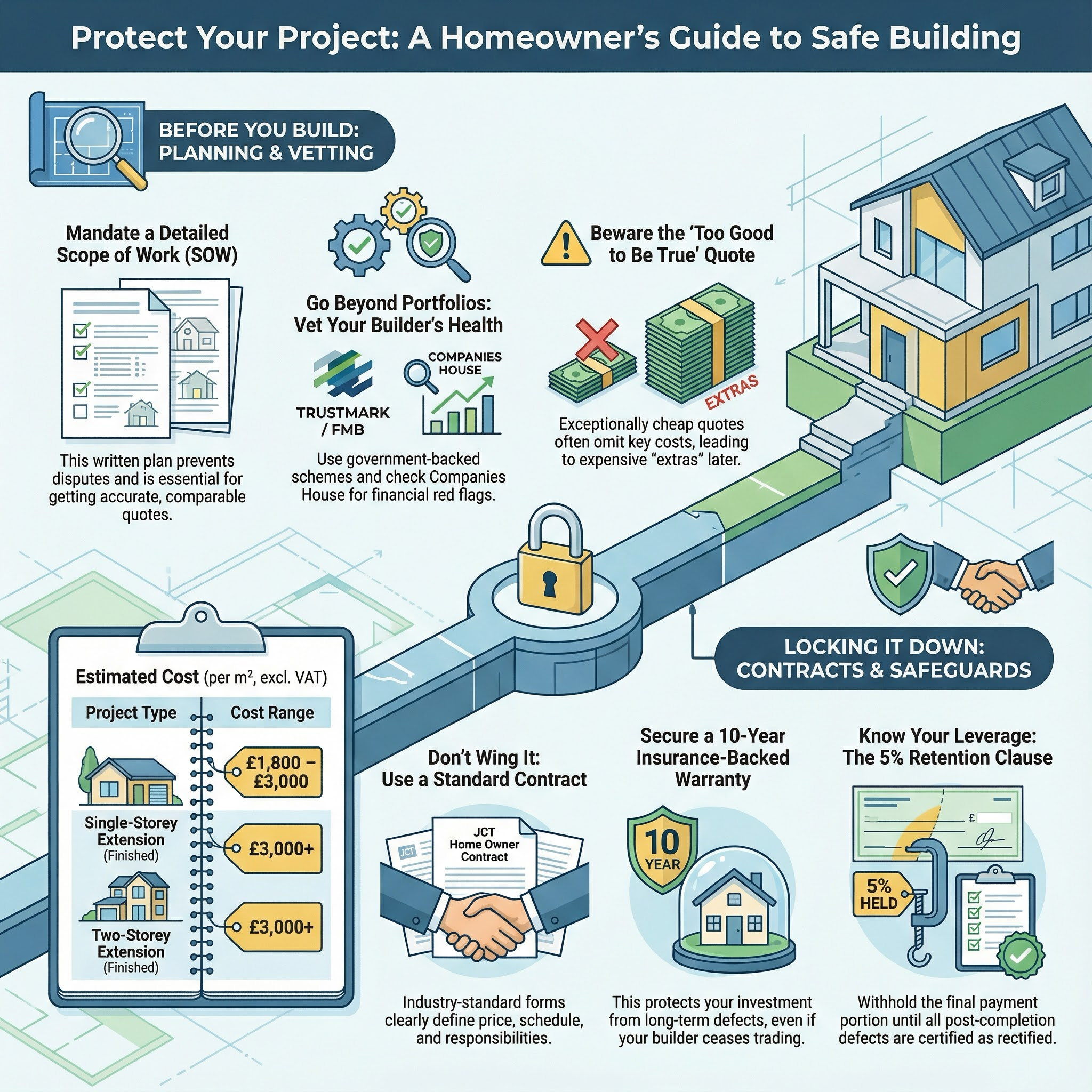
Project costs vary significantly based on your location (London and the South East attract a 15-25% premium) and the specification of finishes. The following figures are realistic 2025/26 estimates including VAT.
| Item / Project Type | Low £ | High £ | Notes |
|---|---|---|---|
| Single Storey Extension (per m²) | £1,900 | £3,200 | Basic vs. high-end finish. |
| Double Storey Extension (per m²) | £2,200 | £3,500 | More cost-effective per m² than single. |
| Garage Conversion (Standard Single) | £10,000 | £22,000 | Assumes existing foundations are adequate. |
| Dormer Loft Conversion | £45,000 | £75,000 | Includes staircase and en-suite. |
| Architect & Structural Engineer | £2,500 | £7,000 | Percentage of build or fixed fee. |
| Building Control Fees | £600 | £1,200 | Paid to local council or private inspector. |
Note: Always set aside a 10-15% contingency fund. Unexpected issues like poor soil quality or hidden Victorian pipework can quickly drain a strict budget.
Structural extensions and conversions are not suitable for DIY, except for cosmetic internal finishes. In the UK, major works must comply with Building Regulations, and certain elements are legally restricted.
Electrical work must be "Part P" compliant, and any gas boiler relocations or new pipework must be performed by a Gas Safe registered engineer.
Attempting a structural build yourself can invalidate your home insurance and make the property impossible to sell later without the correct completion certificates. Hiring a professional builder ensures the project is managed safely and meets all legal standards.
Don't simply choose the cheapest quote. A "cowboy" builder can leave you with a dangerous structure and a legal nightmare.
Not necessarily. Many rear extensions fall under "Permitted Development" if they are single-storey and don't exceed specific size limits (usually 3m to 4m from the original wall). However, you should always apply for a Lawful Development Certificate to prove the work was legal when you come to sell.
On average, a well-built extension can add between 10% and 20% to your home's value. Loft conversions with an extra bedroom and bathroom typically offer the highest return on investment in the UK market.
For loft conversions and garage conversions, yes. For large rear extensions involving the removal of the back wall, it is possible but very dusty and noisy. Many homeowners choose to move out during the "knock-through" phase for 2-4 weeks.
This is where the builder completes the foundations, walls, roof, and windows, making the structure watertight. You then take over the internal fitting, such as plastering, flooring, and decorating, to save on costs.
If you are building an extension within 3 or 6 metres of a neighbour’s structure (depending on depth) or working on a shared wall, you must serve a Party Wall Notice. If they don't dissent, it's simple; if they do, you'll need a surveyor.
This guide was written with AI assistance and is intended for general information only. Prices are estimates based on UK averages and may vary by region. Always get at least three quotes and consult a qualified professional before starting any work.
Ask follow-ups in plain English. The AI explains options, sequencing and what to ask the builder — so you walk in informed.
Install Air Vent Overview Create a through‑wall opening and fit a vent sleeve and grilles to improve room ventilation. Skill level: 3 / 5 (competent DIYer). Typ...
READ GUIDE →GuideMaintaining a business premises is a critical responsibility for UK property owners and commercial tenants alike. Beyond first impressions, regular maintenance ...
READ GUIDE →GuideHouse Extension and Electrical Work Scope of Works Site survey, drawings & planning (architect measurements, concept plans, planning/Building Reg applicatio...
READ GUIDE →GuideDemolition is often the first and most critical phase of a UK home renovation project. Whether you are removing an internal wall to create an open-plan kitchen ...
READ GUIDE →GuideModifying internal walls is one of the most effective ways for UK homeowners to modernise a property, whether you are creating a trendy open-plan kitchen-diner ...
READ GUIDE →GuideHiring a general labourer is often the most cost-effective way to keep a UK home improvement project on track. While skilled trades like electricians or plumber...
READ GUIDE →