Instant
01 · Ask
Ask the AI about your build
Not sure if you need a builder, a structural engineer, or both? Describe the project — the AI tells you exactly who you need and in what order.

Extensions, loft conversions and renovations — itemised quotes from JCT-friendly builders in your area.
You've read the costs. You've seen the timeline. Now lean on us to find a Trustmark/FMB builder — and stay in control of the project.
Not sure if you need a builder, a structural engineer, or both? Describe the project — the AI tells you exactly who you need and in what order.
JCT contracts, retention, deposit norms, Building Control checkpoints. The builder brief covers what most homeowners don't know to ask.
Itemised quotes from up to 3 vetted local builders, FMB and insurance — so you compare like-for-like, not lump sums.
Ready when you are
Enter your postcode and get free quotes from local pros.
Four moves that separate a smooth job from a nightmare.
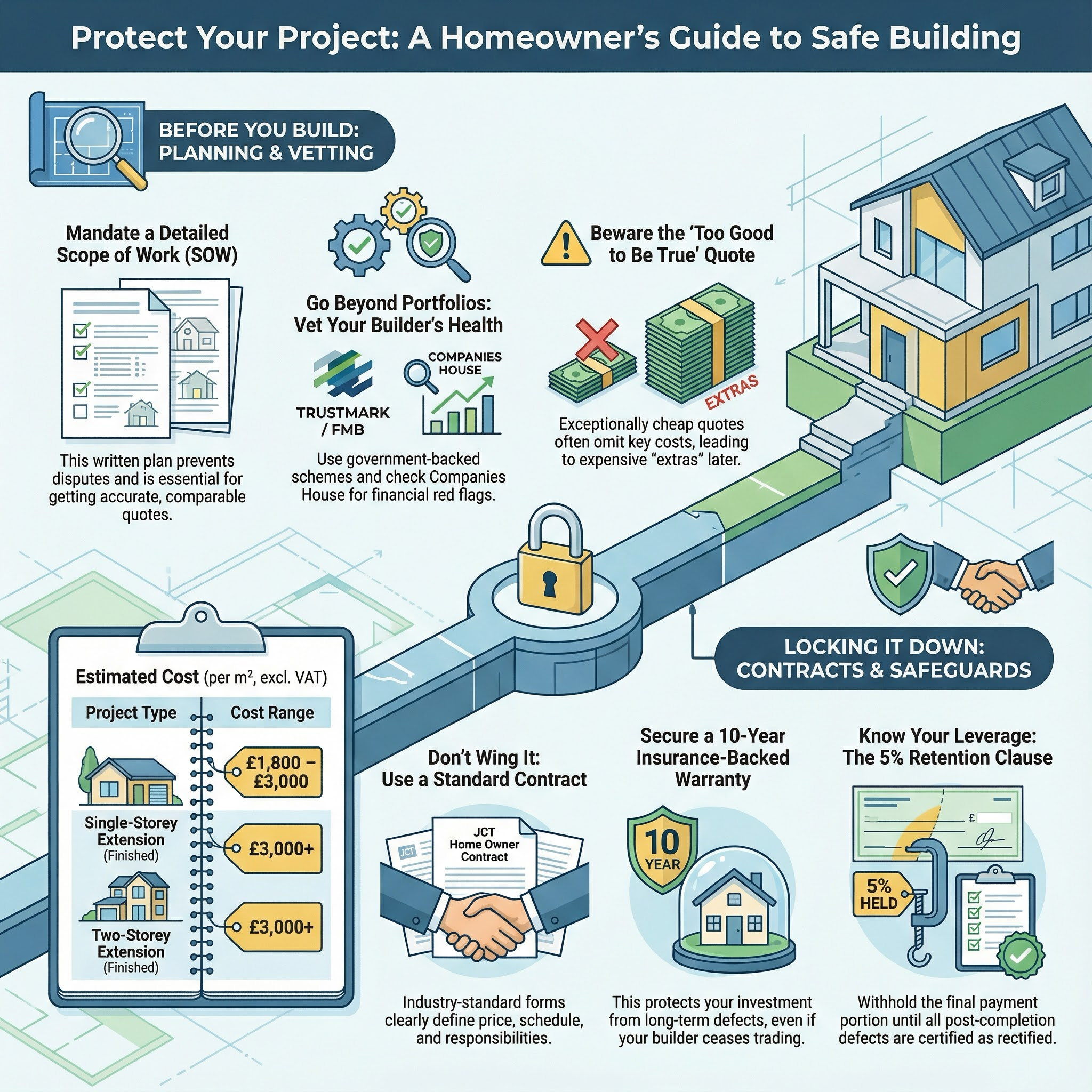
For anything over £10k, a JCT Homeowner Contract sets out payment stages, dispute resolution and snagging windows. Don't accept a one-page invoice.
Pay 95% on completion, 5% six months later. It funds snagging and gives you leverage when the boiler's flue is wrong in week three.
A 10% deposit is fair to lock the slot. Stage payments tied to milestones (DPC, watertight, plaster, snags) keep both sides honest.
Within 3m of a neighbour's wall, you legally need a Party Wall Award. Skip it and they can stop the job — or sue after.
Indicative UK ranges and a typical week-by-week schedule.
By job type
Quote spread is typically ± 18% — always get 3 quotes.
25 m² single-storey extension · week by week
Schedule slips on dependencies — pad each phase by 10–20% for real-world delays.
Visual breakdown of costs, timelines and the questions you should be asking.
Builder quick-view
Builder explained
Everything you need to know before hiring a builder.
Builders are the cornerstone of UK home improvement, specialising in the structural development, alteration, and maintenance of residential properties. From minor internal reconfigurations to complex multi-storey extensions and new builds, a professional builder provides the technical expertise and project management required to transform a house into a home.
Hiring a builder is often the first step in a major renovation. They coordinate various specialist trades, manage site safety, and ensure that every brick laid or steel beam installed meets the rigorous standards required for modern UK living.
A professional builder offers a comprehensive range of construction services. While some focus on specific niches like loft conversions, most general builders handle a broad spectrum of work including:
The process typically begins with a site visit and a review of your architectural drawings. Once a quote is agreed upon, the builder will establish a timeline, manage the delivery of materials, and liaise with Building Control officers throughout the various inspection stages.
Structural work is high-stakes; errors can lead to property damage, safety risks, and legal complications. A professional builder ensures your project complies with UK Building Regulations, covering everything from structural integrity (Part A) to fire safety (Part B) and energy efficiency (Part L).
Beyond technical skill, professionals carry essential insurance, such as Public Liability and Employer’s Liability. They also understand the CDM 2015 regulations regarding site safety. Attempting large-scale structural work as DIY can invalidate your home insurance and make the property difficult to sell without the necessary completion certificates.
Construction costs vary significantly based on your location in the UK, the complexity of the site, and the quality of finishes. Below are estimated costs for 2025/26, inclusive of VAT and standard labour rates.
| Service | Low £ | High £ | Notes |
|---|---|---|---|
| Single Storey Extension | £1,800 | £2,600 | Per square metre (m2). |
| Double Storey Extension | £1,500 | £2,200 | Per m2 (cheaper per m2 than single). |
| Internal Wall Removal | £1,200 | £4,000 | Includes RSJ and plastering. |
| Garage Conversion | £12,000 | £25,000 | Standard single garage. |
| New Build (Mid-range) | £2,100 | £3,200 | Per m2, excluding land costs. |
Price fluctuations are often driven by ground conditions (e.g., needing deeper foundations), site access restrictions, and the fluctuating cost of raw materials like timber and steel.
Finding a reliable builder requires due diligence to ensure your investment is protected. Look for the following markers of quality:
Questions to ask: How do you handle "extras" or changes to the plan? Who will be the daily point of contact on-site? Can you provide a detailed schedule of works?
Not necessarily. Many smaller extensions and conversions fall under "Permitted Development" rights. However, all structural work must comply with Building Regulations, which is a separate process from planning permission.
A small deposit to secure a start date is common, but you should never pay for the entire job upfront. Establish a payment schedule based on completed milestones (e.g., foundations, wall plate, watertight stage).
A builder often performs the physical work with a small team. A main contractor manages the entire project, hiring various subcontractors (plumbers, electricians, etc.) and taking full responsibility for the timeline and budget.
Describe the job in plain English. The AI asks a few smart questions, then tells you whether a builder is the right call, what it should cost, and what to ask before they start.
Maintaining a business premises is a critical responsibility for UK property owners and commercial tenants alike. Beyond first impressions, regular maintenance ...
READ GUIDE →GuideCommercial property maintenance is a critical investment for UK landlords and business owners. Regular upkeep ensures your building remains safe, compliant with...
READ GUIDE →GuideGeneral maintenance is the essential upkeep required to preserve the structural integrity and aesthetic value of your UK home. For many homeowners, a profession...
READ GUIDE →GuideMaintaining a property in the UK is a constant battle against the elements. From the driving rain of winter to the fluctuating temperatures that cause masonry t...
READ GUIDE →A flat roof extension is one of the most practical and cost-effective ways for UK homeowners to add valuable living space. Whether you are expanding a kitchen o...
READ GUIDE →GuideExpanding your home is often a more cost-effective and less stressful alternative to moving house in the UK. Whether you are looking to create a spacious open-p...
READ GUIDE →GuideHouse Extension and Electrical Work Scope of Works Site survey, drawings & planning (architect measurements, concept plans, planning/Building Reg applicatio...
READ GUIDE →Demolition is often the first and most critical phase of a UK home renovation project. Whether you are removing an internal wall to create an open-plan kitchen ...
READ GUIDE →GuideModifying internal walls is one of the most effective ways for UK homeowners to modernise a property, whether you are creating a trendy open-plan kitchen-diner ...
READ GUIDE →