Instant
01 · Ask
Ask the AI about your build
Not sure if you need a builder, a structural engineer, or both? Describe the project — the AI tells you exactly who you need and in what order.

Passivhaus, low-carbon and natural materials — design and contractor advice for low-impact builds.
You've read the costs. You've seen the timeline. Now lean on us to find a Trustmark/FMB builder — and stay in control of the project.
Not sure if you need a builder, a structural engineer, or both? Describe the project — the AI tells you exactly who you need and in what order.
JCT contracts, retention, deposit norms, Building Control checkpoints. The builder brief covers what most homeowners don't know to ask.
Itemised quotes from up to 3 vetted local builders, FMB and insurance — so you compare like-for-like, not lump sums.
Ready when you are
Enter your postcode and get free quotes from local pros.
Four moves that separate a smooth job from a nightmare.
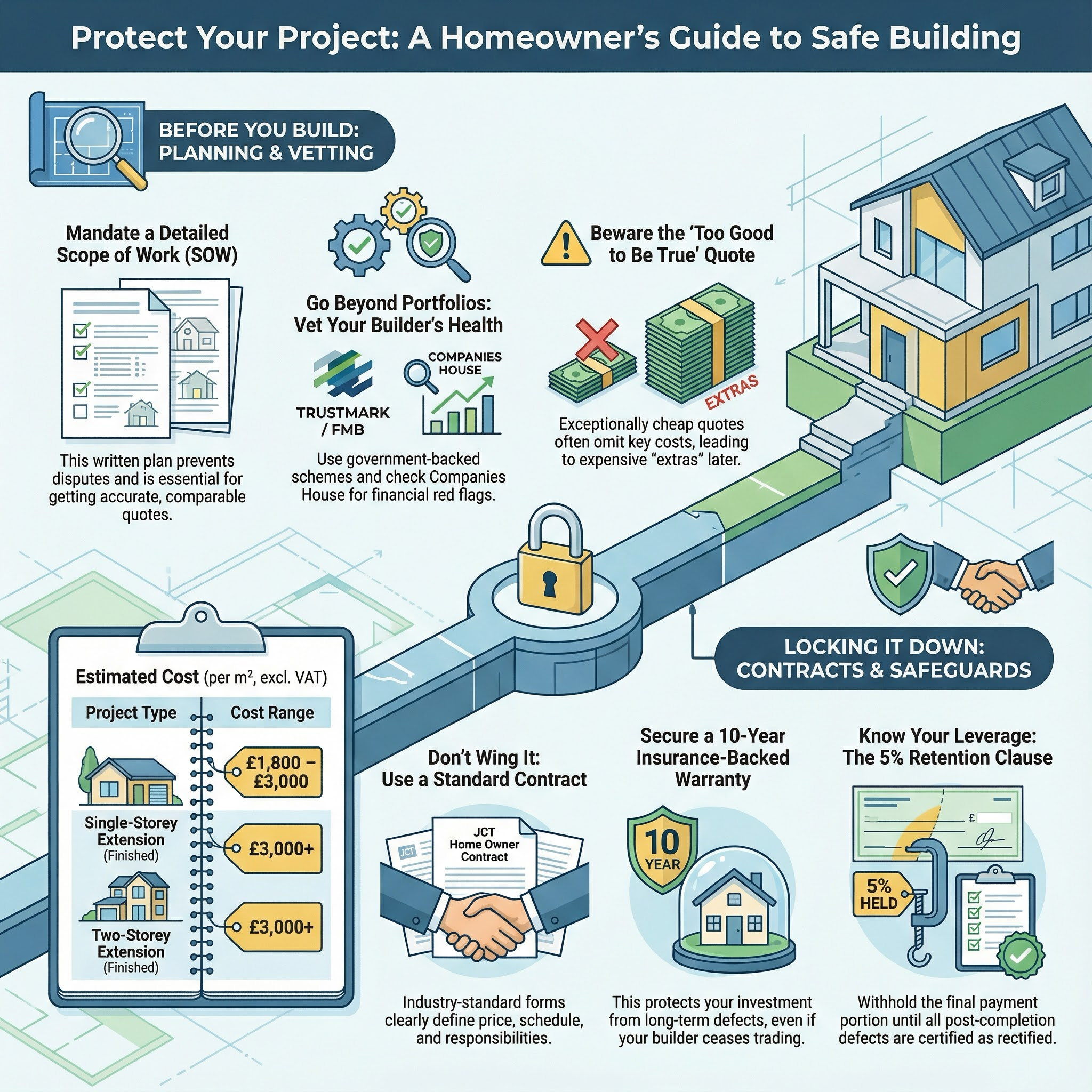
For anything over £10k, a JCT Homeowner Contract sets out payment stages, dispute resolution and snagging windows. Don't accept a one-page invoice.
Pay 95% on completion, 5% six months later. It funds snagging and gives you leverage when the boiler's flue is wrong in week three.
A 10% deposit is fair to lock the slot. Stage payments tied to milestones (DPC, watertight, plaster, snags) keep both sides honest.
Within 3m of a neighbour's wall, you legally need a Party Wall Award. Skip it and they can stop the job — or sue after.
Indicative UK ranges and a typical week-by-week schedule.
By job type
Quote spread is typically ± 18% — always get 3 quotes.
25 m² single-storey extension · week by week
Schedule slips on dependencies — pad each phase by 10–20% for real-world delays.
Builder quick-view
Builder explained
A sustainable construction consultation in the UK typically costs £500–£3,500 as a one-off design-stage service, or £2,000–£8,000 for ongoing involvement through a project. The consultant reviews your build (extension, renovation or new-build) for energy efficiency, low-carbon materials, renewable energy integration, and compliance with Future Homes / Future Buildings Standard requirements.
For a typical homeowner, this is most valuable when you're already planning major work and want to get fabric efficiency, heating and renewable choices right while everything else is in flux. Adding it after the build is finished costs 3–5x more for the same end result.
| Service | Typical price |
|---|---|
| One-off design review (existing plans) | £500–£1,200 |
| Full design-stage consultation (extension) | £1,500–£3,500 |
| Whole-build sustainability lead (new-build / major refurb) | £3,500–£8,000+ |
| SAP / Part L assessment | £250–£600 |
| PHPP (Passivhaus) calculation | £1,500–£4,000 |
| Air-tightness test (post-build) | £250–£450 |
Worth it: extensions over 30 m², new-builds, full house refurbs, projects where you're targeting EPC A or going off-gas, or any project where you want a heat pump fitted properly rather than retrofitted badly.
Probably not worth it: a single-room kitchen refurb, a like-for-like boiler swap, or any small project where the sustainability gains are limited by what's already there. In those cases, ask the contractor to use efficient products and skip the formal consultancy fee.
No — they're complementary. The architect designs the building's form and layout; the sustainability consultant focuses on energy, fabric and systems performance. Many architects have a sustainability lead in-house, but for serious low-energy builds, an independent specialist is often more rigorous.
Long-term, almost always — a properly designed heat pump and PV system saves £1,000–£2,500 a year on energy bills vs a gas-boiler equivalent, and the consultancy fee usually pays back inside 2–4 years. Short-term, you spend more upfront on better fabric and equipment.
Passivhaus is a strict performance standard requiring PHPP modelling and specific design discipline; it makes sense if you're targeting that certification or near-Passivhaus performance. For a standard low-carbon UK build, a general sustainability consultant is fine and cheaper.
Boiler Upgrade Scheme: £7,500 toward an air-source or ground-source heat pump. Smart Export Guarantee: payments for exporting solar to the grid. ECO4: limited eligibility, mainly for low-income households. Local council schemes vary. A consultant will check what applies to your project.
Ideally at concept design, before planning. The biggest sustainability decisions (orientation, glazing ratio, heating system, structural fabric) are baked in early; changing them later is much more expensive. A pre-application review is the most cost-effective entry point.
Sometimes — especially on details like air-tightness tape, thermal bridging at floor-to-wall junctions, and underfloor heating commissioning. A good consultant will write clear specs the builder can follow and visit at key stages to check workmanship. Pick a consultant comfortable with on-site coordination.
Want a local pro to handle this? A sustainability consultant or low-carbon-specialist architect will pay back their fee in energy savings and avoid the expensive retrofits that follow when fabric and systems are specified poorly first time around.
This guide was written with AI assistance and is intended for general information only. Prices are estimates based on UK averages and may vary by region. Always get at least three quotes and consult a qualified professional before starting any work.
Ask follow-ups in plain English. The AI explains options, sequencing and what to ask the builder — so you walk in informed.
Install Air Vent Overview Create a through‑wall opening and fit a vent sleeve and grilles to improve room ventilation. Skill level: 3 / 5 (competent DIYer). Typ...
READ GUIDE →GuideMaintaining a business premises is a critical responsibility for UK property owners and commercial tenants alike. Beyond first impressions, regular maintenance ...
READ GUIDE →GuideHouse Extension and Electrical Work Scope of Works Site survey, drawings & planning (architect measurements, concept plans, planning/Building Reg applicatio...
READ GUIDE →GuideDemolition is often the first and most critical phase of a UK home renovation project. Whether you are removing an internal wall to create an open-plan kitchen ...
READ GUIDE →GuideModifying internal walls is one of the most effective ways for UK homeowners to modernise a property, whether you are creating a trendy open-plan kitchen-diner ...
READ GUIDE →GuideHiring a general labourer is often the most cost-effective way to keep a UK home improvement project on track. While skilled trades like electricians or plumber...
READ GUIDE →