Instant
01 · Ask
Regular, deep or end-of-tenancy?
Describe the property and frequency — the AI tells you the right scope and price band.

What you should pay for a weekly clean in 2026 — by home size, region and what's included.
Read the brief on insurance, chemicals and regular vs one-off — then let Three local cleaners quote.
Describe the property and frequency — the AI tells you the right scope and price band.
Public liability cover, inventories, key handover protocols, chemical disclosure. Know what to expect.
Three local cleaners quote on the same scope — hours, frequency, products — so the cheapest isn't the rushed one.
Ready when you are
Enter your postcode and get free quotes from local pros.
Four moves that separate a smooth job from a nightmare.
Inside the oven? Behind the cooker? Windows? Be specific — every cleaner has a different default. A written checklist before booking saves arguments later.
Vases get broken, taps get loosened. £1m public liability is minimum — if they don't have it, walk away.
Eco-friendly, bleach-based, low-tox — different rooms need different. If you've got pets, kids or asthma, get the cleaning products listed.
Quality regular cleaning improves over weeks — they learn your home. Agencies that send different cleaners every week never deliver the same standard.
Indicative UK ranges and what affects price.
By job type
Quote spread is typically ± 18% — always get 3 quotes.
Cleaning Services quick-view
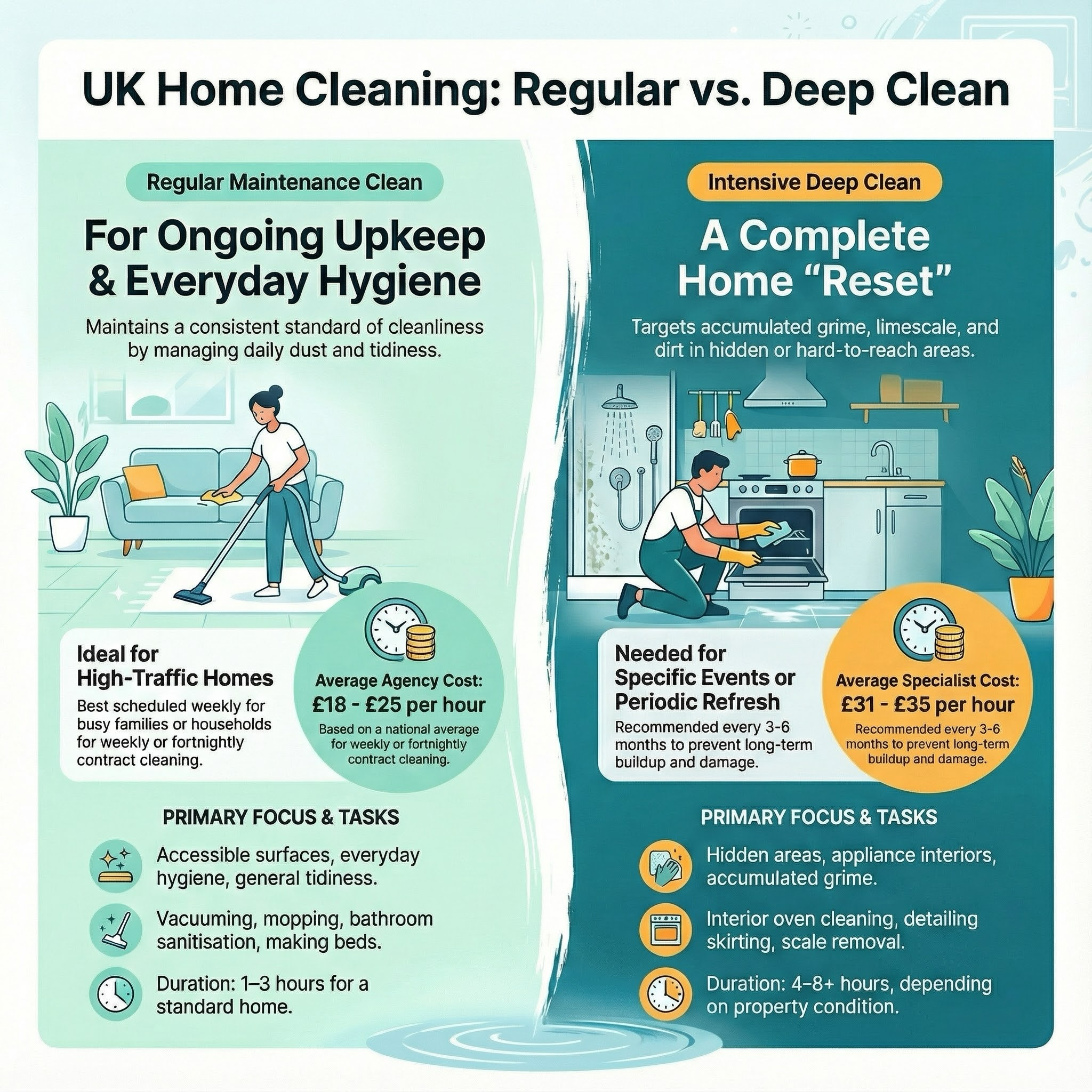
Cleaning Services explained
Weekly domestic cleaning in the UK typically costs £40–£100 per visit for a 2–4 hour booking, working out at £15–£28 per hour. Most homes settle on either weekly or fortnightly; weekly is the right cadence for families with children, pets, or anyone working long hours. Fortnightly works for low-traffic homes and singles who keep on top of mess between visits.
Long-term arrangements typically attract a small discount over one-off bookings — many cleaners charge £2–£4/hour less for a regular weekly slot.
| Home size | Hours per visit | Typical weekly cost |
|---|---|---|
| 1-bed flat | 1.5–2 hours | £25–£50 |
| 2-bed flat | 2–3 hours | £35–£70 |
| 3-bed semi | 2.5–3.5 hours | £45–£90 |
| 4-bed detached | 3.5–5 hours | £70–£130 |
| 5+ bed / large house | 5+ hours | £100–£200+ |
London / South East: add 20–30% to these figures. Major Northern cities (Manchester, Leeds, Liverpool): typically at the lower end. Rural areas: variable, often higher because of cleaner travel time.
These are typically added as deep-clean tasks every quarter or arranged separately.
The first visit is always longer — often double the eventual regular slot — because the cleaner is establishing the baseline. After 2–3 visits, they know the home, the products, and the priorities. The hourly rate should be the same; the time required drops.
Walk through the house with them on visit one. Point out: rooms / surfaces to skip, products you don't want used (e.g., bleach, scented sprays), preferred order of work, where keys / alarm codes are if you'll be out.
For a 1-bed flat, fortnightly is usually enough — keeps the place tidy without the cost of weekly. Switch to weekly if you work long hours, travel frequently, or just don't enjoy cleaning. £25–£50 a fortnight is a small price for time back.
Not weekly — the agreed hourly rate is the full payment. Christmas bonus equivalent to one visit's value is a common gesture for long-term arrangements (and appreciated). Mid-year bonuses are unusual.
Agency: £18–£32/hour, includes insurance, holiday cover, and replacements. Self-employed: £15–£25/hour, often the same person each visit, no cover when they're away. Self-employed is cheaper if reliability and continuity work for you; agency is better if you need cover guarantees.
Talk to them directly first — most issues (missed surfaces, pace, product preferences) are easily fixed once raised. If standards don't improve after a couple of visits, agencies will swap the cleaner; self-employed bookings end and you find someone else.
Yes, after the first few visits. Most regular arrangements involve key access. Make sure your home insurance covers tradespeople with key access; check the cleaner has public liability insurance for any accidental damage.
Self-employed cleaners are responsible for declaring their income to HMRC, regardless of whether you pay cash, bank transfer or by app. As the customer, you're not liable for their tax — but paying through a transparent method (bank transfer with a clear reference) protects both sides if questions ever arise.
Want a local pro to handle this? Whether agency or self-employed, a regular weekly cleaner is one of the highest-leverage services for time-poor households. Worth comparing 2–3 options before committing — fit and reliability matter more than the £2/hour price difference.
This guide was written with AI assistance and is intended for general information only. Prices are estimates based on UK averages and may vary by region. Always get at least three quotes and consult a qualified professional before starting any work.
Ask follow-ups in plain English. The AI explains options, sequencing and what to ask the cleaning services — so you walk in informed.
Leather furniture is a significant investment for any UK home, offering durability and timeless style. However, scuffs, scratches, and fading are inevitable ove...
READ GUIDE →GuideThe kitchen and lounge are the hardest-working rooms in any UK home. While the lounge is your primary space for relaxation, the kitchen is a high-traffic zone t...
READ GUIDE →GuideMaintaining a clean commercial environment is about more than just appearances; it is a fundamental requirement for health, safety, and operational efficiency. ...
READ GUIDE →GuideMaintaining a professional workspace is about more than just aesthetics; it is essential for employee health, productivity, and making the right impression on c...
READ GUIDE →GuideMoving house is one of life’s most stressful events, and the final hurdle is often the most daunting: the end-of-tenancy deep clean. This isn't a standard weekl...
READ GUIDE →GuideA flat deep clean is more than just a quick vacuum and a wipe-down of surfaces. It is a comprehensive, "top-to-bottom" sanitisation of your home, designed to ta...
READ GUIDE →