Instant
01 · Ask
Ask the AI a follow-up
Got more questions about curtain alteration and fitting? Describe the bit you're unsure about — the AI explains options, sequencing and what to ask the curtains & blinds.

Take up, take in, re-line or pelmet — alterations to existing curtains plus a clean fit.
You've read the brief on curtain alteration and fitting. Now lean on us to find the right curtains & blinds — and stay in control of the job.
Got more questions about curtain alteration and fitting? Describe the bit you're unsure about — the AI explains options, sequencing and what to ask the curtains & blinds.
Costs, timelines, pitfalls and the right questions to ask before any curtains & blinds starts on curtain alteration and fitting.
Itemised quotes from up to 3 local curtains & blindss on curtain alteration and fitting — so you can compare like-for-like, not lump sums.
Ready when you are
Enter your postcode and get free quotes from local pros.
Four moves that separate a smooth job from a nightmare.
Using standard rawlplugs in plasterboard can cause the pole to pull out of the wall under the weight of heavy curtains.
Floors and ceilings in older UK homes are rarely level; curtains must be measured and pinned in situ to ensure they hang straight.
Poorly executed alterations often result in corners that kick out or droop, ruining the silhouette.
Failing to account for protruding radiators or window handles, which can prevent curtains from closing properly or cause unsightly bulges.
Indicative UK ranges and what affects price.
By job type
Quote spread is typically ± 18% — always get 3 quotes.
Curtains & Blinds quick-view
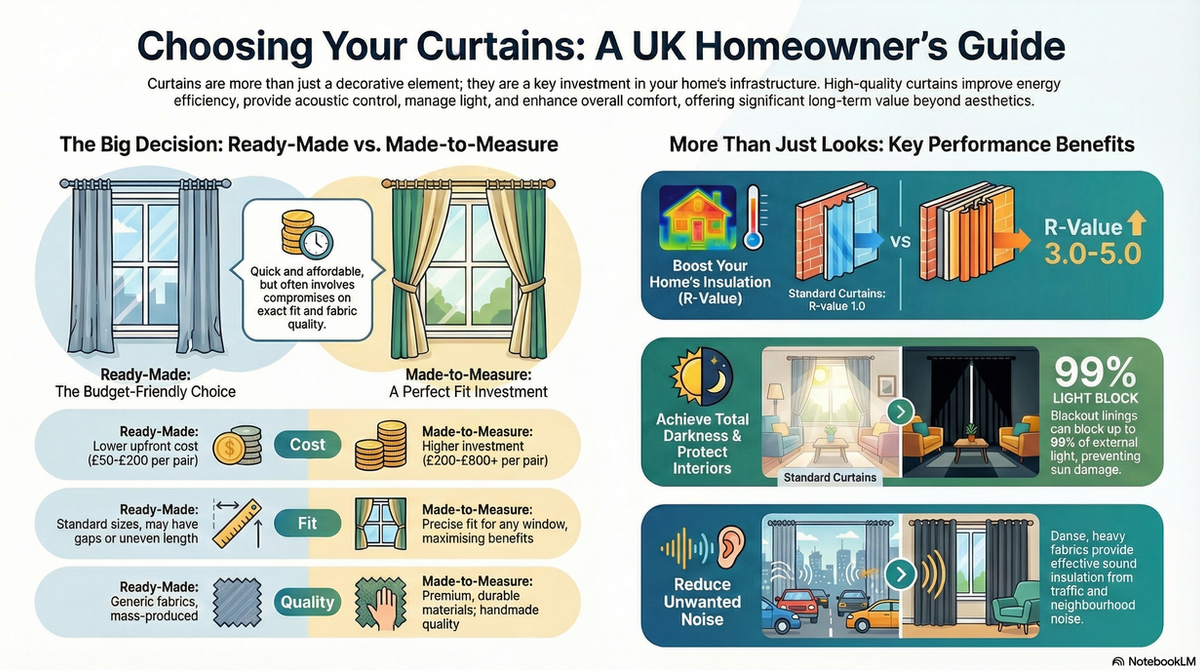
Curtains & Blinds explained
Poorly installed tracks or incorrectly hemmed fabric can ruin the look of an entire room and even cause damage to your walls. Enlisting a specialist ensures that heavy fabrics are securely anchored and that hems hang perfectly level, regardless of uneven floors or window sills.
| Item / Service | Low £ | High £ | Notes |
|---|---|---|---|
| Call-out / Minimum Charge | £65 | £130 | Covers travel and the first hour of labour. |
| Labour (per hour) | £40 | £75 | Varies by location (London/SE usually higher). |
| Shortening (per pair) | £35 | £90 | Depends on width and if they are lined/interlined. |
| Track/Pole Fitting (per window) | £50 | £160 | Higher end for bay windows or heavy-duty tracks. |
| Materials (Basic) | £25 | £200 | Standard poles vs. high-end corded tracks. |
| Full Room (Fitting & Hanging) | £250 | £650 | Typical for 3-4 windows including minor alterations. |
Pricing is primarily influenced by the complexity of the window shape (such as bays or bifold doors) and the weight of the fabric. Specialist materials, such as heavy-duty fixings for "dot and dab" plasterboard or motorised tracking systems, will also increase the overall project cost.
While hanging a simple pole might seem like a straightforward DIY task, larger projects carry risks. Heavy velvet or interlined curtains can weigh significantly more than standard plasterboard fixings can handle, leading to collapsed poles and wall damage.
Professional fitters carry specialized equipment to deal with concrete lintels and "crumbly" Victorian masonry often found in UK homes. Furthermore, altering expensive fabric requires a professional eye; one wrong cut can be an incredibly costly mistake that cannot be undone.
Always hire a professional if you are dealing with bay windows, double-height ceilings, or motorised tracking systems to ensure safety and warranty compliance.
Yes, but it is a more complex process than shortening unlined fabric. The lining and the main fabric must be unpicked, shortened independently, and then re-stitched to ensure they don't "pucker" or pull against each other.
Bay windows require either bespoke bent tracks or specialized poles with corner joints. Measuring and installing these requires high precision to ensure the gliders move smoothly around the corners without catching.
Most fitters can work with hardware you have purchased, but many prefer to supply professional-grade tracks which are often more durable and smoother than "off-the-shelf" retail options.
Dressing involves training the fabric to fall in neat, uniform folds. This often involves "stacking" the curtains open, tying them loosely for 48 hours, and using a professional steamer to remove creases and set the pleats.
Usually, yes. A fitter will typically fill the damaged area with high-strength filler or use specialized "grip" fixings or a wooden "batten" to provide a secure new mounting surface.
This guide was written with AI assistance and is intended for general information only. Prices are estimates based on UK averages and may vary by region. Always get at least three quotes and consult a qualified professional before starting any work.
Ask follow-ups in plain English. The AI explains options, sequencing and what to ask the curtains & blinds — so you walk in informed.
Installing conservatory blinds is one of the most effective ways for UK homeowners to reclaim their living space. While conservatories offer beautiful light, th...
READ GUIDE →GuideVenetian blinds are a staple in UK homes, offering a classic look with excellent light control. However, because they rely on a complex system of cords, pulleys...
READ GUIDE →GuideProfessional curtain installation is about more than just aesthetics; it ensures your window treatments are level, secure, and operate smoothly. For UK homeowne...
READ GUIDE →GuideA snapped or frayed curtain cord can render even the most expensive window dressings useless. In the UK, many homes still rely on corded tracks or Roman blind s...
READ GUIDE →GuideVertical blinds are a practical and popular choice for UK homes, particularly for large patio doors and bay windows. While they are durable, the moving parts wi...
READ GUIDE →GuideWooden shutters, often referred to as plantation shutters, are a premium window treatment that offers a timeless aesthetic for UK homes. Beyond their visual app...
READ GUIDE →