Instant
01 · Ask
Ask the AI a follow-up
Got more questions about patterned Concrete Driveway? Describe the bit you're unsure about — the AI explains options, sequencing and what to ask the driveways.

Imprinted concrete driveway — stamped pattern, coloured, sealed. Looks like block paving, lasts longer.
You've read the brief on patterned Concrete Driveway. Now lean on us to find the right driveways — and stay in control of the job.
Got more questions about patterned Concrete Driveway? Describe the bit you're unsure about — the AI explains options, sequencing and what to ask the driveways.
Costs, timelines, pitfalls and the right questions to ask before any driveways starts on patterned Concrete Driveway.
Itemised quotes from up to 3 local drivewayss on patterned Concrete Driveway — so you can compare like-for-like, not lump sums.
Ready when you are
Enter your postcode and get free quotes from local pros.
Four moves that separate a smooth job from a nightmare.
Often caused by failing to cut expansion joints or a sub-base that wasn't properly compacted.
This usually happens when a cheap "integral" colour is used alone or if the driveway hasn't been resealed in many years.
White, powdery salt deposits can appear; these are natural but should be cleaned off before sealing.
Without an anti-slip "grit" additive in the sealer, patterned concrete can become very slick when wet or icy.
Indicative UK ranges and what affects price.
By job type
Quote spread is typically ± 18% — always get 3 quotes.
Driveways quick-view
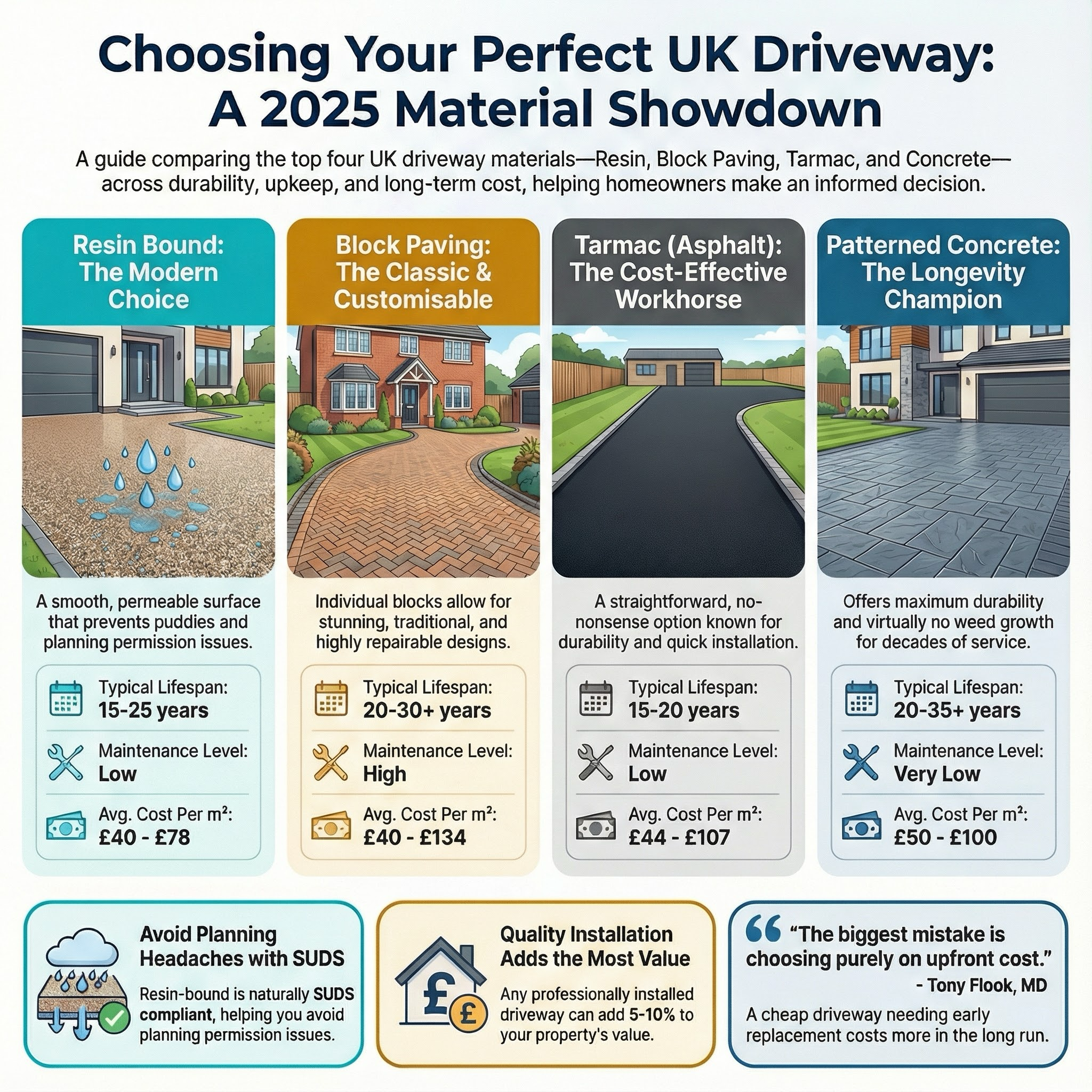
Driveways explained
Beyond its aesthetic appeal, a well-installed patterned concrete driveway is incredibly resilient to the British weather. Because it is a continuous slab rather than individual bricks, it eliminates the risk of sinking or shifting over time, providing a long-term solution for off-street parking.
| Item | Low £ | High £ | Notes |
|---|---|---|---|
| Small Driveway (approx. 30m²) | £2,700 | £4,200 | Includes excavation, materials, and labour. |
| Medium Driveway (approx. 60m²) | £5,400 | £8,400 | Standard two-car driveway size. |
| Large Driveway (approx. 100m²) | £9,000 | £14,000 | Price per m² often drops slightly on larger areas. |
| Drainage Installation (SuDS) | £500 | £1,500 | Required if the driveway doesn't naturally drain to a garden. |
| Resealing (Maintenance) | £300 | £600 | Recommended every 3–5 years. |
Prices are influenced primarily by the complexity of the design, the depth of excavation required, and your location in the UK. Homeowners in London and the South East should expect to pay 15-20% more due to higher labour and waste disposal (muck away) costs.
Patterned concrete is not a DIY project. Unlike block paving, which can be adjusted if you make a mistake, concrete begins to set the moment it leaves the mixer. You have a very narrow window of time to level, colour, and stamp the surface before it hardens.
Professional installers have the specialised tools and the large crew necessary to manage the pour. Mistakes in patterned concrete are permanent and usually require the entire slab to be jackhammered out and replaced.
3 Questions to Ask:
It depends on your priorities. Patterned concrete is generally better for weed prevention and won't sag like blocks. However, block paving is easier to repair if you ever need to dig up the driveway for utility repairs.
No. While you can usually walk on it after 24–48 hours, you should wait at least 7 days before parking a vehicle on it to allow the concrete to reach sufficient structural strength.
All concrete has the potential to crack. However, professional installers use expansion joints to "encourage" the concrete to crack in straight, hidden lines rather than across the main pattern.
Very little. You should wash it down with a hose occasionally. Every 3 to 5 years, you should have it professionally cleaned and resealed to keep it looking new and protected from oil stains.
The colour is hardened into the top layer of the concrete, so it doesn't "peel." However, if the sealer wears away, the colour can look dull. Resealing brings the vibrancy back immediately.
This guide was written with AI assistance and is intended for general information only. Prices are estimates based on UK averages and may vary by region. Always get at least three quotes and consult a qualified professional before starting any work.
Ask follow-ups in plain English. The AI explains options, sequencing and what to ask the driveways — so you walk in informed.
Combining paving slabs with artificial grass is one of the most popular garden transformations for UK homeowners. This pairing offers a "best of both worlds" so...
READ GUIDE →GuideGravel is one of the most versatile and cost-effective landscaping solutions for UK homeowners. Whether you are looking to create a low-maintenance border, a tr...
READ GUIDE →GuideInstalling garden slabs is one of the most effective ways to transform an underutilised outdoor space into a functional, all-weather seating area. Whether you a...
READ GUIDE →GuideA driveway is more than just a place to park; it is the first impression your home makes and a significant factor in its market value. In the UK, our fluctuatin...
READ GUIDE →GuideNeglected pathways and parking spaces are more than just an eyesore; they represent a significant slip hazard and can lead to expensive structural damage. Over ...
READ GUIDE →GuideA brick-paved patio is a timeless addition to any British garden, offering a durable and aesthetically pleasing space for outdoor entertaining. Unlike large pav...
READ GUIDE →