Instant
01 · Ask
Ask the AI a follow-up
Got more questions about commercial EPC Assessment? Describe the bit you're unsure about — the AI explains options, sequencing and what to ask the epc assessor.

Non-domestic EPC for sale, lease or planning — by an accredited commercial assessor.
You've read the brief on commercial EPC Assessment. Now lean on us to find the right epc assessor — and stay in control of the job.
Got more questions about commercial EPC Assessment? Describe the bit you're unsure about — the AI explains options, sequencing and what to ask the epc assessor.
Costs, timelines, pitfalls and the right questions to ask before any epc assessor starts on commercial EPC Assessment.
Itemised quotes from up to 3 local epc assessors on commercial EPC Assessment — so you can compare like-for-like, not lump sums.
Ready when you are
Enter your postcode and get free quotes from local pros.
Four moves that separate a smooth job from a nightmare.
If you cannot provide evidence of cavity wall insulation or specific boiler models, the assessor must use "worst-case" defaults, which ruins your score.
If the assessor cannot see the heating or cooling plant, they cannot accurately record the data, leading to an inaccurate certificate.
Many landlords only realise their EPC has expired during the "due diligence" phase of a sale, causing significant delays to the deal.
Old fluorescent tubes are the most common cause of poor commercial ratings. Upgrading to LED before the assessment is the fastest way to jump a grade.
Indicative UK ranges and what affects price.
By job type
Quote spread is typically ± 18% — always get 3 quotes.
EPC Assessor quick-view
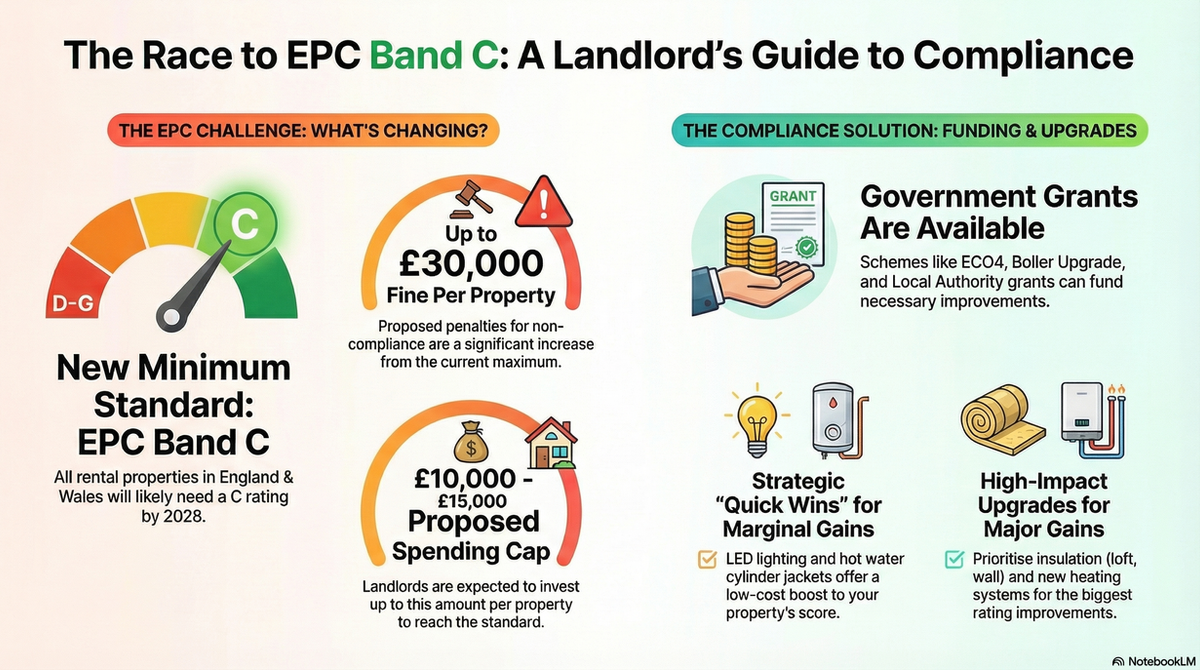
EPC Assessor explained
With the UK government tightening Minimum Energy Efficiency Standards (MEES), having an accurate and up-to-date EPC is no longer just a "tick-box" exercise. It is a critical component of property management that can significantly impact your building's market value and your ability to legally let the premises.
| Building Type / Size | Low £ | High £ | Notes |
|---|---|---|---|
| Small Retail Unit (<100m²) | £200 | £350 | Simple layouts with standard heating. |
| Medium Office/Warehouse (100-500m²) | £400 | £750 | Assumes multiple zones and HVAC systems. |
| Large Industrial/Complex (>1000m²) | £850 | £2,500+ | Requires Level 4 or 5 NDEA accreditation. |
| Urgent Turnaround Surcharge | £50 | £150 | For reports required within 24-48 hours. |
The primary drivers of cost are building size, the complexity of the internal layout, and the sophistication of the heating and cooling systems. Buildings with multiple tenants or varied uses (e.g., a shop with a workshop behind it) require more time for "zoning" and data entry, which increases the fee.
In the UK, it is illegal to produce your own Commercial EPC. The assessment must be carried out by a certified Non-Domestic Energy Assessor (NDEA) who is a member of an approved accreditation scheme such as Elmhurst, Stroma, or Quidos.
Commercial EPCs are far more complex than domestic ones, requiring specialised SBEM software and professional indemnity insurance to be valid for legal transactions.
Most do, but there are exceptions. Places of worship, temporary buildings (used for less than 2 years), and very small standalone buildings (less than 50m²) are generally exempt. Listed buildings may also be exempt if energy improvements would unacceptably alter their character.
Fines for non-compliance are substantial. They are typically based on 12.5% of the rateable value of the building, with a minimum fine of £500 and a maximum cap of £5,000 for most breaches, though MEES violations can reach £150,000.
The most cost-effective "quick win" is replacing all internal lighting with high-efficiency LEDs and adding PIR (motion) sensors. Improving heating controls and insulating exposed pipework are also high-impact, low-cost improvements.
No. If the shop and flat have separate entrances, you will likely need a Commercial EPC for the shop and a Domestic EPC for the flat. If they are sold or let as a single unit, a Commercial EPC may cover the whole building, but the residential part is assessed differently.
SBEM stands for Simplified Building Energy Model. It is the official UK government software tool used to calculate the energy required to light, heat, and cool a non-domestic building over a year, compared to a "benchmark" building of the same type.
This guide was written with AI assistance and is intended for general information only. Prices are estimates based on UK averages and may vary by region. Always get at least three quotes and consult a qualified professional before starting any work.
Ask follow-ups in plain English. The AI explains options, sequencing and what to ask the epc assessor — so you walk in informed.
An Energy Performance Certificate (EPC) is a legal requirement for almost every UK property being built, sold, or rented. It provides an objective rating of a h...
READ GUIDE →GuideFor UK landlords, an Energy Performance Certificate (EPC) is a non-negotiable legal requirement. It provides an efficiency rating from A (most efficient) to G (...
READ GUIDE →GuideAn Energy Performance Certificate (EPC) is a legally required document for almost every home in the UK that is being built, sold, or rented. It provides an obje...
READ GUIDE →GuideScope of Services • Review current sustainability practices and conduct data analysis • Analyse energy consumption, waste management and resource efficiency • A...
READ GUIDE →GuideAn Energy Performance Certificate (EPC) is a legal requirement for anyone selling or renting out a property in the UK. Beyond the legalities, a comprehensive en...
READ GUIDE →GuideAn Energy Performance Certificate (EPC) is a legal requirement for almost every UK homeowner looking to sell their property. It provides potential buyers with a...
READ GUIDE →