Instant
01 · Ask
Ask the AI a follow-up
Got more questions about ePC assessment? Describe the bit you're unsure about — the AI explains options, sequencing and what to ask the epc assessor.

Accredited domestic assessor — on-site visit, lodged same day, certificate valid 10 years.
You've read the brief on ePC assessment. Now lean on us to find the right epc assessor — and stay in control of the job.
Got more questions about ePC assessment? Describe the bit you're unsure about — the AI explains options, sequencing and what to ask the epc assessor.
Costs, timelines, pitfalls and the right questions to ask before any epc assessor starts on ePC assessment.
Itemised quotes from up to 3 local epc assessors on ePC assessment — so you can compare like-for-like, not lump sums.
Ready when you are
Enter your postcode and get free quotes from local pros.
Four moves that separate a smooth job from a nightmare.
If an assessor cannot access the loft or a crawl space, they must mark the insulation as "Unknown." This defaults to the worst-case scenario for the building's age, lowering your score.
For modern measures like internal wall insulation or high-performance glazing, the assessor needs visual proof or certificates. Without these, they cannot credit the improvement.
If the boiler's data plate is missing or unreadable, the software may assume a lower efficiency rating than the unit actually provides.
Open fires or portable electric heaters are often less efficient than central heating; their presence can sometimes negatively impact the overall rating.
Indicative UK ranges and what affects price.
By job type
Quote spread is typically ± 18% — always get 3 quotes.
EPC Assessor quick-view
EPC Assessor explained
For UK homeowners, an EPC is more than just a piece of paperwork; it is a vital tool for understanding your home’s thermal performance. With energy prices remaining a significant concern and the government’s "Net Zero" targets approaching, a high EPC rating can increase your property's market value and make it far more attractive to potential buyers or tenants.
The cost of an EPC is generally determined by the size and location of your property. Unlike many trade services, the price is usually a fixed fee rather than an hourly rate, though complex or very large homes may attract a premium.
| Item | Low £ | High £ | Notes |
|---|---|---|---|
| Studio or 1-Bedroom Flat | £60 | £85 | Simple layouts with single-aspect heat loss. |
| 3-Bedroom Semi-Detached | £85 | £130 | The most common UK property assessment. |
| 5-Bedroom Detached House | £130 | £250 | Higher cost due to multiple floors and zones. |
| Commercial EPC (Small Office) | £250 | £500 | Requires a different level of accreditation. |
| Floor Plan Add-on | £30 | £60 | Often discounted when booked with an EPC. |
Prices typically include the £1.50+ VAT lodgement fee paid to the central register. To get the best value, try to book directly with a local independent assessor rather than through an estate agent, who may add a significant commission to the price.
In the UK, you cannot carry out your own EPC assessment. By law, the certificate must be produced by an accredited Domestic Energy Assessor (DEA) who is a member of an approved government scheme.
The EPC must be lodged on the official National Register to be legally valid for a sale or tenancy agreement.
While you cannot do the assessment yourself, you can "DIY" the preparation. Gathering documentation for works that aren't visible—such as certificates for underfloor insulation or proof of a high-spec boiler—can significantly improve your final score.
Finding a reliable assessor ensures your rating is accurate and you aren't unfairly penalised by "assumed" data. Use these criteria when hiring:
EPCs are governed by the Energy Performance of Buildings (England and Wales) Regulations. It is essential to understand the following:
An EPC lasts for 10 years. However, if you have carried out major renovations like adding an extension, installing new windows, or upgrading your boiler, it is worth getting a new one to reflect the improved efficiency.
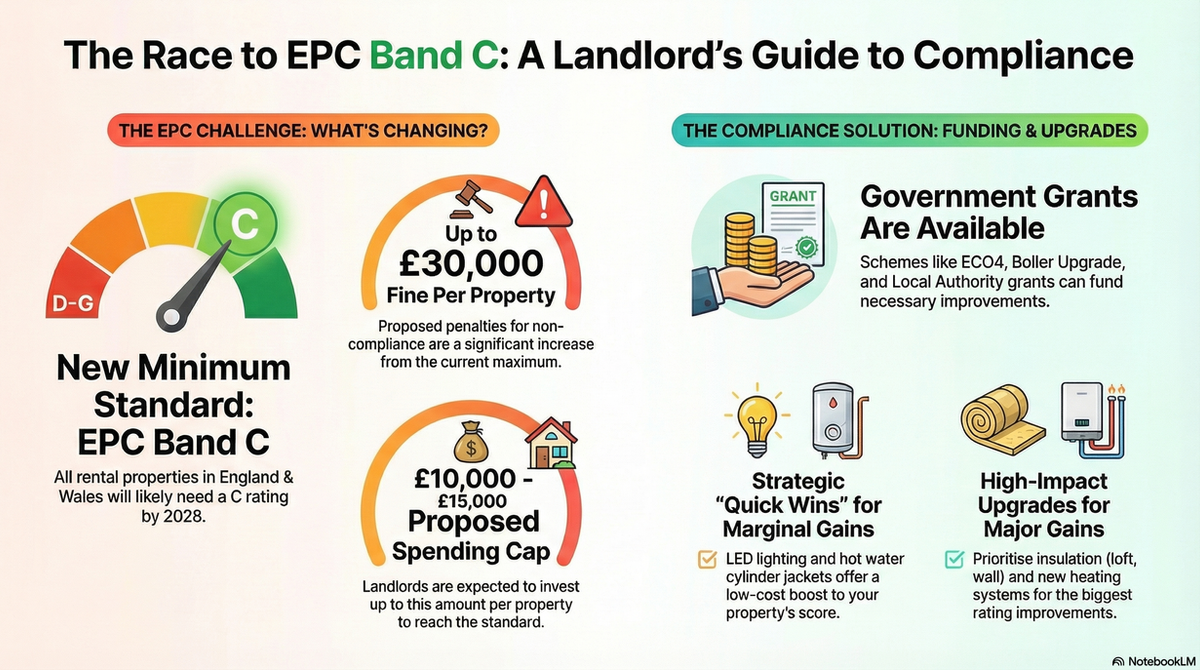
For homeowners, there is no "pass" or "fail." However, for landlords, the property must meet the Minimum Energy Efficiency Standard (currently a rating of E or above) to be legally rented out.
The quickest wins are usually switching all light bulbs to LEDs, increasing loft insulation to 270mm, and installing a cylinder jacket on your hot water tank. These are low-cost but highly effective in the RdSAP software.
Yes. The assessor must see every room, including the loft, to take accurate measurements and check for heating emitters (radiators). They also need to photograph specific features as evidence for their accreditation body.
While solar panels significantly boost a score, they do not guarantee an 'A'. The rating is a holistic view of the building's fabric, heating efficiency, and renewable energy. A poorly insulated house with solar panels may still only achieve a 'C' or 'D'.
You can find any valid EPC for a property in England, Wales, or Northern Ireland by searching the official government database at 'Find an energy certificate' on GOV.UK using the postcode.
This guide was written with AI assistance and is intended for general information only. Prices are estimates based on UK averages and may vary by region. Always get at least three quotes and consult a qualified professional before starting any work.
Ask follow-ups in plain English. The AI explains options, sequencing and what to ask the epc assessor — so you walk in informed.
An Energy Performance Certificate (EPC) is a legal requirement for almost every UK property being built, sold, or rented. It provides an objective rating of a h...
READ GUIDE →GuideFor UK landlords, an Energy Performance Certificate (EPC) is a non-negotiable legal requirement. It provides an efficiency rating from A (most efficient) to G (...
READ GUIDE →GuideA Commercial Energy Performance Certificate (EPC) is a legal requirement for almost all non-domestic buildings in the UK when they are sold, rented, or construc...
READ GUIDE →GuideScope of Services • Review current sustainability practices and conduct data analysis • Analyse energy consumption, waste management and resource efficiency • A...
READ GUIDE →GuideAn Energy Performance Certificate (EPC) is a legal requirement for anyone selling or renting out a property in the UK. Beyond the legalities, a comprehensive en...
READ GUIDE →GuideAn Energy Performance Certificate (EPC) is a legal requirement for almost every UK homeowner looking to sell their property. It provides potential buyers with a...
READ GUIDE →