Instant
01 · Ask
Ask the AI a follow-up
Got more questions about spring repair? Describe the bit you're unsure about — the AI explains options, sequencing and what to ask the garage doors.

Torsion or extension spring — snapped, tired or out-of-balance — replaced and re-tensioned safely.
You've read the brief on spring repair. Now lean on us to find the right garage doors — and stay in control of the job.
Got more questions about spring repair? Describe the bit you're unsure about — the AI explains options, sequencing and what to ask the garage doors.
Costs, timelines, pitfalls and the right questions to ask before any garage doors starts on spring repair.
Itemised quotes from up to 3 local garage doorss on spring repair — so you can compare like-for-like, not lump sums.
Ready when you are
Enter your postcode and get free quotes from local pros.
Four moves that separate a smooth job from a nightmare.
If you hear a sound like a gunshot from the garage, it is almost certainly a torsion spring snapping under tension.
A torsion spring will show a clear 2-inch gap between the coils once it has broken.
If your door feels incredibly heavy or crashes down the last foot of travel, the springs have likely lost their "memory" and need re-tensioning or replacement.
If one side of the door lifts higher than the other, one side of a dual-spring system has failed or a cable has slipped.
Indicative UK ranges and what affects price.
By job type
Quote spread is typically ± 18% — always get 3 quotes.
Garage Doors quick-view
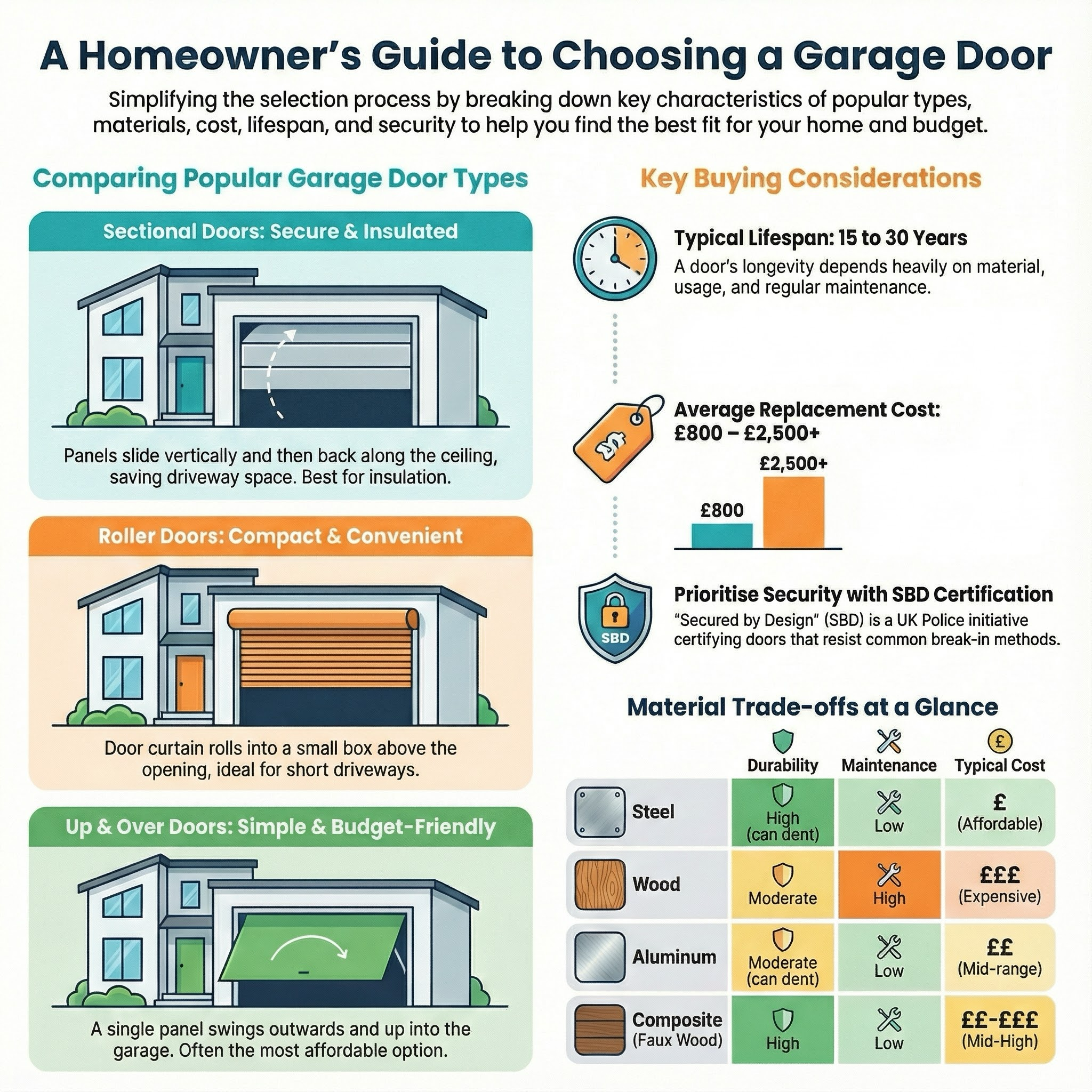
Garage Doors explained
In the UK, most domestic garages use either extension springs (found at the sides of up-and-over doors) or torsion springs (mounted on a bar above sectional doors). When these components fail, the door becomes a deadweight that is difficult, if not impossible, to open safely without professional intervention.
The cost of a garage door spring repair in the UK is largely determined by the type of door system you have. Torsion springs, which are under higher tension and require more labour to calibrate, are generally more expensive than simple side-mounted extension springs.
| Item | Low £ | High £ | Notes |
|---|---|---|---|
| Call-out / Assessment | £80 | £130 | Often covers the first hour of labour. |
| Pair of Extension Springs | £60 | £110 | Parts only; standard up-and-over doors. |
| Single Torsion Spring | £90 | £180 | Parts only; sectional or heavy timber doors. |
| Labour (Standard Repair) | £80 | £150 | Per technician; complex jobs may require two people. |
| Cone and Cable Replacement | £40 | £90 | Commonly replaced alongside springs. |
| Total Project Cost | £180 | £450 | Inc. VAT; varies by region and door complexity. |
Pro Tip: Always replace springs in pairs. If one has snapped due to metal fatigue, the other is likely days or weeks away from failing too, and replacing both at once saves you a second call-out fee.
Garage door spring repair is one of the few home maintenance tasks where professional help is essential. Torsion springs are under enough tension to cause life-changing injuries or even fatalities if they release unexpectedly during a DIY attempt.
While extension springs are slightly less volatile, they still require specific tensioning tools and knowledge of door geometry. Furthermore, an incorrectly balanced door can burn out your expensive automatic motor within months. For UK homeowners, hiring a specialist ensures the door meets safety standards and protects your warranty.
In the UK, garage doors are classified as "machines" under the Supply of Machinery (Safety) Regulations 2008. When a repair is carried out, the door must still comply with BS EN 13241-1.
No. You should immediately disconnect the opener. Electric motors are designed to move a balanced door, not to lift the full weight of the door. Using the motor with a broken spring will likely burn out the gears or the circuit board, turning a £200 repair into a £600 replacement.
Most standard springs are rated for 10,000 "cycles" (one open and one close). For a typical UK family using the garage twice a day, this equates to roughly 7 to 10 years. If you use your garage as a main entrance or workshop, they may fail sooner.
Metal becomes more brittle in cold temperatures. If a spring already has microscopic cracks from years of use, the contraction caused by a UK cold snap is often the final straw that causes it to fail.
Yes, but use the right product. Avoid thick grease which attracts dust and grit. Instead, use a silicone-based spray or a dedicated garage door lubricant once every six months to reduce friction between the coils and prevent rust.
No. Once a spring has snapped, it cannot be welded or "re-joined" because the molecular structure of the steel has been compromised. The only safe and permanent solution is a full replacement with a spring of the same specification.
This guide was written with AI assistance and is intended for general information only. Prices are estimates based on UK averages and may vary by region. Always get at least three quotes and consult a qualified professional before starting any work.
Ask follow-ups in plain English. The AI explains options, sequencing and what to ask the garage doors — so you walk in informed.
A misaligned garage door is more than just a noisy nuisance; it is a significant security risk and a potential safety hazard. When a door is out of plumb, it pl...
READ GUIDE →GuideIndustrial garage doors, including roller shutters and sectional overhead doors, are heavy-duty systems designed for security and frequent use. For UK homeowner...
READ GUIDE →GuideScope of Works • Inspect garage opening and measure dimensions • Remove existing door (if applicable) and prepare the opening • Assemble and install the new gar...
READ GUIDE →GuideA faulty garage door is more than just a daily inconvenience; it is a significant security risk to your home and a potential safety hazard for your family. Whet...
READ GUIDE →GuideUpgrading to an electric garage door is one of the most practical home improvements for UK homeowners. Beyond the obvious convenience of opening your door at th...
READ GUIDE →GuideA garage door is often the largest moving component in a UK home, yet it is frequently the most neglected until it fails. Beyond providing security for your veh...
READ GUIDE →