Instant
01 · Ask
Replace, install or emergency?
Broken pane, new splashback, full balustrade? Describe the job and the AI tells you scope, glass grade and turnaround.

Single mirror or full-wall mirror — securely fixed with proper anchors and finished flush.
Read the brief on toughened glass, low-E coatings and warm-edge spacers — then let three GGF glaziers quote.
Broken pane, new splashback, full balustrade? Describe the job and the AI tells you scope, glass grade and turnaround.
BS 6206 toughened safety zones, argon vs air, low-E coatings, warm-edge spacers, BFRC A-rating. Know the spec.
Three GGF glaziers quote on the same spec — glass grade, coatings, spacer, install — so you don't accidentally buy single-glazed.
Ready when you are
Enter your postcode and get free quotes from local pros.
Four moves that separate a smooth job from a nightmare.
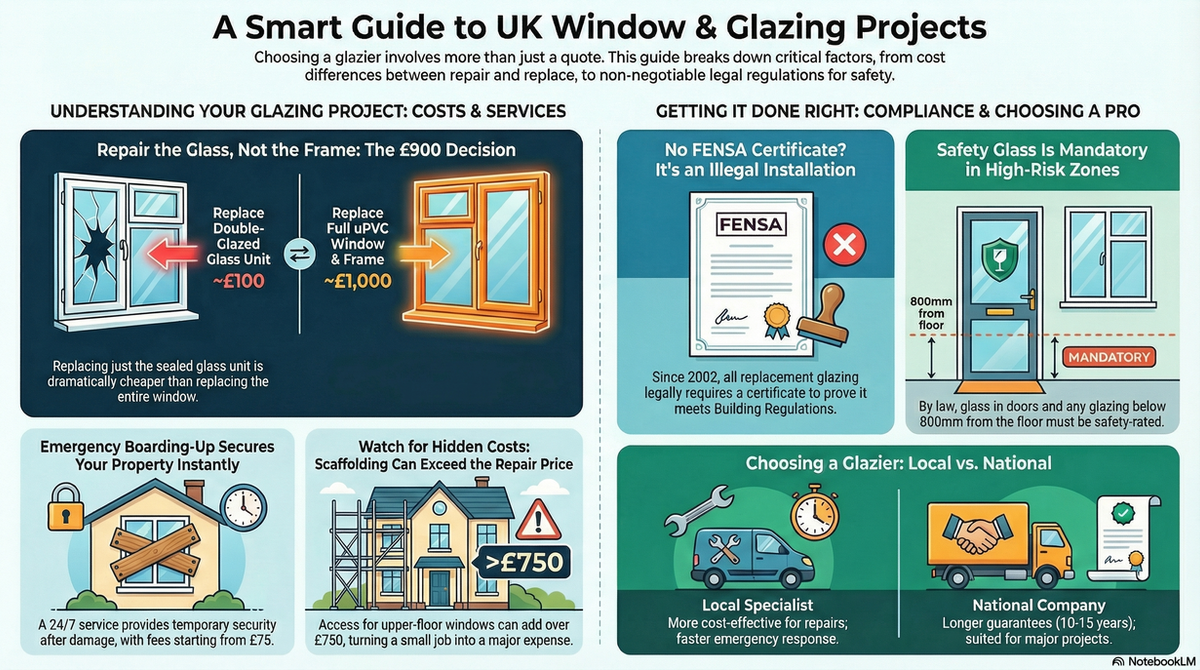
Floor-to-ceiling, near doors, bathrooms, low-level — all need BS 6206 toughened glass. Insist on the kitemark on every pane in those zones.
On any double-glazed unit, argon fill + low-E (low emissivity) coating cuts heat loss by half. Cheap units skip both — and you pay in heating bills.
Pilkington K is low-E coated glass; Activ adds self-cleaning. Activ on conservatory roofs and high-up windows saves a fortune in ladder hire.
Aluminium spacer = standard, conducts cold. Warm-edge spacer (silicone foam) = no cold bridge, no condensation. Insist on warm-edge.
Indicative UK ranges and what affects price.
By job type
Quote spread is typically ± 18% — always get 3 quotes.
Glazier quick-view
Mirror mounting in the UK typically costs £50–£250 for a domestic install, depending on size, weight and wall type. A typical bathroom mirror or hallway mirror runs £60-£120 fitted; large statement mirrors (over 1.2 m) and gym/dance studio mirrors are £150-£400+. The cost is mostly labour and the right fixings — the mirror itself is whatever you've sourced.
The skill is in knowing the wall (plasterboard, masonry, tiled, lath-and-plaster) and selecting fixings that hold reliably for the mirror's weight. Get this wrong and the mirror falls — at best, expensive damage; at worst, dangerous.
| Mirror size / type | Typical price |
|---|---|
| Small bathroom mirror (under 60×60 cm) | £50–£90 |
| Standard bathroom / hallway mirror (60-100 cm) | £70–£140 |
| Large statement mirror (1-1.5 m) | £100–£200 |
| Oversized / leaner mirror (1.5-2 m) | £150–£300 |
| Gym / dance studio mirror wall | £250–£800 |
| Frameless mirror with hidden fixings | £100–£250 |
| Mirror over fireplace / brick wall | £90–£180 |
| Multiple mirrors as a feature wall | £300–£700 |
£100-£300 for typical heavy mirrors (statement pieces, leaners, frameless gym mirrors). Includes fixings, time, and care to ensure level alignment. DIY is achievable for those experienced with stud fixings, but a specialist gives certainty for £150-ish.
For small mirrors (under 60×60 cm) on flat solid walls, yes — using mirror mastic or specialist adhesive tape. For larger or heavier mirrors, mechanical fixings (clips, J-channel, D-rings) are essential as a backup; adhesive alone fails over time, particularly in damp environments.
Hollow-wall toggle fixings (Snaptoggle, Geefix, Gripit) for mirrors up to 30-40 kg per fixing in 12.5 mm plasterboard. Heavier mirrors should be fixed into studs where possible. Plain plasterboard plugs (without metal toggle) are usually under-rated for mirror weight.
French cleat (Z-hangers) hide neatly behind the mirror frame; you only see the mirror, not the fixings. Frameless mirrors use bottom J-channel and small top clips; the J-channel can be siliconed to colour-match the wall.
Yes — bathroom mirrors must have moisture-resistant backing (silver or aluminium with epoxy or copper seal). Cheap "indoor" mirrors corrode at the edges within 2-3 years in steamy bathrooms. Specify "bathroom-grade" or "shower-suitable" when buying.
Within ±0.5° for the human eye not to notice — a standard 600 mm spirit level held against the top of the mirror should show clearly level. Slight misalignment is much more visible on tall mirrors than wide ones.
Want a local pro to handle this? A glazier, handyman, or mirror specialist will assess wall type, choose the right fixings, and install level and secure. For statement mirrors over 1 m, expensive frames, or anything in a bathroom, the £100-£200 spend is worth it for confidence the mirror won't fall.
This guide was written with AI assistance and is intended for general information only. Prices are estimates based on UK averages and may vary by region. Always get at least three quotes and consult a qualified professional before starting any work.
Ask follow-ups in plain English. The AI explains options, sequencing and what to ask the glazier — so you walk in informed.
Specialist leadwork is a hallmark of British architectural heritage, providing both decorative charm and essential weatherproofing for UK homes. Whether you are...
READ GUIDE →GuideGlass restoration is a highly specialised service designed to return damaged, scratched, or weathered glass to its original clarity. For UK homeowners, this is ...
READ GUIDE →GuideUpgrading or repairing residential glazing is one of the most effective ways to improve a UK home’s energy efficiency, security, and noise insulation. Whether y...
READ GUIDE →GuideGlass polishing is a highly specialised service designed to restore the clarity of windows, doors, and glass surfaces without the significant expense of replace...
READ GUIDE →GuideInstalling a glass shower screen is a sophisticated upgrade that transforms the look and feel of a UK bathroom. Beyond the aesthetic appeal, a professionally fi...
READ GUIDE →GuideGlass splashbacks have become a staple in modern UK kitchen design, offering a sleek, hygienic alternative to traditional tiling. Beyond their aesthetic appeal,...
READ GUIDE →