Instant
01 · Ask
Ask the AI a follow-up
Got more questions about front door lock replacement? Describe the bit you're unsure about — the AI explains options, sequencing and what to ask the locksmith.

Front door lock swapped — BS 3621 mortice or TS 007 3-star cylinder, insurance-grade hardware.
You've read the brief on front door lock replacement. Now lean on us to find the right locksmith — and stay in control of the job.
Got more questions about front door lock replacement? Describe the bit you're unsure about — the AI explains options, sequencing and what to ask the locksmith.
Costs, timelines, pitfalls and the right questions to ask before any locksmith starts on front door lock replacement.
Itemised quotes from up to 3 local locksmiths on front door lock replacement — so you can compare like-for-like, not lump sums.
Ready when you are
Enter your postcode and get free quotes from local pros.
Four moves that separate a smooth job from a nightmare.
If the door has sagged, the lock won't line up with the strike plate. Forcing the key in this scenario will eventually snap the internal mechanism.
Cheap, standard cylinders can be snapped in seconds. Always upgrade to an "Anti-Snap" 3-star cylinder for uPVC doors.
Buying a lock that is too long or too short for the door thickness leads to security vulnerabilities and poor aesthetics.
Non-branded locks often lack the internal hardened steel pins required to resist drilling.
Indicative UK ranges and what affects price.
By job type
Quote spread is typically ± 18% — always get 3 quotes.
Locksmith quick-view
Locksmith explained
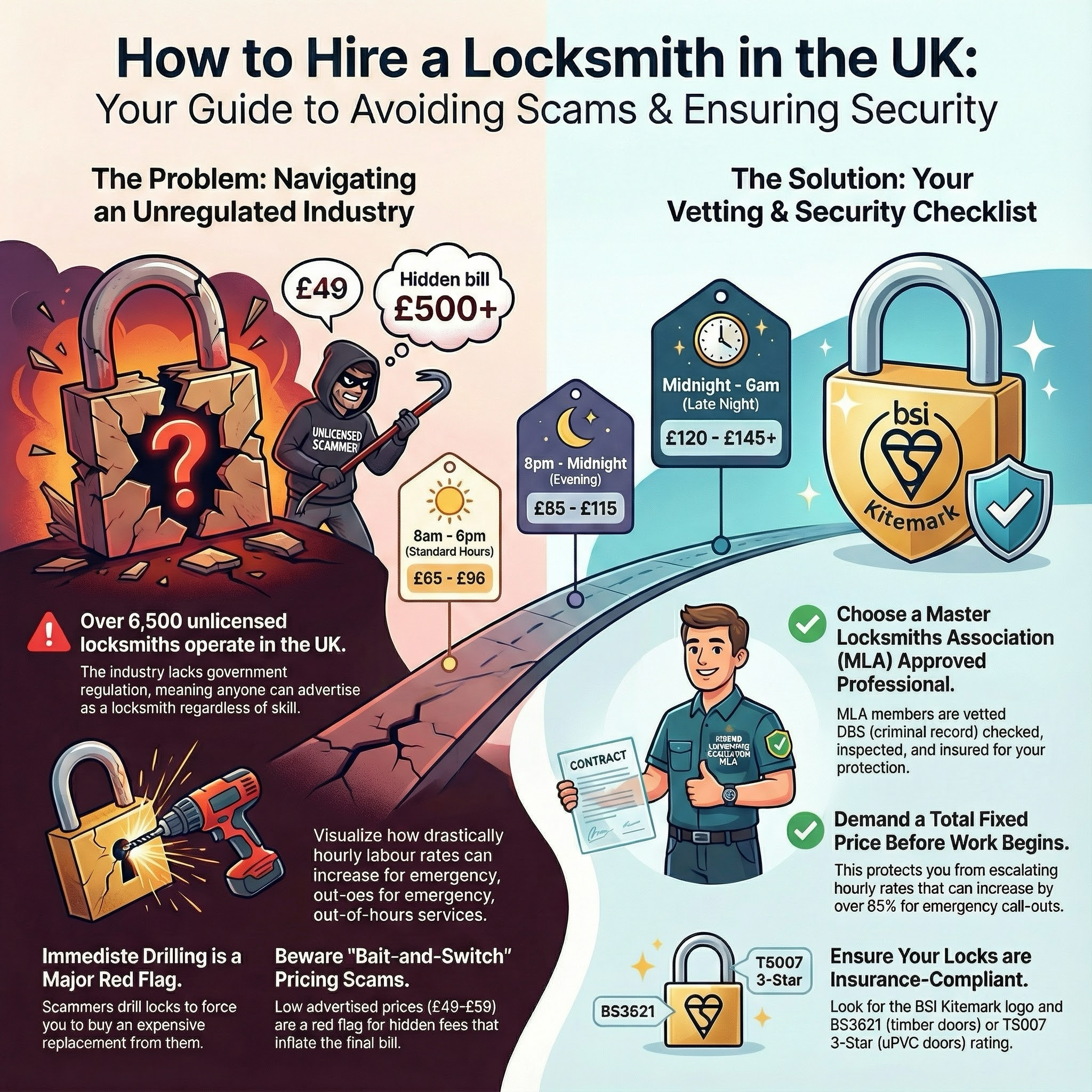
In the UK, the type of lock you need depends heavily on your door material. Timber doors usually require mortice locks or night latches, while uPVC and composite doors rely on multipoint locking systems and euro cylinders. Choosing the right hardware is essential not just for security, but for complying with your home insurance policy.
Prices vary based on the complexity of the lock and whether you require an emergency out-of-hours visit. High-security "3-star" cylinders and British Standard mortice locks carry a premium but are often required by insurers.
| Item | Low £ | High £ | Notes |
|---|---|---|---|
| Standard Euro Cylinder | £85 | £130 | Basic uPVC/Composite replacement. |
| High-Security (3-Star) Cylinder | £120 | £190 | Anti-snap, anti-drill, and anti-pick. |
| Mortice Deadlock (BS3621) | £110 | £175 | For timber doors; includes labour. |
| Multipoint Gearbox Replacement | £180 | £350 | Full mechanism for uPVC doors. |
| Emergency Call-Out Fee | £60 | £150 | Added to the labour/parts cost. |
Factors affecting the final price include your location (London rates are typically 20-30% higher), the brand of hardware chosen (e.g., Yale, ERA, or Brisant Ultion), and whether the door frame requires repair work.
While swapping a basic euro cylinder is a common DIY task, it is fraught with risks. If you measure the cylinder incorrectly and it protrudes more than 3mm from the handle, it is vulnerable to "lock snapping"—a technique used in the majority of UK burglaries.
For mortice locks and multipoint systems, professional installation is highly recommended. Incorrect DIY fitting can void your home insurance if a break-in occurs. A professional locksmith ensures the hardware meets British Standard BS3621, which is a mandatory requirement for many UK insurers.
Always ask the locksmith if the hardware they are installing is "insurance approved" and meets the current British Standards.
Yes, a new lock will come with a fresh set of keys (usually 2 or 3). If you have multiple doors, a locksmith can often "key alike" the cylinders so one key opens the front, back, and patio doors.
This refers to locks tested against common burglary techniques. For timber doors, look for the BS3621 Kitemark. For uPVC doors, insurers usually look for a 3-star rating or a combination of a 1-star cylinder and 2-star handles.
Not necessarily. It could be a simple alignment issue or a lack of lubrication (always use graphite powder, never WD-40). However, a sticking key is often an early warning sign of mechanical failure.
Yes, many smart locks are now compatible with UK multipoint systems. Ensure the model you choose is "BSI IoT Kitemarked" to ensure it is digitally secure as well as physically strong.
A thumb-turn allows you to lock the door from the inside without a key. They are excellent for fire safety but should be paired with a security letterbox restrictor to prevent "fishing" attacks.
This guide was written with AI assistance and is intended for general information only. Prices are estimates based on UK averages and may vary by region. Always get at least three quotes and consult a qualified professional before starting any work.
Ask follow-ups in plain English. The AI explains options, sequencing and what to ask the locksmith — so you walk in informed.
Van crime in the UK remains a significant concern for tradespeople and homeowners alike, with tool theft occurring every few minutes. Standard factory-fitted lo...
READ GUIDE →GuideGetting locked out of your vehicle is a stressful experience, whether you have left the keys in the ignition, trapped them in the boot, or lost them entirely. M...
READ GUIDE →GuideGetting locked out of your home is a stressful experience that requires a fast, reliable solution. Whether you have lost your keys, snapped one in the barrel, o...
READ GUIDE →GuideA stiff or misaligned door is more than a daily nuisance; it is a significant security vulnerability. For UK homeowners, a door that doesn't latch properly can ...
READ GUIDE →GuideGetting locked out of your vehicle is more than a minor inconvenience; in the UK, it often happens at the most inopportune moments, from rain-swept supermarket ...
READ GUIDE →GuideFor UK tradespeople and homeowners, a Ford Transit is often more than just a vehicle; it is a mobile workshop and a livelihood. Unfortunately, the Transit remai...
READ GUIDE →