Instant
01 · Ask
Ask the AI a follow-up
Got more questions about electric oven cleaning? Describe the bit you're unsure about — the AI explains options, sequencing and what to ask the oven cleaning.

Electric oven stripped, dipped, refitted and back to baking same day — full deep clean.
You've read the brief on electric oven cleaning. Now lean on us to find the right oven cleaning — and stay in control of the job.
Got more questions about electric oven cleaning? Describe the bit you're unsure about — the AI explains options, sequencing and what to ask the oven cleaning.
Costs, timelines, pitfalls and the right questions to ask before any oven cleaning starts on electric oven cleaning.
Itemised quotes from up to 3 local oven cleanings on electric oven cleaning — so you can compare like-for-like, not lump sums.
Ready when you are
Enter your postcode and get free quotes from local pros.
Four moves that separate a smooth job from a nightmare.
If too much moisture reaches the electrical connections, the element can trip the RCD; professionals use "dry" techniques near these areas.
Using incorrect chemicals can perish the rubber or silicone seals, leading to heat loss.
Using wire wool or abrasive pads on certain surfaces can permanently ruin the finish.
Failing to properly dry and buff the glass panes can leave streaks that are visible once the oven light is on.
Indicative UK ranges and what affects price.
By job type
Quote spread is typically ± 18% — always get 3 quotes.
Oven Cleaning quick-view
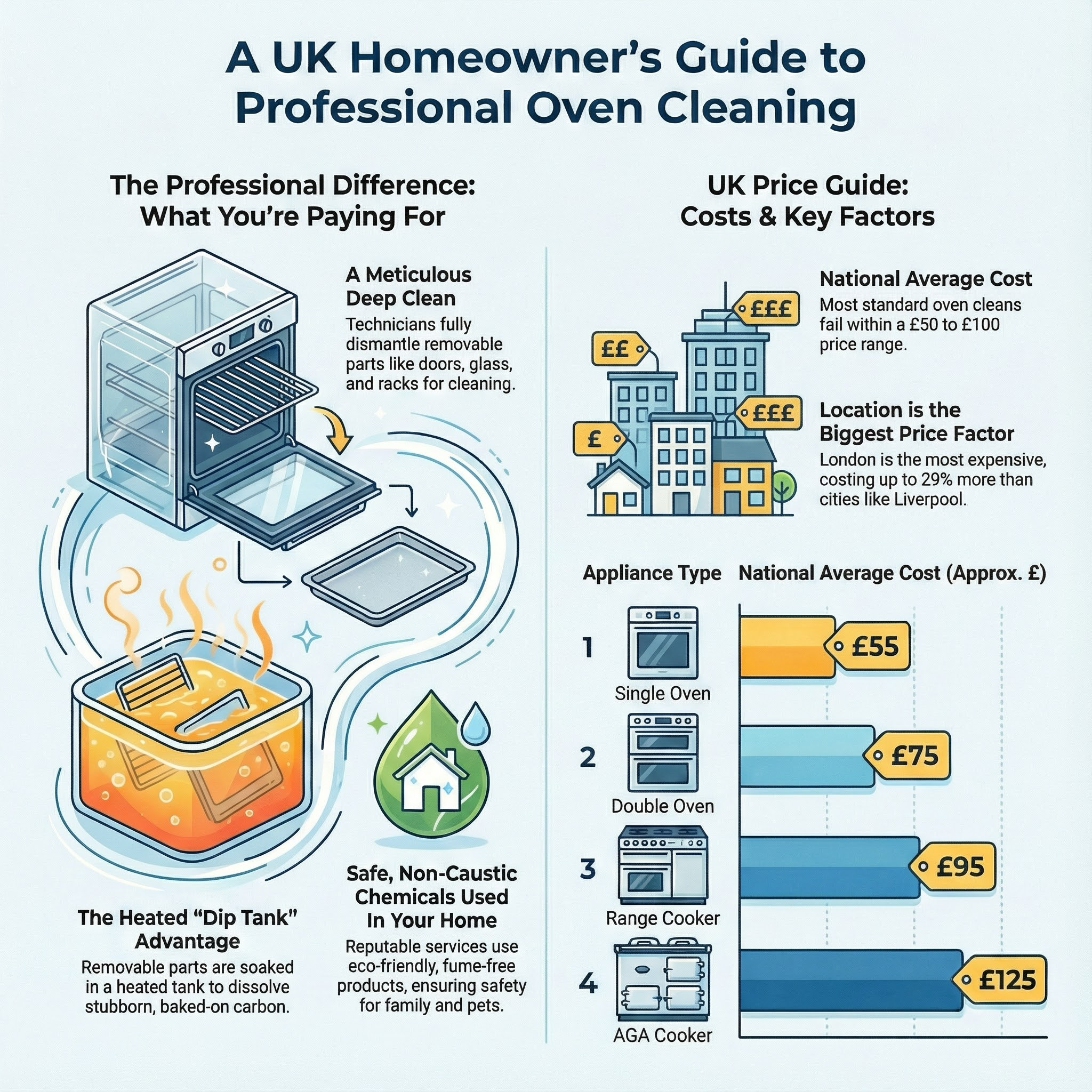
Oven Cleaning explained
While domestic sprays often struggle with stubborn "baked-on" grime, a professional service uses specialist equipment and non-caustic solutions to return your oven to near-showroom condition. This guide covers what to expect from a professional deep clean in the UK, including current market rates and timeframes.
| Item | Low £ | High £ | Notes |
|---|---|---|---|
| Single Oven (Standard 60cm) | £50 | £75 | Includes racks and grill pan. |
| Double Oven (Built-in) | £75 | £110 | Includes both cavities. |
| Range Cooker (Small/90cm) | £110 | £150 | Usually 2-3 cavities and a grill. |
| Large Range / AGA | £150 | £220 | Complex, multi-oven units. |
| Extractor Hood Add-on | £15 | £30 | Includes filter replacement/cleaning. |
| Ceramic/Induction Hob Add-on | £10 | £20 | Deep clean and polish. |
Prices vary based on your location in the UK and the level of carbon build-up. Most technicians charge a fixed price per appliance type rather than an hourly rate, though some may apply a small surcharge for exceptionally neglected ovens or travel to remote areas.
DIY cleaning is possible but often involves harsh, caustic chemicals that produce unpleasant fumes and can damage oven seals or heating elements. Professional cleaners typically use eco-friendly, non-caustic products that are safe for pets and children, allowing you to use the oven immediately after the service.
Professional cleaning is highly recommended for glass doors; attempting to disassemble these yourself can lead to shattered panes or incorrect reassembly that compromises heat retention.
Yes, if the technician uses non-caustic, fume-free products. You simply need to turn the oven on for a few minutes to ensure any residual moisture has evaporated before cooking.
Standard professional services include all original wire racks and the grill pan. Extra baking trays or roasting tins may incur a small additional fee per item.
Pyrolytic ovens are great for light maintenance, but they don't clean the glass, the racks, or the area behind the fan cover. A professional clean provides a deeper, more comprehensive result without the high energy cost and smell of a pyrolytic cycle.
For an average UK household, a professional deep clean every 6 to 12 months is recommended to maintain efficiency and hygiene. If you roast meat frequently, you may require a clean every 4 months.
Professional oven cleaning focuses on the appliance itself (internal and external surfaces). They do not typically pull the oven out to clean the floor or kitchen cabinetry unless specifically agreed upon as an extra service.
This guide was written with AI assistance and is intended for general information only. Prices are estimates based on UK averages and may vary by region. Always get at least three quotes and consult a qualified professional before starting any work.
Ask follow-ups in plain English. The AI explains options, sequencing and what to ask the oven cleaning — so you walk in informed.
Professional oven cleaning is more than just a cosmetic fix; it is a vital maintenance task for any UK household. Over time, carbonised grease and burnt-on food...
READ GUIDE →GuideFor UK homeowners with high-end range cookers, such as AGAs, Wolf, or Lacanche, or those managing light commercial kitchens, standard supermarket sprays rarely ...
READ GUIDE →GuideA professional heavy-duty oven clean is a transformative service that goes far beyond a standard domestic wipe-down. For UK homeowners, it is an essential maint...
READ GUIDE →GuideOven Cleaning Cost Guide Scope of Works Survey & protect surrounding worktops/floor with heat‑proof sheets. Remove racks, trays, glass panels and fan guard ...
READ GUIDE →GuideProfessional oven cleaning is one of the most popular home maintenance services in the UK, transforming a greasy, carbon-caked appliance back to near-showroom c...
READ GUIDE →GuideIn the high-pressure environment of a UK commercial kitchen, a standard domestic scrub simply won't cut it. Professional restaurant oven cleaning is a specialis...
READ GUIDE →