Instant
01 · Ask
Diagnose before you call
Tell the AI what's leaking, dripping or rumbling. It tells you whether you need a plumber, a gas engineer, or a drain specialist — and how urgent it is.

Stuck, leaking or seized stopcock — repaired or replaced by a plumber with mains water isolation.
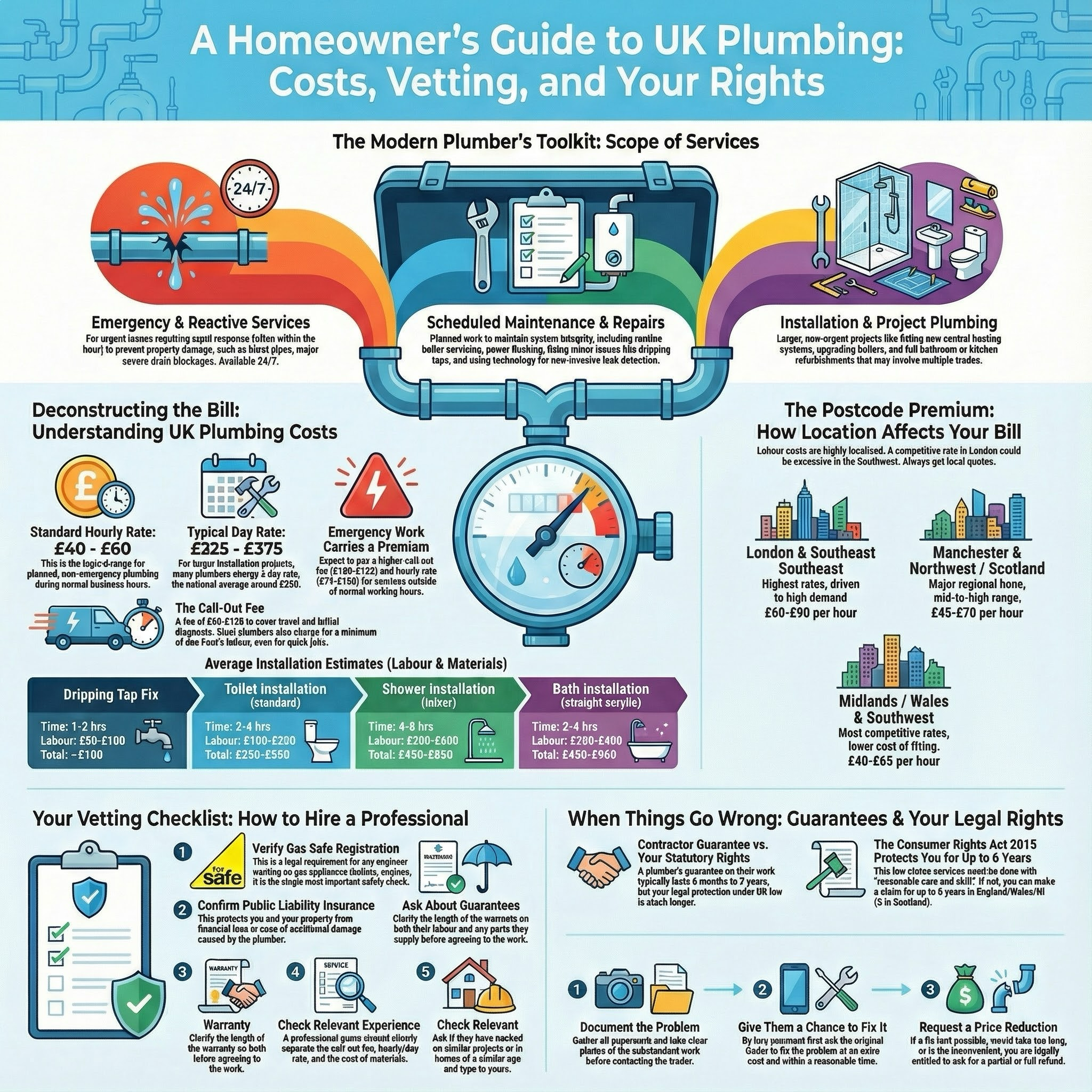
You've read the costs and the questions to ask. Now lean on us to find a Gas Safe-verified plumber — and keep the bill honest.
Tell the AI what's leaking, dripping or rumbling. It tells you whether you need a plumber, a gas engineer, or a drain specialist — and how urgent it is.
Gas Safe vs WaterSafe, boiler warranty conditions, unvented cylinder rules. The plumber brief covers the regs most homeowners learn the hard way.
Up to Three local plumbers come back with itemised quotes — parts, labour and call-out fees — so you can compare like-for-like.
Ready when you are
Enter your postcode and get free quotes from local pros.
Four moves that separate a smooth job from a nightmare.
If gas work is part of the job, the engineer must show their Gas Safe registration card. Verify the number at gassaferegister.co.uk before they touch anything.
Plumbing prices vary wildly by job and area. Three quotes shows you the market — anything more than 20% out from the others is a flag.
For boiler parts, valves and cylinders, ask for manufacturer receipts. Genuine parts come with warranty; refurbished kit often doesn't.
Pay in stages, not upfront. Hold the last 10–20% until you've run hot taps, flushed the system and seen the certificate.
Indicative UK ranges and what affects price.
By job type
Quote spread is typically ± 18% — always get 3 quotes.
Plumber quick-view
Plumber explained
Stopcock repair or replacement in the UK typically costs £100–£300 depending on location, condition, and accessibility. The stopcock (also called the main stop tap or stop valve) is the master shut-off for the cold water supply to your home — every house has at least one inside (under the kitchen sink usually) and one outside (in a buried cover, typically near the property boundary).
Most homes ignore the stopcock for years; when an emergency strikes (burst pipe, major leak), people discover the internal stopcock has seized solid. A working stopcock is one of the most important plumbing items in your home — test it annually.
| Service | Typical price |
|---|---|
| Free up seized stopcock (with WD-40 / spanner) | £60–£140 |
| Replace internal stopcock (accessible) | £120–£250 |
| Replace internal stopcock (awkward access) | £200–£400 |
| Replace external stopcock (water company involvement) | £200–£500 |
| Add isolation valves to system (multiple) | £150–£400 |
| Emergency stopcock repair (out-of-hours) | £180–£400 |
A working internal stopcock allows you to:
A stopcock that won't move during an emergency means the only option is calling the water company to shut off at the boundary — which can take hours during peak times.
Most commonly under the kitchen sink. Other locations: airing cupboard, under stairs, garage, cellar, near hot water cylinder. Trace the cold water pipe back from a tap to find it.
Turn it fully off (clockwise to close). Run a kitchen tap — if water continues flowing for more than a few seconds, the stopcock isn't fully closing. Turn it back on. If it doesn't move at all, it's seized — call a plumber.
£120-£250 for an accessible internal stopcock. £200-£400 for awkward locations. £200-£500 for external stopcock (may require water company involvement). Adding isolation valves nearby for future easier maintenance: extra £30-£90 each.
Possible for confident DIYers with appropriate tools — but the water must be turned off at the external stopcock first (which itself may be seized). Most homeowners hire a plumber to avoid the risk of failure mid-replacement.
Stopcock: master shut-off for the entire house. Isolation valve: smaller valve on individual fittings (washing machine, taps, toilet) for local shut-off without affecting the rest of the home. Modern installations have both.
Try a longer key for more leverage. If still seized, contact your water company (Thames Water, Severn Trent, etc.) — they're responsible for the supply pipe up to your property boundary and will repair or replace. Often free for the external side.
Want a local pro to handle this? A plumber will diagnose, replace, and add modern isolation valves while they're there. £150-£250 for a working stopcock is excellent insurance against potential burst-pipe damage that could otherwise cost thousands.
This guide was written with AI assistance and is intended for general information only. Prices are estimates based on UK averages and may vary by region. Always get at least three quotes and consult a qualified professional before starting any work.
Ask follow-ups in plain English. The AI explains options, sequencing and what to ask the plumber — so you walk in informed.
Upgrading a shower is one of the most impactful improvements you can make to a UK home. Whether you are replacing a tired electric unit or installing a high-end...
READ GUIDE →GuideA blocked toilet is more than just a minor inconvenience; it is a hygiene risk that can quickly lead to water damage if not handled correctly. For UK homeowners...
READ GUIDE →GuideUnderfloor heating (UFH) has moved from a luxury addition to a standard feature in modern British homes. It provides a consistent, radiant heat that eliminates ...
READ GUIDE →GuideSink Replacement Cost Guide Scope of Works Isolate water supplies and drain down local pipework. Remove the existing sink , taps, trap, silicone and fixings; ca...
READ GUIDE →GuideShower Repair Costs Guide Scope of Works Isolate water & electrics and protect adjacent finishes. Diagnose the fault (e.g. leaking mixer valve, cracked tray...
READ GUIDE →GuideA wet room is the ultimate upgrade for a modern UK home, offering a sleek, open-plan aesthetic and unparalleled accessibility. Unlike a traditional bathroom wit...
READ GUIDE →