Instant
01 · Ask
Ask the AI a follow-up
Got more questions about rooftop Solar Installation? Describe the bit you're unsure about — the AI explains options, sequencing and what to ask the renewable energy.

Pitched or flat-roof solar PV — sized to roof area, panel orientation and household usage.
You've read the brief on rooftop Solar Installation. Now lean on us to find the right renewable energy — and stay in control of the job.
Got more questions about rooftop Solar Installation? Describe the bit you're unsure about — the AI explains options, sequencing and what to ask the renewable energy.
Costs, timelines, pitfalls and the right questions to ask before any renewable energy starts on rooftop Solar Installation.
Itemised quotes from up to 3 local renewable energys on rooftop Solar Installation — so you can compare like-for-like, not lump sums.
Ready when you are
Enter your postcode and get free quotes from local pros.
Four moves that separate a smooth job from a nightmare.
Even a small amount of shade from a chimney or tree can significantly drop the output of an entire string of panels. Use optimisers to mitigate this.
Installing panels on a 50-year-old roof that needs replacing in 5 years is a costly mistake. Fix the roof first.
Pigeons love the warmth under panels. If you don't install mesh, they will nest, create mess, and potentially damage wiring.
If your inverter is too small for your array, you will "clip" your peak generation, losing out on free energy during mid-summer.
Indicative UK ranges and what affects price.
By job type
Quote spread is typically ± 18% — always get 3 quotes.
Renewable Energy quick-view
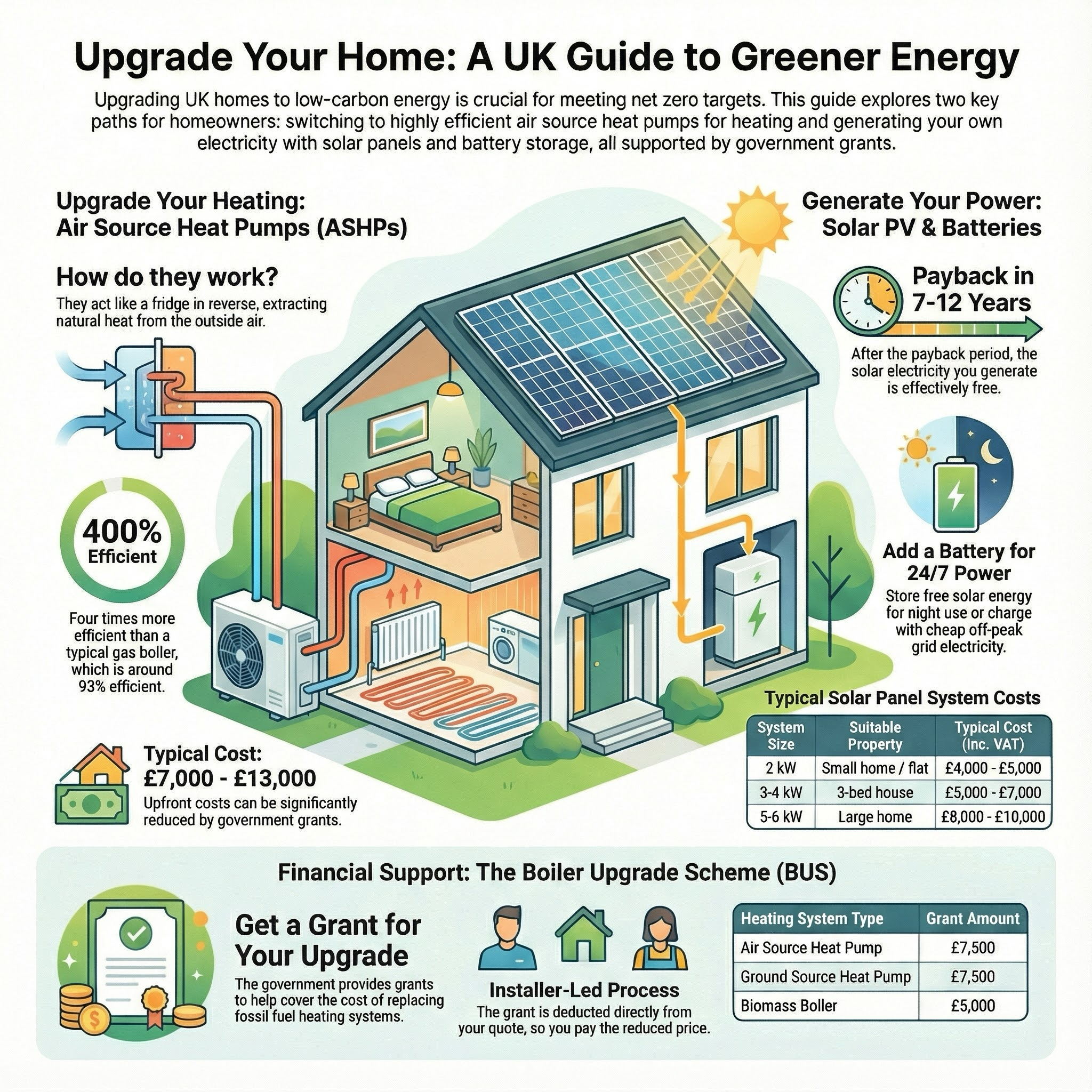
Renewable Energy explained
Modern solar technology is highly efficient, even in the UK's overcast climate, capturing daylight rather than direct sunlight to power your home. This guide outlines the costs, regulations, and practicalities of installing a solar array on your roof in 2025/26.
The cost of solar depends heavily on the size of the system (measured in kilowatts peak, or kWp) and whether you include battery storage. Prices have stabilised in 2025, but labour and scaffolding remain significant factors.
| Item | Low £ | High £ | Notes |
|---|---|---|---|
| 3kWp System (8-10 panels) | £5,000 | £6,500 | Best for small terrace/semi-detached homes. |
| 5kWp System (12-14 panels) | £7,500 | £9,500 | Typical for a 3-4 bedroom family home. |
| Battery Storage (5kWh - 10kWh) | £2,500 | £5,500 | Includes installation and hybrid inverter. |
| Scaffolding | £800 | £1,500 | Varies by house height and complexity. |
| Bird Proofing (Mesh/Spikes) | £400 | £700 | Essential to prevent pigeons nesting under panels. |
Factors affecting the price include the brand of panels (Tier 1 vs. budget), the type of inverter (string vs. micro-inverters), and your roof material. Slate or rosemary tiles often require more labour-intensive mounting than standard concrete tiles.
Solar installation is not a DIY project. While a competent DIYer might be able to physically bolt panels to a roof, the electrical work involves high-voltage DC current which is extremely dangerous. Furthermore, to access the Smart Export Guarantee (SEG)—which pays you for the energy you send back to the grid—your system must be installed by an MCS-certified professional.
Failure to use an MCS-certified installer usually means you cannot claim export payments, and your home insurance may be voided in the event of a fire or structural failure.
Yes. While they are most efficient in direct sunlight, solar PV panels use daylight (photons) to generate electricity. On a typical cloudy UK day, a system will still produce around 10-25% of its peak capacity.
A typical family can save between £400 and £900 per year, depending on their electricity usage patterns and whether they have a battery. Savings are highest if you use appliances during the day when the sun is out.
Generally, the UK's rainfall is sufficient to keep panels clean if they are tilted at 15 degrees or more. However, a professional clean every 2-3 years is recommended if you live near the coast or in a high-pollution area.
The SEG is a government-backed initiative that requires energy suppliers to pay you for every unit of renewable electricity you export back to the National Grid. Rates vary by supplier, so it pays to shop around.
Most panels are warrantied for 25 years but can continue generating power for 30-40 years at a slightly reduced efficiency. The inverter usually needs replacing every 10-12 years.
This guide was written with AI assistance and is intended for general information only. Prices are estimates based on UK averages and may vary by region. Always get at least three quotes and consult a qualified professional before starting any work.
Ask follow-ups in plain English. The AI explains options, sequencing and what to ask the renewable energy — so you walk in informed.
Investing in renewable energy is a significant commitment for any UK homeowner. Whether you have solar PV panels, a battery storage system, or an air source hea...
READ GUIDE →GuideSolar Photovoltaic (PV) systems are one of the most effective ways for UK homeowners to shield themselves from volatile energy prices. By converting sunlight di...
READ GUIDE →GuideSolar panels are no longer a niche luxury; they are a core component of a modern, energy-efficient UK home. With energy prices remaining volatile, generating yo...
READ GUIDE →GuideA biomass feasibility assessment is the essential first step for UK homeowners considering a switch from fossil fuels to renewable wood-based heating. This prof...
READ GUIDE →GuideSolar thermal systems are a highly efficient way for UK homeowners to reduce their carbon footprint and slash energy bills by harnessing free heat from the sun....
READ GUIDE →GuideDomestic wind turbines are an increasingly popular choice for UK homeowners looking to slash energy bills and reduce their carbon footprint. While solar panels ...
READ GUIDE →