Instant
01 · Ask
Ask the AI a follow-up
Got more questions about commercial Rubbish Removal Costs? Describe the bit you're unsure about — the AI explains options, sequencing and what to ask the rubbish clearance.

What commercial rubbish removal costs in 2026 — by waste type, volume and collection frequency.
You've read the brief on commercial Rubbish Removal Costs. Now lean on us to find the right rubbish clearance — and stay in control of the job.
Got more questions about commercial Rubbish Removal Costs? Describe the bit you're unsure about — the AI explains options, sequencing and what to ask the rubbish clearance.
Costs, timelines, pitfalls and the right questions to ask before any rubbish clearance starts on commercial Rubbish Removal Costs.
Itemised quotes from up to 3 local rubbish clearances on commercial Rubbish Removal Costs — so you can compare like-for-like, not lump sums.
Ready when you are
Enter your postcode and get free quotes from local pros.
Four moves that separate a smooth job from a nightmare.
Heavy materials like rubble or tiles can reach a van’s weight limit long before the van looks "full," leading to unexpected surcharges.
Failing to secure a parking permit or loading bay access can lead to aborted collections and "dry run" fees.
Putting hazardous items (like paint or chemicals) in with general waste can lead to the entire load being rejected at the gate.
If you hire an unlicensed "man with a van" and they dump your items, the Environment Agency can prosecute you as the original producer of the waste.
Indicative UK ranges and what affects price.
By job type
Quote spread is typically ± 18% — always get 3 quotes.
Rubbish Clearance quick-view
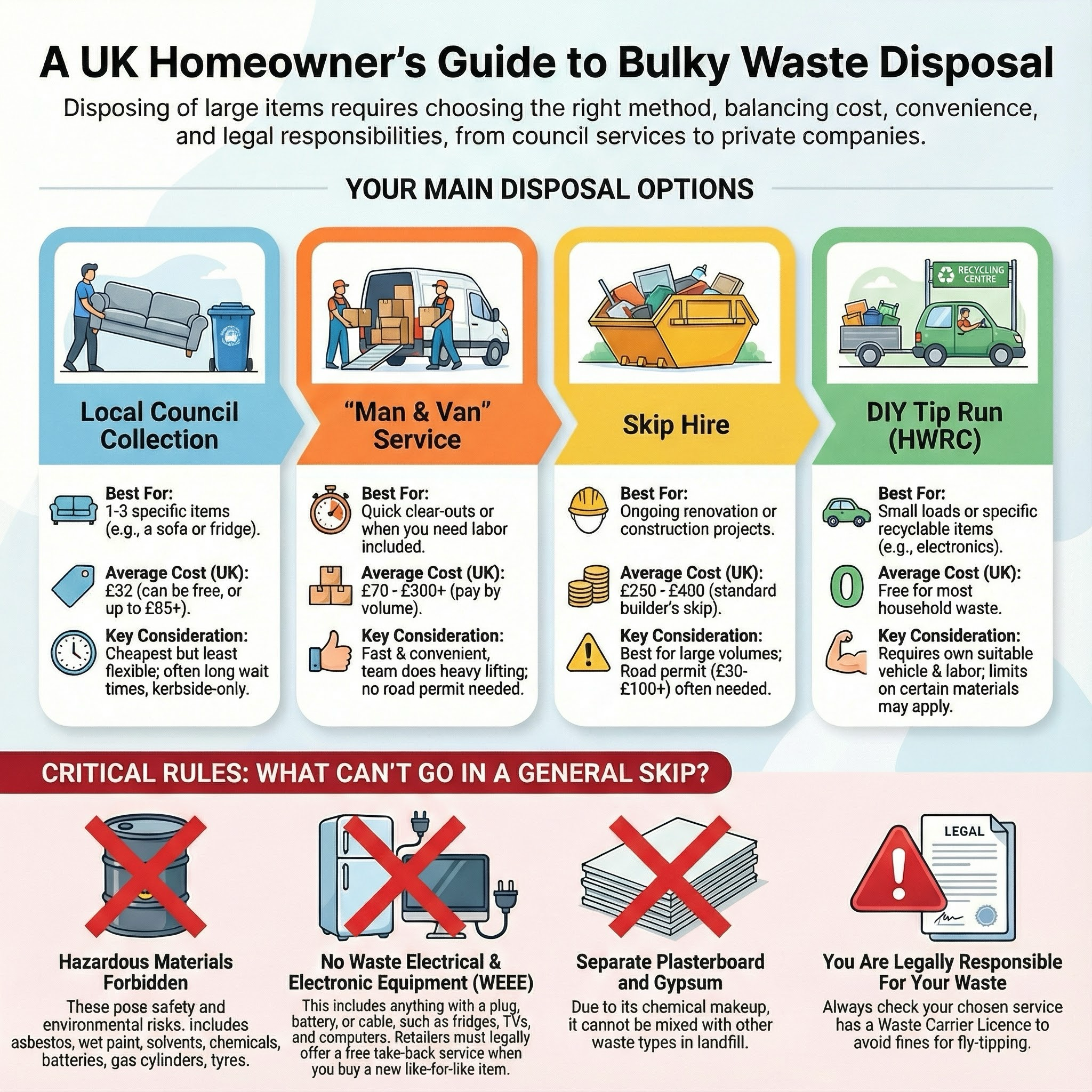
Rubbish Clearance explained
For UK property owners, commercial clearance isn't just about moving heavy items; it is about "Duty of Care." Using a licensed professional guarantees that your waste is disposed of at authorised facilities, protecting you from the heavy fines associated with fly-tipping and improper disposal.
Commercial waste costs are primarily driven by volume (fractions of a van load) and weight. Unlike domestic waste, commercial disposal incurs "gate fees" at transfer stations and Landfill Tax, which are reflected in the price.
| Item | Low £ | High £ | Notes |
|---|---|---|---|
| Minimum Call-out (incl. 1/4 load) | £80 | £150 | Includes ~250kg and 15 mins labour. |
| Half Van Load | £190 | £280 | Includes ~500kg and 30 mins labour. |
| Full Van Load (14 cubic yards) | £350 | £550 | Includes ~1,000kg and 1 hour labour. |
| Hazardous Surcharge (per item) | £25 | £120 | Fridges, monitors, tyres, or fire extinguishers. |
| Extra Labour (per 30 mins) | £30 | £50 | Applies for long carries or dismantling. |
Prices in London and the South East typically sit 15-20% higher due to increased disposal gate fees and ULEZ/Congestion charges. Always confirm if the quote includes VAT, as many commercial providers quote "plus VAT" by default.
For commercial waste, DIY is rarely the best route. UK "Civic Amenity" sites (local tips) often ban commercial vehicles or charge high trade rates that match professional removal fees. Furthermore, you are legally required to transport commercial waste with a Waste Carrier Licence; failing to produce one if stopped by the police can result in an on-the-spot fine.
Professional removal is not just a convenience; it is a legal safeguard. Your "Duty of Care" means you are responsible for the waste until it is properly disposed of, even after it leaves your property.
A WTN is a legal document that tracks the transfer of waste from one person to another. It must include a description of the waste, the EWC code, and the signatures of both parties. You are legally required to keep these for two years.
Yes, but these fall under WEEE (Waste Electrical and Electronic Equipment) regulations. They must be handled separately from general waste, and there is usually a small surcharge per item for compliant recycling.
A man-and-van service is usually better for commercial waste as it includes labour, you don't need a skip permit from the council, and you only pay for the volume you actually use.
Most professional crews will sort the waste for you as they load the vehicle. However, keeping heavy materials separate from light, bulky items can often help you get a more accurate quote.
Most cannot take "prohibited" hazardous waste like raw asbestos, medical waste, or large quantities of chemicals/solvents unless they have a specialist hazardous waste licence.
This guide was written with AI assistance and is intended for general information only. Prices are estimates based on UK averages and may vary by region. Always get at least three quotes and consult a qualified professional before starting any work.
Ask follow-ups in plain English. The AI explains options, sequencing and what to ask the rubbish clearance — so you walk in informed.
Disposing of an old mattress or a bulky bed frame is one of the more challenging tasks for UK homeowners. Beyond the physical strain of navigating heavy, awkwar...
READ GUIDE →GuideDisposing of an old sofa or armchair in the UK has become more complex due to recent environmental legislation. Bulky furniture is difficult to move, and many i...
READ GUIDE →GuideScrapping a car in the UK is a straightforward process, but it is governed by strict environmental and legal regulations. Whether your vehicle is a non-runner, ...
READ GUIDE →GuideAccumulating black bin bags is a common headache for UK homeowners, whether it’s due to a missed council collection, a deep spring clean, or the aftermath of a ...
READ GUIDE →GuideWhether you are decommissioning a commercial suite or simply reclaiming a spare bedroom from years of "home office" clutter, a professional office clean-out is ...
READ GUIDE →GuideDisposing of an old bed or mattress is one of the most awkward tasks a UK homeowner can face. Beyond the sheer bulk and weight, mattresses are notoriously diffi...
READ GUIDE →