Instant
01 · Ask
Ask the AI a follow-up
Got more questions about office Clean-Out? Describe the bit you're unsure about — the AI explains options, sequencing and what to ask the rubbish clearance.

Office clearance — desks, IT, files and furniture removed for downsizing, relocation or closure.
You've read the brief on office Clean-Out. Now lean on us to find the right rubbish clearance — and stay in control of the job.
Got more questions about office Clean-Out? Describe the bit you're unsure about — the AI explains options, sequencing and what to ask the rubbish clearance.
Costs, timelines, pitfalls and the right questions to ask before any rubbish clearance starts on office Clean-Out.
Itemised quotes from up to 3 local rubbish clearances on office Clean-Out — so you can compare like-for-like, not lump sums.
Ready when you are
Enter your postcode and get free quotes from local pros.
Four moves that separate a smooth job from a nightmare.
Not measuring the lift or failing to book the loading bay can lead to aborted call-out fees.
Old offices may contain hazardous materials like fluorescent tubes or even asbestos in older partitions; inform your tradie early.
If your waste is found dumped, the Environment Agency will trace it back to you, not just the person who dumped it.
Adding "just a few more things" on the day of the move often leads to price disputes or the van running out of space.
Indicative UK ranges and what affects price.
By job type
Quote spread is typically ± 18% — always get 3 quotes.
Rubbish Clearance quick-view
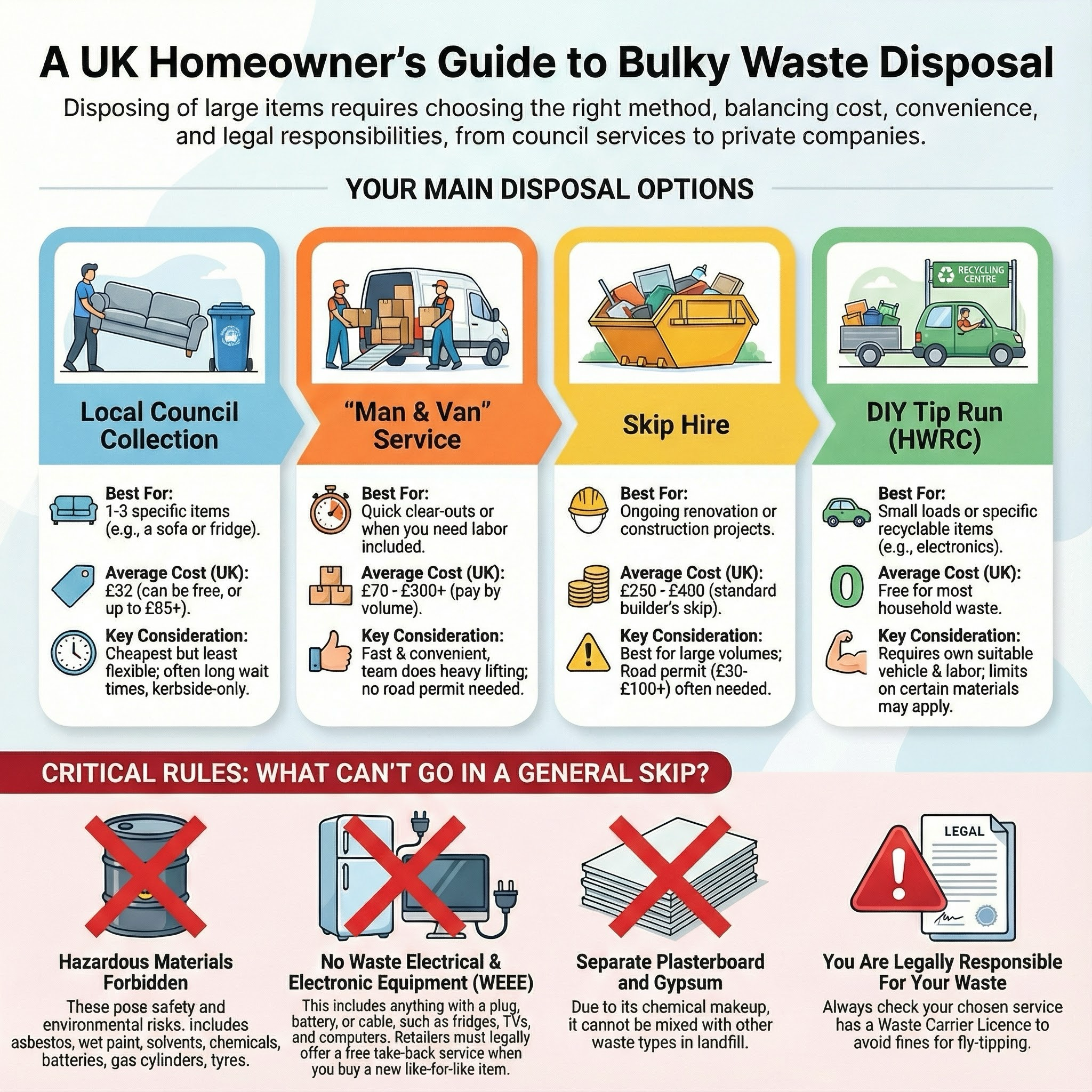
Rubbish Clearance explained
A professional clearance service ensures that bulky desks, outdated tech, and mountains of paperwork are disposed of legally and sustainably. This guide breaks down the costs, timelines, and legal requirements for a hassle-free office clearance in 2025.
Prices for office clearances are generally based on the volume of waste (measured in cubic yards or van loads) and the weight of the materials. Special items like computer monitors or refrigeration units often incur a surcharge due to hazardous components.
| Item / Service | Low £ | High £ | Notes |
|---|---|---|---|
| Minimum Call-out Charge | £120 | £180 | Covers travel and first 1-2 cubic yards. |
| Small Office (1-2 people) | £250 | £450 | Half-van load; includes basic furniture. |
| Medium Office (5-10 people) | £600 | £950 | 1-2 full van loads; multiple desks/chairs. |
| WEEE Surcharge (per item) | £15 | £45 | Monitors, TVs, or small appliances. |
| Confidential Shredding | £10 | £25 | Per standard archive box or sack. |
| Labour (per person/hour) | £40 | £70 | For complex dismantling or heavy lifting. |
Note: Prices include VAT. Factors such as parking restrictions, lack of lift access, and the distance to the nearest recycling centre will influence the final quote.
While you can take a car-load of office chairs to the local tip, commercial waste is legally different. Most UK Household Waste Recycling Centres (HWRCs) will not accept office furniture if they suspect it comes from a business. Furthermore, heavy items like fireproof filing cabinets present significant manual handling risks.
Professional clearance companies carry the necessary Waste Carrier Licences, protecting you from heavy fines associated with illegal fly-tipping.
Some charities or social enterprises may take working IT for free, but most clearance companies charge a fee. This covers the cost of data wiping, testing for electrical safety (PAT testing), and the transport involved.
No, most professional teams will bring tools to dismantle furniture. However, doing this yourself beforehand can sometimes reduce the labour cost if you are on a tight budget.
Most clearance companies cannot take "prohibited" hazardous waste such as loose asbestos, chemicals, paints, or gas canisters. These require a specialist hazardous waste contractor.
A WTN is a legal document that describes the waste, who produced it, and who is taking it away. It is your proof that you have met your legal Duty of Care under UK law.
Yes, many UK firms specialise in weekend or evening clearances to minimise disruption to surrounding businesses. Expect to pay a small premium for out-of-hours service.
Reputable companies will provide a "Certificate of Destruction." This lists the serial numbers of the drives and confirms they have been physically shredded or degaussed.
This guide was written with AI assistance and is intended for general information only. Prices are estimates based on UK averages and may vary by region. Always get at least three quotes and consult a qualified professional before starting any work.
Ask follow-ups in plain English. The AI explains options, sequencing and what to ask the rubbish clearance — so you walk in informed.
Disposing of an old mattress or a bulky bed frame is one of the more challenging tasks for UK homeowners. Beyond the physical strain of navigating heavy, awkwar...
READ GUIDE →GuideManaging commercial waste is a significantly different beast compared to standard residential rubbish. Whether you are a landlord clearing a shop unit, a home-b...
READ GUIDE →GuideDisposing of an old sofa or armchair in the UK has become more complex due to recent environmental legislation. Bulky furniture is difficult to move, and many i...
READ GUIDE →GuideScrapping a car in the UK is a straightforward process, but it is governed by strict environmental and legal regulations. Whether your vehicle is a non-runner, ...
READ GUIDE →GuideAccumulating black bin bags is a common headache for UK homeowners, whether it’s due to a missed council collection, a deep spring clean, or the aftermath of a ...
READ GUIDE →GuideDisposing of an old bed or mattress is one of the most awkward tasks a UK homeowner can face. Beyond the sheer bulk and weight, mattresses are notoriously diffi...
READ GUIDE →