Instant
01 · Ask
Ask the AI a follow-up
Got more questions about swimming Pool Maintenance? Describe the bit you're unsure about — the AI explains options, sequencing and what to ask the swimming pools.

Weekly chemistry, monthly clean, annual deep service — what each costs and what schedule keeps a pool healthy.
You've read the brief on swimming Pool Maintenance. Now lean on us to find the right swimming pools — and stay in control of the job.
Got more questions about swimming Pool Maintenance? Describe the bit you're unsure about — the AI explains options, sequencing and what to ask the swimming pools.
Costs, timelines, pitfalls and the right questions to ask before any swimming pools starts on swimming Pool Maintenance.
Itemised quotes from up to 3 local swimming poolss on swimming Pool Maintenance — so you can compare like-for-like, not lump sums.
Ready when you are
Enter your postcode and get free quotes from local pros.
Four moves that separate a smooth job from a nightmare.
Usually caused by low sanitiser levels or high phosphate levels; requires "shocking" and specialist algaecide.
Often a sign of poor filtration or incorrect pH levels preventing the chlorine from working effectively.
Usually indicates worn bearings or air being sucked into the system through a leak in the pipework.
Often caused by chemical imbalance (low pH) "eating" the heat exchanger over time.
Indicative UK ranges and a typical week-by-week schedule.
By job type
Quote spread is typically ± 18% — always get 3 quotes.
Concrete in-ground pool build · week by week
Schedule slips on dependencies — pad each phase by 10–20% for real-world delays.
Swimming Pools quick-view
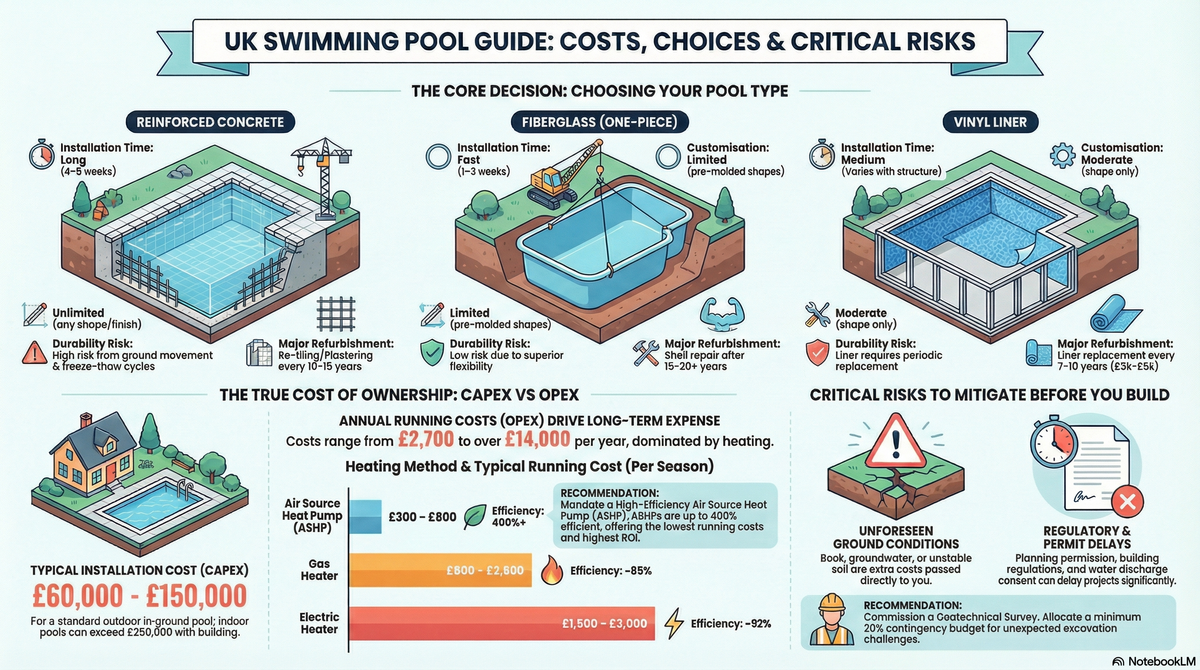
Swimming Pools explained
A well-maintained pool is about more than just clear water; it is about chemical balance, equipment longevity, and hygiene. Neglecting the plant room or water chemistry can lead to costly liner replacements or heater repairs that far exceed the price of a regular service contract.
The cost of pool maintenance in the UK varies based on the pool size, the type of filtration system, and your location. Most homeowners opt for a service contract which reduces the "per-visit" cost compared to emergency call-outs.
| Item | Low £ | High £ | Notes |
|---|---|---|---|
| Routine Service Visit | £90 | £180 | Labour only; excludes chemicals. |
| Spring Opening (Summerisation) | £350 | £700 | Deep clean, shock dose, and system start-up. |
| Winterisation (Closing) | £250 | £500 | Chemical winterising and cover fitting. |
| Monthly Chemical Pack | £40 | £100 | Varies by pool volume and usage. |
| Sand Filter Media Change | £300 | £600 | Recommended every 3–5 years. |
Prices are generally higher in London and the South East. Large pools or those with complex features like infinity edges or advanced automation will sit at the higher end of these estimates.
Many UK homeowners handle basic skimming and leaf removal themselves, but professional maintenance is highly recommended for the plant room and chemical balancing. Handling concentrated pool chemicals carries health and safety risks if not stored or mixed correctly.
Professional technicians have the diagnostic tools to spot a failing pump or a micro-leak before it becomes a multi-thousand-pound repair job.
Electrical work on pool pumps and heaters must be carried out by a Part P qualified electrician. If you have a gas pool heater, any service or repair on that unit must legally be performed by a Gas Safe registered engineer with specific qualifications for pool heaters.
Questions to ask:
For most UK outdoor pools, a professional visit once every two weeks during the summer is ideal. Indoor pools generally require monthly professional checks alongside weekly homeowner maintenance.
This is often due to "Chlorine Lock," caused by high levels of Cyanuric Acid (stabiliser). If this level is too high, the chlorine becomes ineffective, and the only solution is to partially drain and refill the pool.
No. Salt water pools are still chlorine pools; they simply use a salt cell to generate chlorine. You still need to balance the pH and alkalinity, and the salt cell requires periodic cleaning with acid to remove calcium scale.
The most effective way is to use a high-quality solar cover whenever the pool is not in use. This prevents evaporative cooling, which accounts for up to 70% of heat loss in UK pools.
Yes, in the UK it is standard practice to leave the pool full but "winterised." This involves lowering the water level slightly below the skimmers, adding winter chemicals, and fitting a debris cover to protect the structure.
This guide was written with AI assistance and is intended for general information only. Prices are estimates based on UK averages and may vary by region. Always get at least three quotes and consult a qualified professional before starting any work.
Ask follow-ups in plain English. The AI explains options, sequencing and what to ask the swimming pools — so you walk in informed.
An emergency swimming pool failure is more than just a ruined weekend; it can lead to significant structural damage, sky-high water bills, or hazardous chemical...
READ GUIDE →GuideA hot tub is a significant investment for any UK homeowner, offering a private retreat for relaxation and hydrotherapy. However, the combination of high tempera...
READ GUIDE →GuideHot tubs are a significant investment for UK homeowners, providing a year-round retreat in the garden. However, the combination of high-voltage electricity, com...
READ GUIDE →GuideInstalling a hot tub is one of the most popular ways to enhance a UK garden, offering a year-round retreat for relaxation and hydrotherapy. While the prospect o...
READ GUIDE →GuideBuilding a swimming pool is one of the most significant home improvements a UK homeowner can undertake. Beyond the lifestyle benefits, a well-constructed pool c...
READ GUIDE →GuideScope of Supply • Browse our extensive range of hot tubs, including both portable and built-in models • Undertake rigorous quality checks to ensure safety, dura...
READ GUIDE →