Instant
01 · Ask
Ask the AI a follow-up
Got more questions about carpet Supply and Installation? Describe the bit you're unsure about — the AI explains options, sequencing and what to ask the carpets.

Carpet types, underlay options and what fair fitting actually costs in 2026.
You've read the brief on carpet Supply and Installation. Now lean on us to find the right carpets — and stay in control of the job.
Got more questions about carpet Supply and Installation? Describe the bit you're unsure about — the AI explains options, sequencing and what to ask the carpets.
Costs, timelines, pitfalls and the right questions to ask before any carpets starts on carpet Supply and Installation.
Itemised quotes from up to 3 local carpetss on carpet Supply and Installation — so you can compare like-for-like, not lump sums.
Ready when you are
Enter your postcode and get free quotes from local pros.
Four moves that separate a smooth job from a nightmare.
Usually caused by poor stretching during installation or a failure to use a power stretcher in larger rooms.
While some seams are inevitable, they should be neatly butt-jointed and placed away from direct light sources where possible.
Using old underlay with a new carpet is a false economy; it will likely collapse within a year, leaving the carpet unsupported.
Choosing a carpet with a low recovery rate for a room with heavy furniture can lead to permanent crushing of the pile.
Indicative UK ranges and what affects price.
By job type
Quote spread is typically ± 18% — always get 3 quotes.
Carpets quick-view
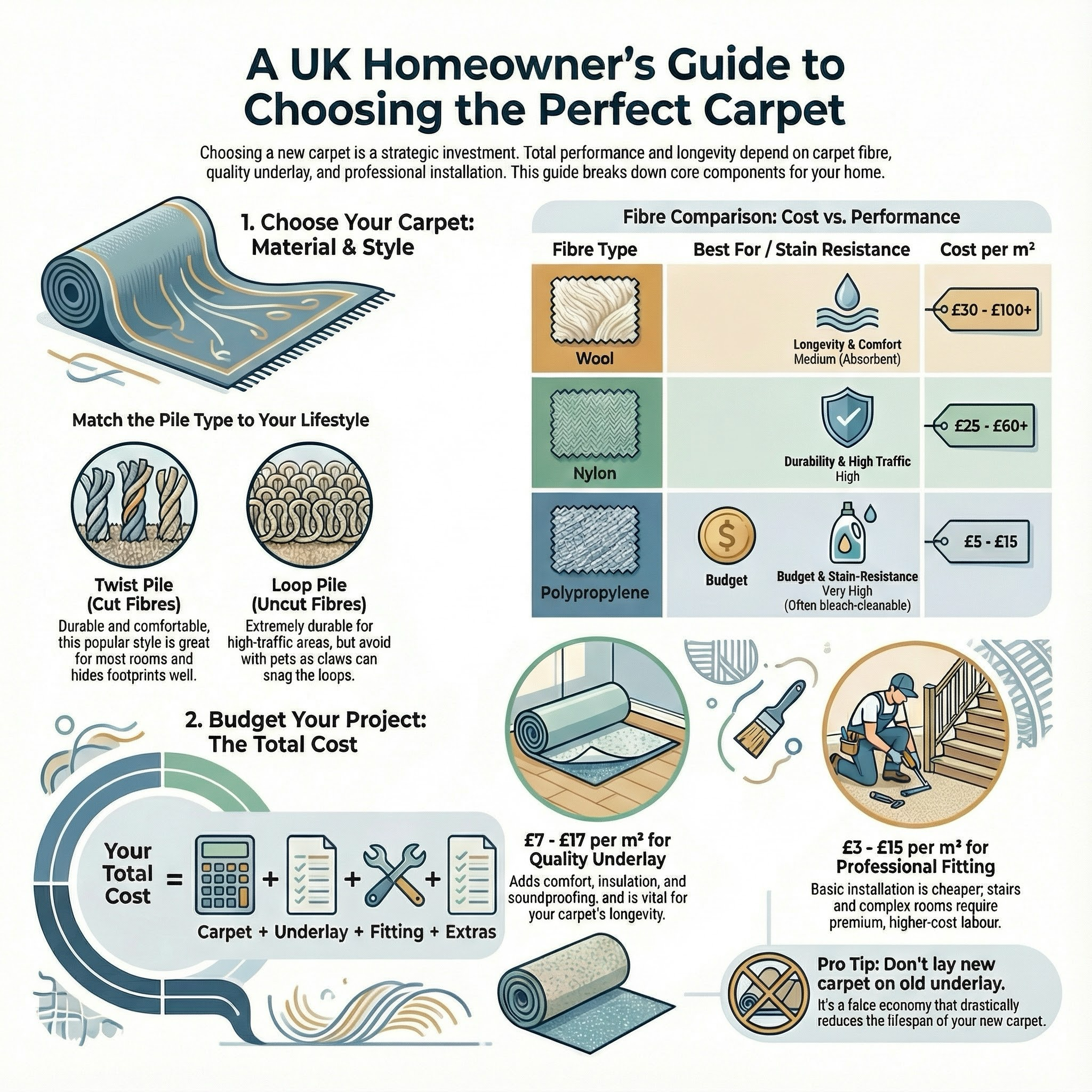
Carpets explained
A professional fit ensures your carpet stays taut, wears evenly, and lasts for its intended lifespan. In the UK, where dampness and draughts can be an issue, choosing the right underlay and fitting method is essential for maintaining a warm, energy-efficient household.
Carpet pricing in the UK is usually quoted per square metre (m²). Remember to factor in the cost of underlay, grippers, and door bars, as these are often priced separately from the carpet and labour.
| Item | Low £ | High £ | Notes |
|---|---|---|---|
| Budget Synthetic Carpet | £10 | £20 | Per m². Usually polypropylene. |
| Mid-range Wool Mix | £25 | £45 | Per m². 80/20 wool/nylon is standard. |
| Luxury/Premium Carpet | £50 | £100+ | Per m². High-end Wilton or Axminster. |
| Underlay (8mm - 12mm) | £6 | £14 | Per m². Essential for comfort/warmth. |
| Fitting Labour | £4 | £8 | Per m². Minimum call-out fees usually apply. |
| Disposal of Old Carpet | £30 | £60 | Flat fee per room or by weight. |
Prices vary based on your location in the UK, with London and the South East typically seeing higher labour rates. Intricate areas like winding staircases will also attract a premium due to the complexity of the cuts required.
While laying a small, square room might seem achievable for a confident DIYer, professional fitting is highly recommended for larger areas and stairs. Professional fitters use specialist tools like power stretchers to prevent the carpet from "bagging" or rippling over time.
Incorrectly fitted carpet can void your manufacturer’s warranty and lead to premature wear in high-traffic areas.
It is rarely recommended. Underlay wears out just like carpet, losing its elasticity and thermal properties. New carpet laid on old underlay will wear out significantly faster.
Yes. It is best to leave the carpet in the room for 24 hours before fitting, especially in winter. This allows the backing to soften and reach room temperature, making it easier to stretch.
A "wool twist" with at least 80% wool content is generally best for stairs. It is resilient, hides footprints, and resists the flattening that occurs on the "nose" of the step.
Most fitters expect the room to be clear. Some will move large items like sofas for an extra charge, but they usually won't move electronics, breakables, or clear small items from shelves.
This is caused by VOCs off-gassing. Keeping the windows open and the room well-ventilated for 48 hours after installation will usually resolve the odour.
This guide was written with AI assistance and is intended for general information only. Prices are estimates based on UK averages and may vary by region. Always get at least three quotes and consult a qualified professional before starting any work.
Ask follow-ups in plain English. The AI explains options, sequencing and what to ask the carpets — so you walk in informed.
New flooring is one of the most impactful upgrades you can make to a UK home. Beyond the immediate aesthetic boost, high-quality flooring improves insulation, r...
READ GUIDE →GuideLaminate flooring remains one of the most popular choices for UK homeowners, offering the aesthetic of real hardwood with significantly higher durability and ea...
READ GUIDE →GuideFloor screeding is the process of applying a blended mixture of cement and graded sand (or a specialized liquid compound) to a structural concrete subfloor. For...
READ GUIDE →GuideModern vinyl flooring has evolved far beyond the basic "lino" of the past. Today, UK homeowners can choose from high-end sheet vinyl, Luxury Vinyl Tiles (LVT), ...
READ GUIDE →GuideRefinishing a wooden floor is one of the most effective ways to restore character and add significant value to a UK home. Whether you have discovered original V...
READ GUIDE →GuideWood floor restoration is one of the most effective ways to breathe new life into a UK home, especially for period properties with original pine or oak boards. ...
READ GUIDE →