Instant
01 · Ask
Ask the AI a follow-up
Got more questions about flooring Installation Costs? Describe the bit you're unsure about — the AI explains options, sequencing and what to ask the carpets.

Carpet, vinyl, laminate, engineered or hardwood — what each costs supply-and-fit in 2026.
You've read the brief on flooring Installation Costs. Now lean on us to find the right carpets — and stay in control of the job.
Got more questions about flooring Installation Costs? Describe the bit you're unsure about — the AI explains options, sequencing and what to ask the carpets.
Costs, timelines, pitfalls and the right questions to ask before any carpets starts on flooring Installation Costs.
Itemised quotes from up to 3 local carpetss on flooring Installation Costs — so you can compare like-for-like, not lump sums.
Ready when you are
Enter your postcode and get free quotes from local pros.
Four moves that separate a smooth job from a nightmare.
Laying wood or LVT on a damp concrete slab will cause the floor to buckle or grow mould; always insist on a damp-proof membrane (DPM) if moisture is detected.
If the subfloor isn't perfectly flat, "click" joints will eventually snap under the pressure of foot traffic.
Wood and laminate expand and contract with temperature; failing to leave a 10-15mm gap at the edges will cause the floor to "peak" in the centre.
New flooring is often thicker than the old material; doors may need to be "planed" or trimmed to clear the new surface.
Indicative UK ranges and what affects price.
By job type
Quote spread is typically ± 18% — always get 3 quotes.
Carpets quick-view
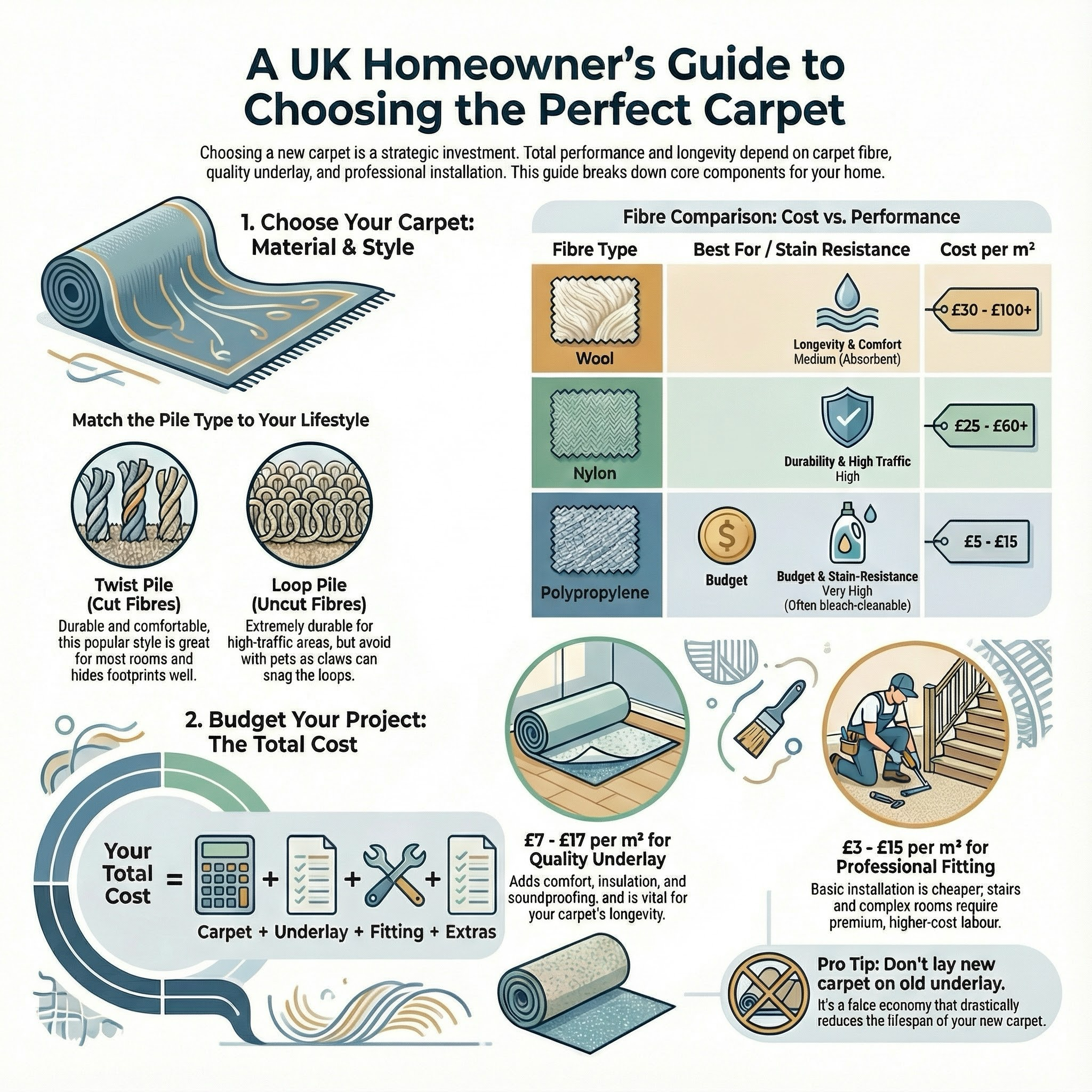
Carpets explained
Whether you are installing plush carpets in a bedroom or durable luxury vinyl tiles in a busy kitchen, the success of the project relies heavily on the preparation of what lies beneath. A professional finish ensures your investment stands up to years of foot traffic without warping, lifting, or thinning.
Flooring costs are generally quoted per square metre (m²). Prices vary significantly based on the material quality and the amount of preparation required for your specific subfloor.
| Item / Material Type | Low £ (per m²) | High £ (per m²) | Notes |
|---|---|---|---|
| Standard Carpet & Underlay | £25 | £55 | Includes basic fitting and mid-range underlay. |
| Laminate Flooring | £30 | £65 | Higher costs for AC5-rated "waterproof" boards. |
| Luxury Vinyl Tiles (LVT) | £45 | £95 | Glue-down versions require more prep than click-fit. |
| Engineered Wood | £70 | £160 | Depends on oak thickness and finish (oiled/lacquered). |
| Subfloor Prep (Screeding/Ply) | £15 | £30 | Essential for a flat, professional finish. |
| Labour Only (Day Rate) | £200 | £350 | Varies by region and installer expertise. |
Factors affecting the final bill include the complexity of the room layout, the need for door trimming, and whether you require the installer to move heavy furniture. Expect to pay a premium for "herringbone" or "chevron" patterns due to the increased waste and labour time involved.
Always confirm if the quote includes VAT and the cost of waste removal, as disposing of old carpets and underlay can incur significant commercial tip fees.
While laying a basic "click-fit" laminate in a square spare room is a viable DIY project, more complex materials like LVT or solid wood are best left to professionals. Incorrectly prepared subfloors are the leading cause of flooring failure, leading to "bounce," clicking sounds, or joint separation.
Professional installers have the specialist tools—such as jamb saws, moisture meters, and heavy-duty rollers—that ensure a seamless finish. Furthermore, many high-end flooring warranties are only valid if the product is installed by a certified professional.
While flooring itself isn't usually subject to planning permission, certain UK Building Regulations do apply, particularly in flats and new builds.
Yes, in almost all cases. Old underlay loses its elasticity and "crumbles" over time, meaning your new carpet will wear out twice as fast and feel less comfortable underfoot.
Most engineered wood requires 48 hours, while solid wood may need up to a week. This prevents the boards from shrinking or expanding excessively after they have been fitted.
It is possible if the tiles are secure and level. However, a "feather finish" or a thin layer of smoothing compound is usually required to stop the grout lines from "telegraphing" through to the new surface.
Luxury Vinyl Tiles (LVT) and engineered wood are excellent choices. They conduct heat efficiently and are stable enough to handle the temperature changes without warping.
LVT is generally more durable and 100% waterproof, making it better for kitchens and bathrooms. Laminate is often cheaper and offers a more realistic "clack" sound similar to real wood.
This guide was written with AI assistance and is intended for general information only. Prices are estimates based on UK averages and may vary by region. Always get at least three quotes and consult a qualified professional before starting any work.
Ask follow-ups in plain English. The AI explains options, sequencing and what to ask the carpets — so you walk in informed.
Laminate flooring remains one of the most popular choices for UK homeowners, offering the aesthetic of real hardwood with significantly higher durability and ea...
READ GUIDE →GuideInstalling new carpet is one of the most effective ways to instantly improve the comfort and insulation of your home. Whether you are opting for a durable wool-...
READ GUIDE →GuideFloor screeding is the process of applying a blended mixture of cement and graded sand (or a specialized liquid compound) to a structural concrete subfloor. For...
READ GUIDE →GuideModern vinyl flooring has evolved far beyond the basic "lino" of the past. Today, UK homeowners can choose from high-end sheet vinyl, Luxury Vinyl Tiles (LVT), ...
READ GUIDE →GuideRefinishing a wooden floor is one of the most effective ways to restore character and add significant value to a UK home. Whether you have discovered original V...
READ GUIDE →GuideWood floor restoration is one of the most effective ways to breathe new life into a UK home, especially for period properties with original pine or oak boards. ...
READ GUIDE →