Instant
01 · Ask
Ask the AI a follow-up
Got more questions about laminate Flooring Installation? Describe the bit you're unsure about — the AI explains options, sequencing and what to ask the carpets.

Click-lock or glued laminate — sub-floor checked, level corrected and finished with beading or scotia.
You've read the brief on laminate Flooring Installation. Now lean on us to find the right carpets — and stay in control of the job.
Got more questions about laminate Flooring Installation? Describe the bit you're unsure about — the AI explains options, sequencing and what to ask the carpets.
Costs, timelines, pitfalls and the right questions to ask before any carpets starts on laminate Flooring Installation.
Itemised quotes from up to 3 local carpetss on laminate Flooring Installation — so you can compare like-for-like, not lump sums.
Ready when you are
Enter your postcode and get free quotes from local pros.
Four moves that separate a smooth job from a nightmare.
When boards push against each other and rise at the joints; usually caused by a lack of expansion gaps at the walls.
Occurs when the subfloor is uneven, leaving voids beneath the planks that cause them to flex when walked on.
Boards separating over time, often because they weren't acclimatised or the room is subject to extreme temperature swings.
Swelling at the edges caused by wet-mopping or spills entering the joints of non-water-resistant laminate.
Indicative UK ranges and what affects price.
By job type
Quote spread is typically ± 18% — always get 3 quotes.
Carpets quick-view
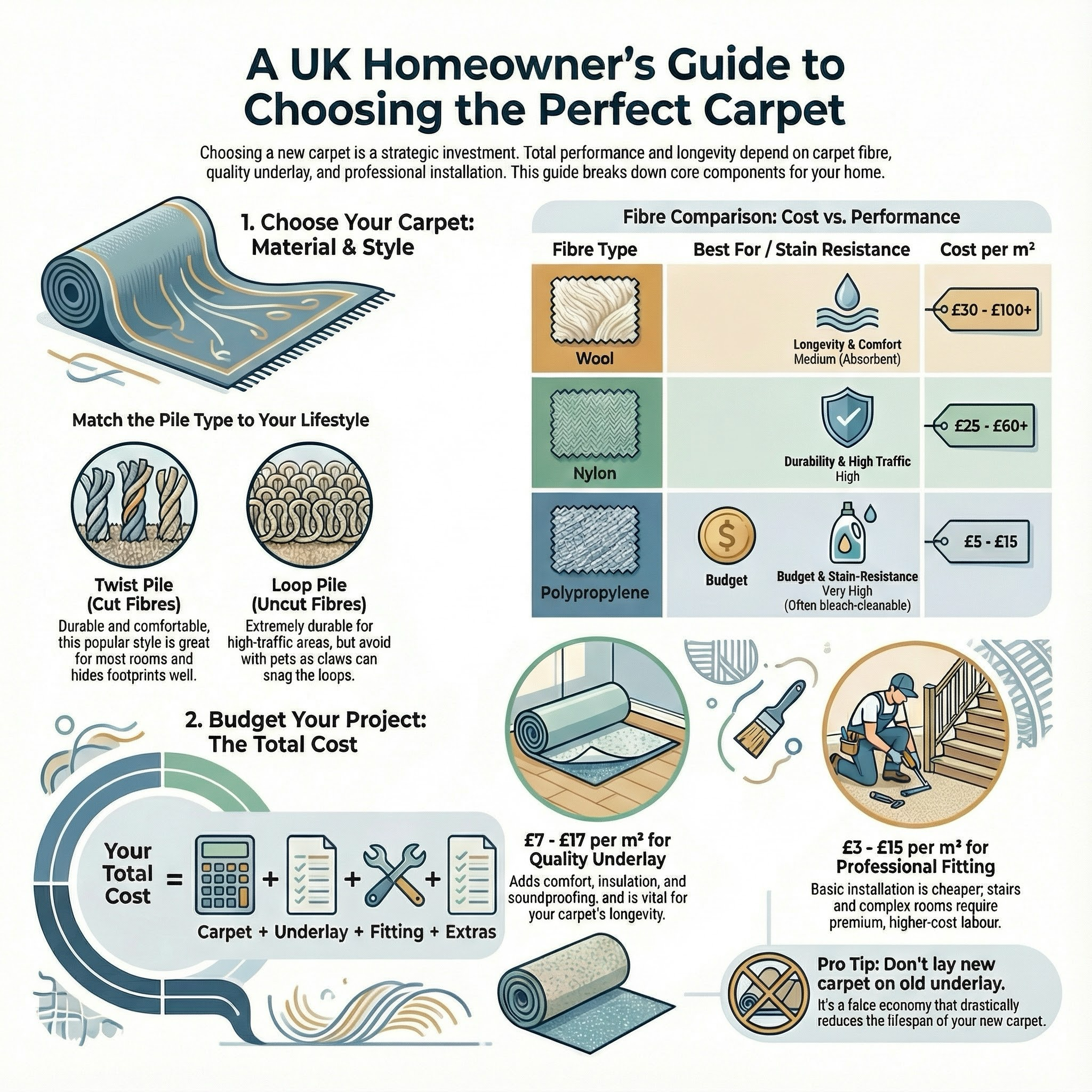
Carpets explained
A professional installation is about more than just clicking planks together; it ensures the subfloor is perfectly prepared and the necessary expansion gaps are maintained. This guide covers everything you need to know about the process, costs, and timelines for a high-quality finish in your home.
| Item | Low £ | High £ | Notes |
|---|---|---|---|
| Labour (Fitting Only) | £15 per m² | £25 per m² | Higher rates for herringbone patterns. |
| Mid-Range Laminate Planks | £12 per m² | £30 per m² | Based on 8mm to 12mm thickness. |
| Quality Underlay | £4 per m² | £8 per m² | Includes vapour barrier for concrete floors. |
| Scotia Beading & Door Bars | £5 per m | £12 per m | Matched to floor colour or white. |
| Subfloor Levelling | £150 | £400 | Per room if ply or compound is needed. |
Prices include VAT and are based on standard 2025 UK market rates. Total costs are heavily influenced by the "wastage" factor; always order 10% more material than the room's square footage to account for cuts.
While laminate is marketed as a DIY-friendly "click" product, the finish is only as good as the subfloor preparation. Professional installers have the specialist tools required to undercut door architraves, ensuring the floor sits under the frame rather than being cut awkwardly around it.
If you are installing over a concrete subfloor or in a flat where sound insulation is a legal requirement, hiring a professional is highly recommended to ensure compliance with UK building standards.
Only if you choose a specific "water-resistant" or "hydro" range. Standard laminate has a wood-fibre core that will swell and blow if exposed to standing water or high humidity.
Yes. Laminate expands and contracts with heat and humidity. If you fit it "cold" straight from a warehouse, it may expand once installed, causing the floor to buckle or peak.
No. Carpet is too soft and will cause the laminate joints to flex and eventually snap. All carpet and underlay must be removed to provide a solid, level base.
Most modern laminates are compatible, but you must check the manufacturer's "TOG" rating. You will also need a specific low-tog underlay designed to allow heat transfer.
Skirting is the board at the base of the wall. Scotia is a small concave trim used to cover the expansion gap if you don't want to remove your existing skirting boards.
This guide was written with AI assistance and is intended for general information only. Prices are estimates based on UK averages and may vary by region. Always get at least three quotes and consult a qualified professional before starting any work.
Ask follow-ups in plain English. The AI explains options, sequencing and what to ask the carpets — so you walk in informed.
New flooring is one of the most impactful upgrades you can make to a UK home. Beyond the immediate aesthetic boost, high-quality flooring improves insulation, r...
READ GUIDE →GuideInstalling new carpet is one of the most effective ways to instantly improve the comfort and insulation of your home. Whether you are opting for a durable wool-...
READ GUIDE →GuideFloor screeding is the process of applying a blended mixture of cement and graded sand (or a specialized liquid compound) to a structural concrete subfloor. For...
READ GUIDE →GuideModern vinyl flooring has evolved far beyond the basic "lino" of the past. Today, UK homeowners can choose from high-end sheet vinyl, Luxury Vinyl Tiles (LVT), ...
READ GUIDE →GuideRefinishing a wooden floor is one of the most effective ways to restore character and add significant value to a UK home. Whether you have discovered original V...
READ GUIDE →GuideWood floor restoration is one of the most effective ways to breathe new life into a UK home, especially for period properties with original pine or oak boards. ...
READ GUIDE →