Instant
01 · Ask
Ask the AI a follow-up
Got more questions about glass Internal Doors? Describe the bit you're unsure about — the AI explains options, sequencing and what to ask the doors.

Frameless, framed or pivot glass doors — for open-plan living rooms and feature spaces.
You've read the brief on glass Internal Doors. Now lean on us to find the right doors — and stay in control of the job.
Got more questions about glass Internal Doors? Describe the bit you're unsure about — the AI explains options, sequencing and what to ask the doors.
Costs, timelines, pitfalls and the right questions to ask before any doors starts on glass Internal Doors.
Itemised quotes from up to 3 local doorss on glass Internal Doors — so you can compare like-for-like, not lump sums.
Ready when you are
Enter your postcode and get free quotes from local pros.
Four moves that separate a smooth job from a nightmare.
Untrained fitters install toughened glass where laminated is required — this is a Building Regs breach and an insurance risk.
Heavy glass on standard butt hinges develops micro-cracks at the bolt holes within 1–2 years. Use pivot or quality flush hinges.
Chipped glass edges spread into stress fractures. Inspect all edges before signing off the install.
Glass doors between heated and unheated rooms (e.g. kitchen to porch) sweat on the cold face. Specify double-glazed glass for that scenario.
Indicative UK ranges and what affects price.
By job type
Quote spread is typically ± 18% — always get 3 quotes.
Doors quick-view
Doors explained
Glass internal doors maximise light flow between rooms — perfect for studies, kitchen-diners and dressing rooms. Options range from frosted single panes to crittall-style steel-framed pairs. Expect to pay £350–£2,400 fitted in the UK depending on style and frame.
Glass doors are heavier than timber (15–35 kg per leaf for single, 40–60 kg for crittall-style pairs). The lining must be reinforced — flush-fit hardware and pivot hinges spread the load better than standard butt hinges. Glass panels are P1A laminated safety glass (BS 6206) — they don't shatter into pebbles. The frame is either steel (crittall-style) or hardwood; frameless glass uses pivot hardware top and bottom mortised into the floor and ceiling.
| Item | Low (£) | High (£) | Notes |
|---|---|---|---|
| Frosted glass slab (single) | 200 | 500 | P1A safety glass, stock sizes |
| Clear glass slab with timber frame | 250 | 700 | Oak or walnut |
| Crittall-style single pane | 400 | 900 | Black steel, industrial look |
| Crittall-style French pair | 900 | 2,200 | Highly popular kitchen divider |
| Frameless pivot system | 800 | 1,800 | Floor and ceiling pivot bearings |
| Carpenter/glazier labour | 250 | 500 | Day rate, two-person lift |
Standard glass slab in existing lining: 4–6 hours. Crittall-style pair with new structural opening: 1–2 days. Frameless pivot system with mortised hardware: 1 day plus prep.
Professional. Heavy glass slabs require two fitters and a glass-suction lifter for safety. Pivot mortices must be cut dead plumb — a 3mm error and the door binds permanently. Crittall-style frames need shimming to within 1mm.
For crittall-style, use a fitter who has installed steel-framed glass doors before — they have specific tolerances. For frameless, use a glazier with architectural-glass experience. Always insist on P1A laminated safety glass; cheap toughened glass is illegal in any door panel under BS 6206.
Glazing in doors and side panels within 1500mm of finished floor level must be safety glass — P1A laminated to BS 6206 (Approved Document Part K). Toughened glass alone (Class A) is not sufficient where laminated is specified. Fire-rated glass doors (FD30) exist but require specific Pyrostop or Pyranova glass at 4–5x the cost.
Genuine Crittall is hot-rolled steel and very expensive. Most "crittall-style" UK doors are mild steel or aluminium painted matte black — they look identical at a fraction of the cost.
Frosted, reeded or stippled glass gives visual privacy while still letting light through. Switchable smart glass (electric privacy) exists but adds £800–£2,000 per leaf.
P1A laminated safety glass is required by Building Regs and will not shatter into shards even under impact. It's actually safer than a standard timber door in many ways — no splinters.
Single-pane glass doors leak sound. For acoustic isolation specify double-glazed glass doors (15–25mm overall thickness, two panes with an air gap) — acoustic rating 32 dB+.
Yes — FD30 glass doors using Pyrostop or Pyranova glass. Cost is 3–5x a standard glass door. Required only between a habitable room and integral garage, or some stair scenarios.
A single 838 × 1981mm 8mm laminated glass slab is roughly 30–35 kg. A double-glazed unit is closer to 50–60 kg. Always plan for a two-person lift.
This guide was written with AI assistance and is intended for general information only. Prices are estimates based on UK averages and may vary by region. Always get at least three quotes and consult a qualified professional before starting any work.
Ask follow-ups in plain English. The AI explains options, sequencing and what to ask the doors — so you walk in informed.
Internal doors: timber, glass, composite. UK 2026 install costs, sizing, and how to choose a fitter.
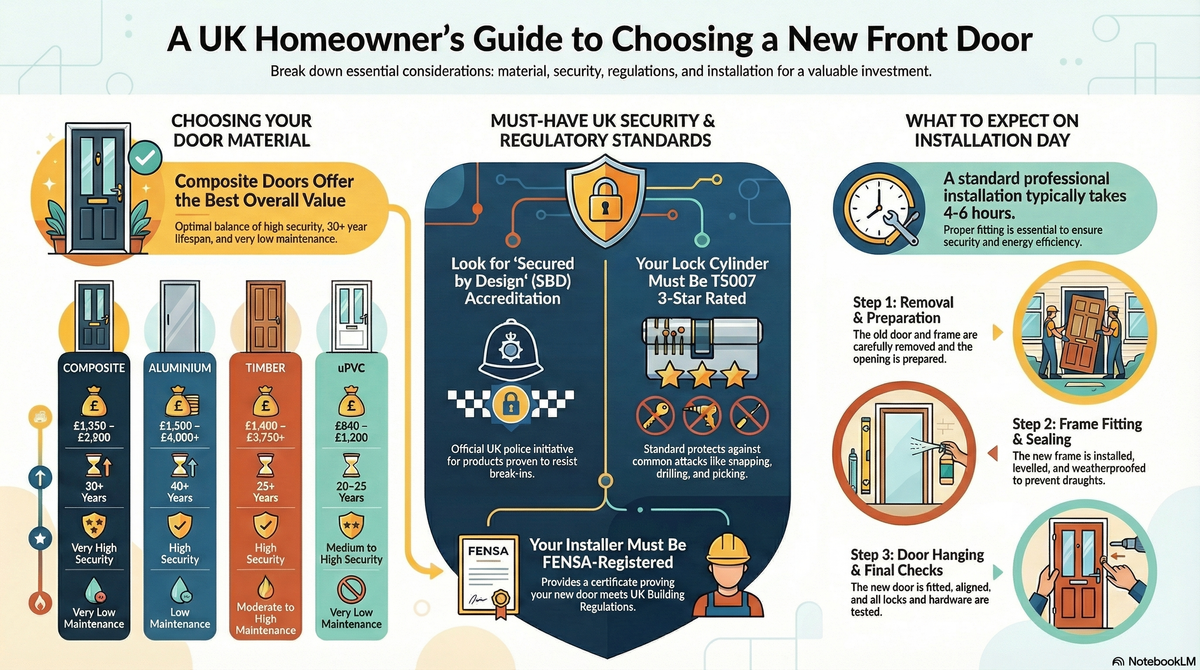
READ GUIDE →GuideFront doors UK 2026: composite, uPVC, timber, aluminium compared. Security, install costs, choose a fitter.
READ GUIDE →GuideComposite front doors: GRP skin, insulated core, multi-point locks. UK 2026 prices and brand comparison.
READ GUIDE →GuideuPVC front doors: budget-friendly options for UK homes. Costs, security, and when uPVC suits.
READ GUIDE →GuideTimber front doors: heritage character, premium look, full maintenance commitment. UK 2026 costs.
READ GUIDE →GuideAluminium front doors offer slim sightlines, modern aesthetics and long lifespans. UK costs, security, thermal performance and install.
READ GUIDE →