Instant
01 · Ask
Spot the warning signs
Buzzing fuse box, hot sockets, lights flickering when you boil the kettle. Describe it in plain English — the AI tells you if it's a 30-min fix or a rewire.

Part P-certified wiring, fuse-board upgrades, EV chargers and EICR reports — get 3 quotes in 60 seconds.
From a single dodgy socket to a full rewire — read the brief, then let Three local electricians quote.
Buzzing fuse box, hot sockets, lights flickering when you boil the kettle. Describe it in plain English — the AI tells you if it's a 30-min fix or a rewire.
Part P, EIC vs EICR, C1/C2/C3 ratings, when Building Control gets involved. Know the lingo before the quote arrives.
Up to Three local electricians come back with itemised quotes — call-out, materials, labour, certificate fee. No flat-rate guesses.
Ready when you are
Enter your postcode and get free quotes from local pros.
Four moves that separate a smooth job from a nightmare.
Part P electrical work must be certified by a registered electrician. NICEIC and NAPIT are the two big ones — verify online before they start.
Any new circuit or consumer unit change needs an Electrical Installation Certificate (EIC). Without it, you can't sell the house cleanly.
An Electrical Installation Condition Report on a house you're buying flags hidden rewire jobs. A C1 or C2 finding is a £2k–£8k negotiation lever.
Honest electricians lift a few floorboards before quoting a rewire. Anyone quoting a flat rate over the phone is guessing.
Indicative UK ranges and what affects price.
By job type
Quote spread is typically ± 18% — always get 3 quotes.
Visual breakdown of costs, timelines and the questions you should be asking.
Electrician quick-view
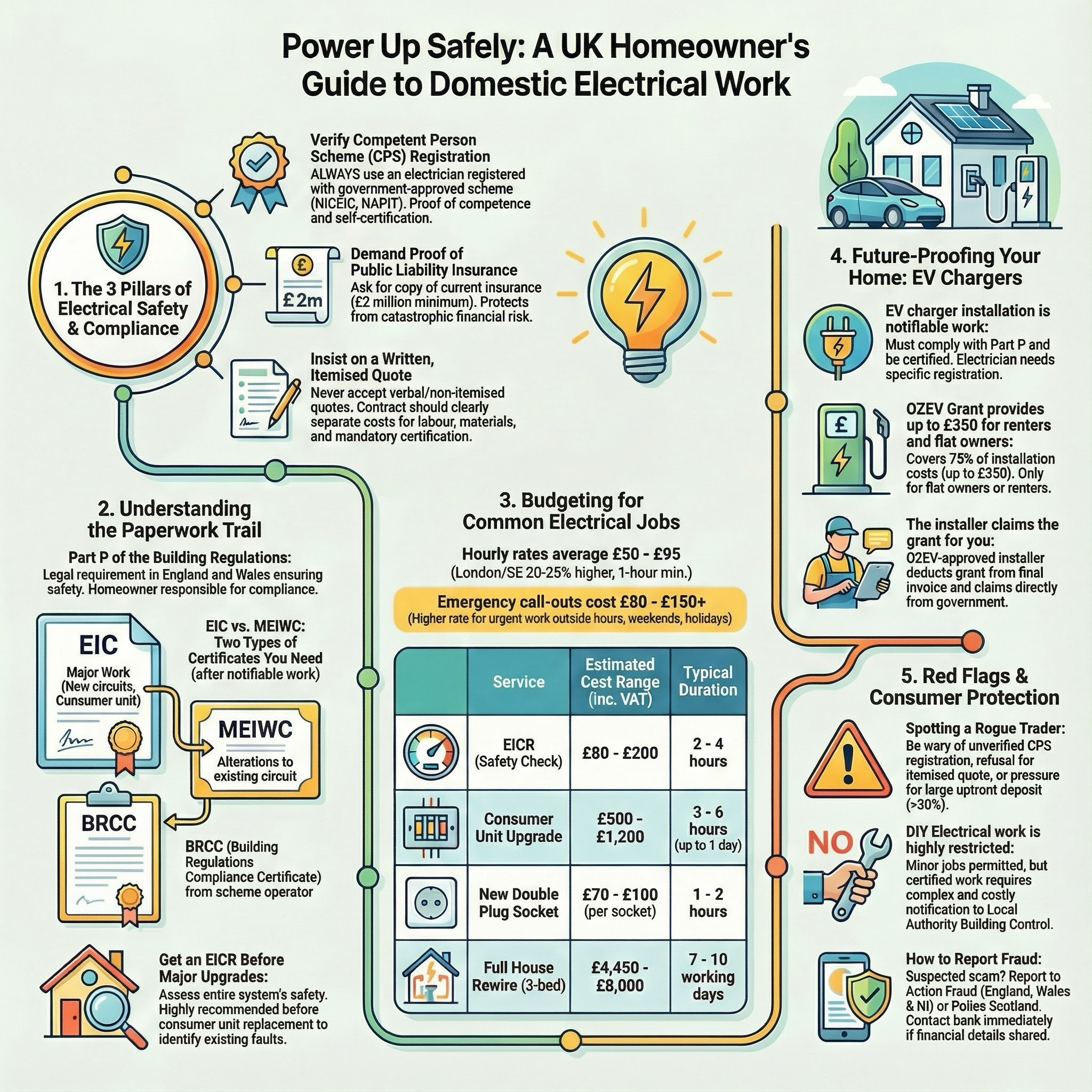
Electrician explained
Everything you need to know before hiring a electrician.
Electricians are the backbone of a safe and functional UK home. From the hidden wiring behind your walls to the smart lighting in your kitchen, these skilled professionals ensure your property meets modern power demands without compromising safety.
Whether you are renovating a period property, installing an electric vehicle (EV) charger, or simply need an extra socket in the home office, hiring a qualified electrician is essential. They deal with complex circuitry, high-voltage systems, and strict building regulations that keep your family safe from fire and electrical shocks.
In the UK, electrical work is strictly governed. Professional electricians don't just "fix things"; they design systems, calculate loads, and provide the legal certification required when you eventually come to sell your home.
Electricians offer a broad range of services catering to maintenance, upgrades, and new installations. Most projects follow a structured process to ensure safety and compliance.
When you hire a pro, the job usually starts with a site visit and a written quote. For larger jobs, they will manage the "first fix" (cabling) and "second fix" (fitting faceplates and lights), followed by rigorous testing and the issuance of a completion certificate.
Electrical work is one of the few areas of home improvement where DIY can be both illegal and lethal. In England and Wales, Part P of the Building Regulations dictates that most electrical work in dwellings must be carried out by a competent person.
Hiring a professional ensures that all work complies with BS 7671 (The IET Wiring Regulations). A registered electrician can self-certify their work and notify Local Authority Building Control on your behalf. This paperwork is vital; without it, you may find it impossible to sell your home or claim on your buildings insurance after a fire.
Professional electricians also possess expensive diagnostic equipment. They can find "invisible" faults, such as a neutral fault or a breakdown in cable insulation, that a homeowner simply cannot detect with basic tools.
Electrical pricing varies significantly based on your location in the UK and the age of your property's existing wiring. The table below provides realistic estimates for 2025/26.
| Service | Low £ | High £ | Notes |
|---|---|---|---|
| Double Socket Installation | £80 | £150 | Per socket, assuming easy access. |
| Replacement Consumer Unit | £450 | £950 | Includes full testing and certification. |
| EICR (3-Bedroom House) | £180 | £350 | Safety inspection only; repairs extra. |
| Full Rewire (3-Bedroom House) | £4,500 | £8,500 | Varies by finishes and wall types. |
| EV Charger Installation | £600 | £1,200 | Excluding any available government grants. |
| Electric Shower Circuit | £250 | £500 | Includes cabling and isolation switch. |
Cost Factors: Prices are influenced by the ease of access (lifting floorboards vs. surface mounting), your distance from the contractor, and whether your existing consumer unit has the capacity for new circuits.
Safety is paramount, so never choose an electrician based on price alone. Use this checklist to ensure you are hiring a qualified professional.
Questions to ask before hiring:
For owner-occupied homes, it is recommended to have an Electrical Installation Condition Report (EICR) carried out every 10 years. If you are a landlord, this is a legal requirement every 5 years or at the start of a new tenancy.
They serve the same purpose, but a 'fuse box' usually refers to older units with replaceable fuse wire. A modern 'consumer unit' uses circuit breakers and RCDs (Residual Current Devices) that provide much higher levels of protection against fire and electrocution.
Replacing a like-for-like light fitting or socket faceplate is generally considered non-notifiable work and doesn't require a formal certificate, though a "Minor Works" certificate is still best practice for your records.
A rewire involves chasing cables into walls, lifting floors, and drilling through joists. It is a major disruptive project that usually requires replastering and redecorating once the electrician has finished the "second fix."
Describe the job in plain English. The AI asks a few smart questions, then tells you whether a electrician is the right call, what it should cost, and what to ask before they start.
Part S EV charger Building Regs for new build UK.
READ GUIDE →GuideGeneral electrical work encompasses everything from minor repairs and socket additions to installing new circuits for home improvements. For UK homeowners, ensu...
READ GUIDE →GuideStandard plate, brushed steel, screw-less or smart dimmer switch swapped by an electrician — LED-compatible, tested.
READ GUIDE →GuideA payment meter, or prepayment meter, allows users to pay for electricity upfront via a key, card, or smart app. For UK homeowners and landlords, these are esse...
READ GUIDE →GuideSmart home wiring UK 2026. Future-proof install.
READ GUIDE →Updating your ceiling light fittings is one of the most effective ways to modernise a room and improve your home's energy efficiency. While it may seem like a s...
READ GUIDE →GuideUpgrading your ceiling lights is one of the most effective ways to transform the atmosphere of a UK home. Whether you are replacing a dated plastic pendant with...
READ GUIDE →GuideGarden lights, wall packs, PIR floods and CCTV-spotlights wired by a Part P electrician — IP-rated, switched and timer-set.
READ GUIDE →GuideUpgrading your home’s lighting and ensuring your doorbell is functional are two of the most common electrical tasks for UK homeowners. While they may seem like ...
READ GUIDE →GuideWhile many floor lamps are marketed as simple flat-pack items, high-end designer models, heavy arched lamps, and vintage restorations often require professional...
READ GUIDE →CU upgrade UK 2026. RCBO and surge protection.
READ GUIDE →GuideA blown fuse in your consumer unit (fuse box) is more than just a minor inconvenience; it is a safety mechanism designed to protect your home from electrical fi...
READ GUIDE →GuideUpgrading your fuseboard—now more accurately called a consumer unit—is one of the most significant safety improvements you can make to a UK home. Modern units d...
READ GUIDE →