Instant
01 · Ask
Ask the AI a follow-up
Got more questions about pocket Doors? Describe the bit you're unsure about — the AI explains options, sequencing and what to ask the doors.

Space-saving sliding doors that disappear into the wall — for tight bathrooms, en-suites and home offices.
You've read the brief on pocket Doors. Now lean on us to find the right doors — and stay in control of the job.
Got more questions about pocket Doors? Describe the bit you're unsure about — the AI explains options, sequencing and what to ask the doors.
Costs, timelines, pitfalls and the right questions to ask before any doors starts on pocket Doors.
Itemised quotes from up to 3 local doorss on pocket Doors — so you can compare like-for-like, not lump sums.
Ready when you are
Enter your postcode and get free quotes from local pros.
Four moves that separate a smooth job from a nightmare.
If the cassette twists during install, the door will bind. Always pack the cassette to the surrounding studs every 200mm.
The cassette's plasterboard cladding is fragile — bashed during plumbing or first fix, it dents into the door cavity.
You can't hang a heavy picture on a pocket-door wall — there's nothing behind the plasterboard skin. Mark the wall and warn the homeowner.
Standard cassettes take 40mm doors. Thicker slabs (45mm, 50mm) need the cassette specified at order.
Indicative UK ranges and what affects price.
By job type
Quote spread is typically ± 18% — always get 3 quotes.
Doors quick-view
Doors explained
Pocket doors slide into a hidden cassette inside the wall, giving a completely uninterrupted opening when open and a clean wall when closed. They free up swing space and look architectural. Expect to pay £900–£3,500 fitted in the UK including the cassette kit.
The pocket-door cassette is a factory-built steel-and-timber frame that gets built into a stud wall. In new construction it is straightforward — the carpenter cuts in the cassette during first fix, the plasterer dot-and-dabs over the metal cladding, and the door is hung at second fix. In retrofit, the existing wall is opened, studs cut, the cassette dropped in, the wall thickened to 120–130mm to accommodate it, and replastered and decorated. The door slab hangs on top-running ball-bearing wheels and slides into the cassette with a soft-close at the end of travel.
| Item | Low (£) | High (£) | Notes |
|---|---|---|---|
| Eclisse Classic kit (single) | 280 | 480 | UK best-seller |
| Coplan PD75 kit | 320 | 520 | Heavy-duty 100kg system |
| Double-pocket kit | 500 | 900 | Two doors meeting centrally |
| Door slab, supply | 180 | 700 | Stock or bespoke |
| Soft-close upgrade | 70 | 180 | Both ends of travel |
| Carpenter labour | 350 | 600 | One day on new build |
| Retrofit (wall opening + plaster) | 800 | 1,800 | 3–5 days total |
New-build first fix: one day. Retrofit: 3–5 days including plastering, drying time, and decoration.
Professional. The cassette has to be installed dead plumb, dead square, and packed against the surrounding studs so it doesn't move when the wall is plastered. A 2mm twist will leave the door binding in the wall — a problem that's near-impossible to fix without opening the wall back up.
Use a carpenter who has fitted Eclisse or Coplan systems before — they have specific tolerances and quirks (e.g. shimming the head rail before plastering). Ask to see previous work, including operating the door — it should glide silently with soft-close at both ends.
Pocket doors in load-bearing walls need a structural engineer's lintel calc. Standard pocket-door cassettes do NOT meet FD30 fire-door requirements; specific FD30-rated pocket cassettes exist but are 3–5x as expensive. Internal doors don't need building-regs notification otherwise.
Yes — but it adds 3–5 days of building work and £600–£1,500 to the cost. The wall thickness must be increased to 120–130mm.
No — there is no stud behind the plasterboard within the door's travel zone. You can hang lightweight pictures using No More Nails or 3M Command strips, but anything that needs a fixing must avoid the pocket zone.
With ball-bearing rollers and soft-close, yes — quieter, in fact, because they don't slam shut. Cheap systems with nylon rollers click and rattle.
Yes — flush-fit privacy locks (with an emergency coin-release outside) are standard. Hook bolts engage into a strike in the jamb.
Eclisse is the UK market leader — well-documented, easy to fit, sub 100kg doors. Coplan is heavier-duty (up to 200kg leaves) and used for full-height architectural slabs. Both have good warranty support.
Yes — double-pocket configurations give a 2.4m+ unobstructed opening. The two leaves meet at the centre with a soft-close strike between them.
This guide was written with AI assistance and is intended for general information only. Prices are estimates based on UK averages and may vary by region. Always get at least three quotes and consult a qualified professional before starting any work.
Ask follow-ups in plain English. The AI explains options, sequencing and what to ask the doors — so you walk in informed.
Internal doors: timber, glass, composite. UK 2026 install costs, sizing, and how to choose a fitter.
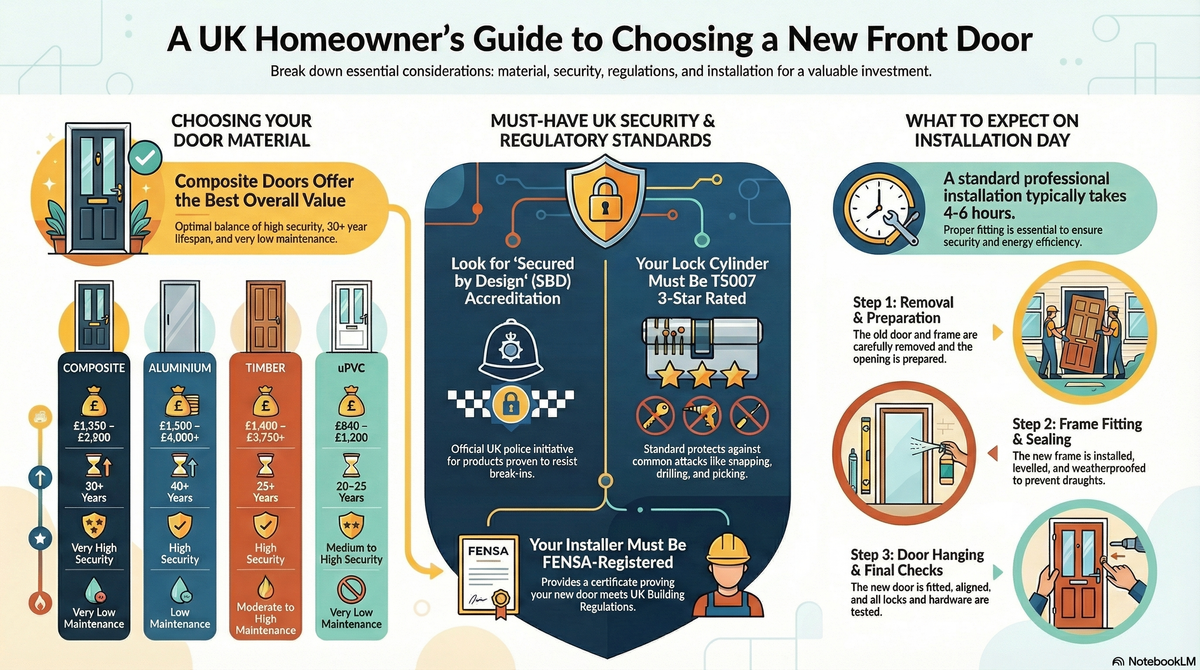
READ GUIDE →GuideFront doors UK 2026: composite, uPVC, timber, aluminium compared. Security, install costs, choose a fitter.
READ GUIDE →GuideComposite front doors: GRP skin, insulated core, multi-point locks. UK 2026 prices and brand comparison.
READ GUIDE →GuideuPVC front doors: budget-friendly options for UK homes. Costs, security, and when uPVC suits.
READ GUIDE →GuideTimber front doors: heritage character, premium look, full maintenance commitment. UK 2026 costs.
READ GUIDE →GuideAluminium front doors offer slim sightlines, modern aesthetics and long lifespans. UK costs, security, thermal performance and install.
READ GUIDE →