Instant
01 · Ask
Ask the AI a follow-up
Got more questions about solid Oak Internal Doors? Describe the bit you're unsure about — the AI explains options, sequencing and what to ask the doors.

Real oak internal doors — pre-finished or unfinished, fitted to clean reveals.
You've read the brief on solid Oak Internal Doors. Now lean on us to find the right doors — and stay in control of the job.
Got more questions about solid Oak Internal Doors? Describe the bit you're unsure about — the AI explains options, sequencing and what to ask the doors.
Costs, timelines, pitfalls and the right questions to ask before any doors starts on solid Oak Internal Doors.
Itemised quotes from up to 3 local doorss on solid Oak Internal Doors — so you can compare like-for-like, not lump sums.
Ready when you are
Enter your postcode and get free quotes from local pros.
Four moves that separate a smooth job from a nightmare.
Solid oak swells in summer humidity and shrinks in winter. Leave wider clearances (4mm sides, 8mm bottom) than for veneered doors.
Cheap pre-finishes flake off in 3–5 years. Re-oil quality timber every 2 years with hardwax oil.
True solid oak can twist 5–10mm out of plane. Inspect every door on delivery before paying.
Brass-effect aluminium handles look fake against quality oak. Spend £30–£60 on real solid brass or satin nickel handles.
Indicative UK ranges and what affects price.
By job type
Quote spread is typically ± 18% — always get 3 quotes.
Doors quick-view
Doors explained
Solid oak internal doors are the British gold standard for warmth, weight, and acoustic performance. A whole-house upgrade is one of the biggest perceived quality jumps a homeowner can make. Expect to pay £150–£700 per door fitted in the UK depending on grade, glazing and finish.
"Solid oak" can mean different things — true solid oak slabs (very expensive, prone to warping), engineered oak (oak laminations on a stable core, the modern standard), or oak veneer (a thin oak skin on MDF). The fitting process is identical to any internal door: measure the lining, plane the slab to fit (3mm clearance per side), hang on three hinges, fit the latch, attach handles, and trim the bottom for floor finish clearance.
| Item | Low (£) | High (£) | Notes |
|---|---|---|---|
| Oak veneer slab, supply | 60 | 140 | MDF core, oak skin, paint-grade hardware |
| Engineered oak slab, supply | 110 | 280 | True oak, laminated, dimensionally stable |
| Solid oak slab, supply | 200 | 550 | Heavy, prone to seasonal movement |
| Hardware (hinges, latch, handles) | 20 | 120 | Brass, satin nickel, antique |
| Carpenter labour per door | 60 | 180 | 2–3 hours each on bulk fit |
| Whole-house fit (10 doors) | 1,400 | 4,500 | Stock pine to engineered oak |
A single oak door swap in an existing lining is 2–3 hours. A whole house (10 doors) takes 2–3 days with one carpenter, or 1–2 days with two.
A confident DIYer can swap a door in an existing lining. Whole-house fits are usually faster and more consistent with a carpenter — and the offcuts to plane down for fitting take experience to get straight.
Use a carpenter, not a general handyman — oak doors are heavy (25–35 kg) and the bevels and clearances need experience. Ask to see previous oak door installs. Confirm whether they include hanging, fitting handles, and trimming carpet clearance in the price.
Internal doors don't need notification. Fire doors (FD30) are required between a habitable room and an integral garage, or between a third-storey habitable room and the stair — oak FD30 doors exist but are 2–3x the cost.
Engineered oak is what most experienced fitters specify — it has the look and weight of solid oak but won't twist or swell as much. True solid oak is for character properties or where customers specifically want the heritage feel.
Yes — they weigh roughly double. The mass-law of acoustics means an oak door rates 27–30 dB versus 22–24 dB for pine hollow-core.
Indirectly — the perceived warmth is mostly visual and tactile. Thermally, an internal door is not a significant heat-loss element.
Hardwax oil (Osmo, Fiddes) gives a natural matte finish, easy to maintain and patch. Polyurethane lacquer gives a glossier, harder finish but is hard to re-coat without sanding.
For convenience, yes — they arrive ready to hang. But the factory pre-finish is harder to repair when scratched. For long-term maintainability, raw doors hand-oiled on site are easier to refresh.
Yes — Fiddes Hard Wax Oil comes in dark walnut, smoked oak, antique and other shades. Always test on an offcut first.
This guide was written with AI assistance and is intended for general information only. Prices are estimates based on UK averages and may vary by region. Always get at least three quotes and consult a qualified professional before starting any work.
Ask follow-ups in plain English. The AI explains options, sequencing and what to ask the doors — so you walk in informed.
Internal doors: timber, glass, composite. UK 2026 install costs, sizing, and how to choose a fitter.
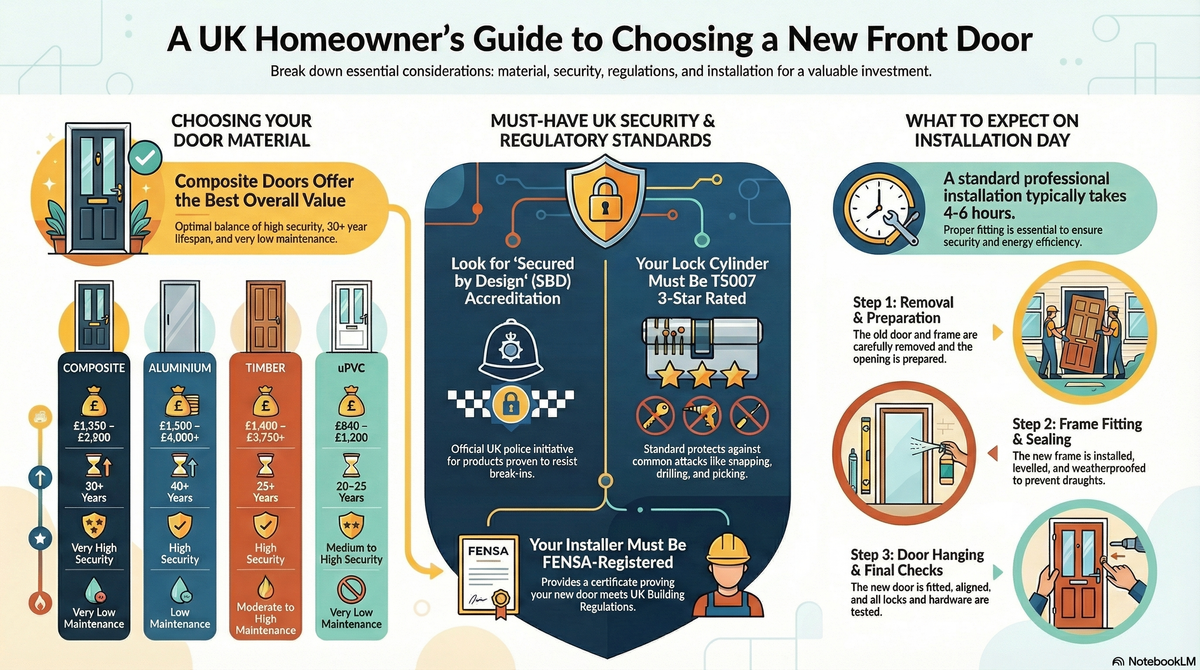
READ GUIDE →GuideFront doors UK 2026: composite, uPVC, timber, aluminium compared. Security, install costs, choose a fitter.
READ GUIDE →GuideComposite front doors: GRP skin, insulated core, multi-point locks. UK 2026 prices and brand comparison.
READ GUIDE →GuideuPVC front doors: budget-friendly options for UK homes. Costs, security, and when uPVC suits.
READ GUIDE →GuideTimber front doors: heritage character, premium look, full maintenance commitment. UK 2026 costs.
READ GUIDE →GuideAluminium front doors offer slim sightlines, modern aesthetics and long lifespans. UK costs, security, thermal performance and install.
READ GUIDE →