Instant
01 · Ask
Ask the AI a follow-up
Got more questions about stable Doors? Describe the bit you're unsure about — the AI explains options, sequencing and what to ask the doors.

Split top and bottom — for back gardens, kitchens or rural cottages. Hardwood, uPVC or composite.
You've read the brief on stable Doors. Now lean on us to find the right doors — and stay in control of the job.
Got more questions about stable Doors? Describe the bit you're unsure about — the AI explains options, sequencing and what to ask the doors.
Costs, timelines, pitfalls and the right questions to ask before any doors starts on stable Doors.
Itemised quotes from up to 3 local doorss on stable Doors — so you can compare like-for-like, not lump sums.
Ready when you are
Enter your postcode and get free quotes from local pros.
Four moves that separate a smooth job from a nightmare.
A wrong-way-round chamfer lets rain run into the house. The meeting profile should overhang outward.
The bottom half takes the full weight; if the top half is opened against the bottom, the hinges stress. Always fit a meeting-bolt to use both halves as one.
An open top half is an invitation. Some homeowners fit a fly screen on the top section.
Roller-ball catches wear in 1–2 years. Fit a quality magnetic catch and meeting-bolt.
Indicative UK ranges and what affects price.
By job type
Quote spread is typically ± 18% — always get 3 quotes.
Doors quick-view
Doors explained
Stable doors split horizontally — the top opens independently of the bottom — letting in air without letting in pets, children or a postman wandering through. They are the cottage-style back-door classic and a popular choice for utility rooms, garden rooms and family homes with toddlers. Expect to pay £600–£2,500 fitted in the UK depending on material and glazing.
A stable door is essentially two half-doors hinged independently, joined by a meeting rail with a quadrant or chamfered weather profile to keep rain out. The frame is installed like a standard external door — measured, ordered to size, bedded plumb, mechanically fixed, foam-insulated. Each half hangs on two hinges. The bottom half has a multi-point lock; the top half has a sliding-bolt or independent latch. A bolt joins the two halves so they can be operated as a single door.
| Item | Low (£) | High (£) | Notes |
|---|---|---|---|
| uPVC stable door, supply | 500 | 900 | White, glazed top half |
| Composite stable door, supply | 900 | 1,800 | Multi-point lock, foam core |
| Hardwood stable door, supply | 1,200 | 2,800 | Engineered oak or accoya, factory-finished |
| Lining/frame | 120 | 320 | Matched to door |
| Installation labour | 300 | 600 | Day rate, two fitters |
| Old door removal | 50 | 150 | uPVC/composite recyclable |
Single stable door swap with existing frame size: 4–6 hours. Frame replacement: full day. Lead times for stock white uPVC are 2–4 weeks; bespoke RAL hardwood is 8–12 weeks.
Professional for the FENSA/Certass certificate and to get the meeting-rail weather profile right. The meeting rail must be planed in the right direction so rain runs off — get it wrong and water sits between the leaves.
Use a FENSA or Certass registered installer. Ask the brand — Solidor, GRP composite makers, and Endurance offer composite stable doors; Ironmongery Direct and Heritage Doors do hardwood. Insist on stainless or brass hardware — galvanised steel rusts within 5 years on a coastal property.
External replacement doors must meet Part L (U-value ≤1.4 W/m²K). Listed buildings need consent for any change in external appearance. FENSA or Certass registration self-certifies the install. Glazing in the top half must be safety glass to BS 6206 if within 800mm of finished floor level.
Yes — when both halves are locked together. The bottom half has a multi-point lock; the meeting bolt secures the top to the bottom. Specify PAS 24:2022 certified units and a 3-star Sold Secure cylinder.
If it's chucking down, yes — rain blowing horizontally will get past any open door. The meeting rail is engineered to seal when both halves are closed.
Yes — composite and hardwood stable doors achieve U-values of 1.2–1.4 W/m²K which is fully Building Regs compliant. The double thickness at the meeting rail actually helps.
Yes — in the bottom half, ordered with the cat flap pre-fitted at the factory. Retro-cutting voids the warranty.
For low maintenance and good security, composite. For heritage and cottage aesthetic, hardwood (accoya is the most durable). uPVC is the cheapest but the meeting rail profile tends to be plasticky.
That's the classic configuration. Top glazed for light and view, bottom solid for security and privacy.
This guide was written with AI assistance and is intended for general information only. Prices are estimates based on UK averages and may vary by region. Always get at least three quotes and consult a qualified professional before starting any work.
Ask follow-ups in plain English. The AI explains options, sequencing and what to ask the doors — so you walk in informed.
Internal doors: timber, glass, composite. UK 2026 install costs, sizing, and how to choose a fitter.
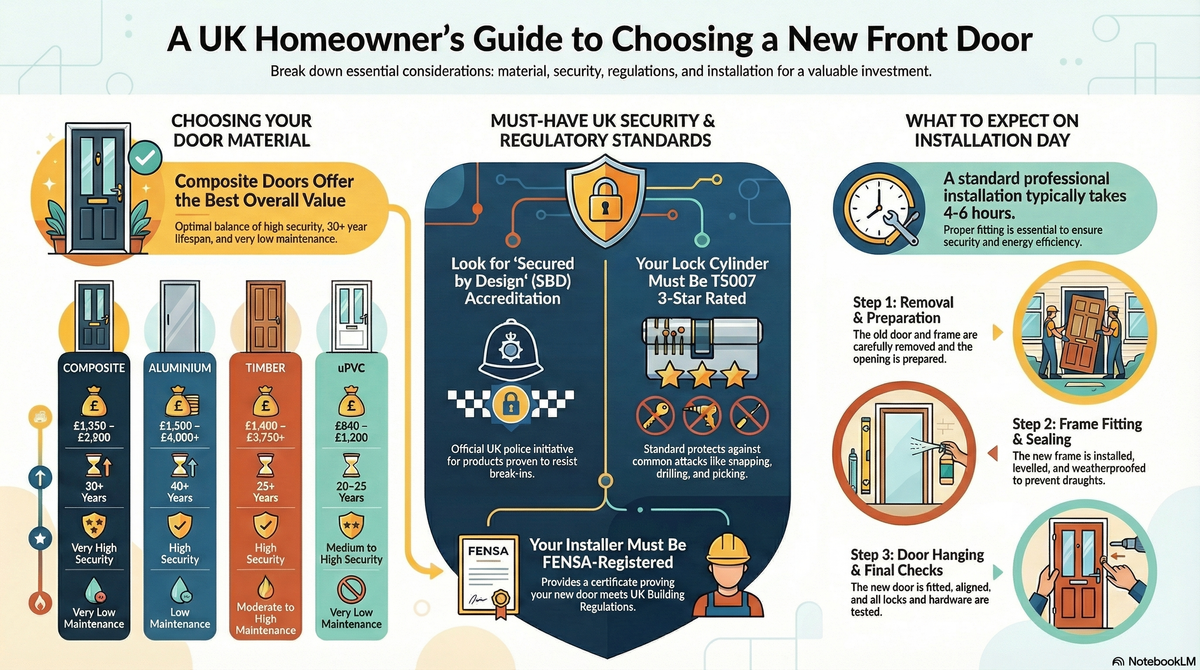
READ GUIDE →GuideFront doors UK 2026: composite, uPVC, timber, aluminium compared. Security, install costs, choose a fitter.
READ GUIDE →GuideComposite front doors: GRP skin, insulated core, multi-point locks. UK 2026 prices and brand comparison.
READ GUIDE →GuideuPVC front doors: budget-friendly options for UK homes. Costs, security, and when uPVC suits.
READ GUIDE →GuideTimber front doors: heritage character, premium look, full maintenance commitment. UK 2026 costs.
READ GUIDE →GuideAluminium front doors offer slim sightlines, modern aesthetics and long lifespans. UK costs, security, thermal performance and install.
READ GUIDE →