Instant
01 · Ask
Spot the warning signs
Buzzing fuse box, hot sockets, lights flickering when you boil the kettle. Describe it in plain English — the AI tells you if it's a 30-min fix or a rewire.

BS 5266-compliant emergency lighting — commercial spaces, HMOs, escape routes and stairs.
From a single dodgy socket to a full rewire — read the brief, then let Three local electricians quote.
Buzzing fuse box, hot sockets, lights flickering when you boil the kettle. Describe it in plain English — the AI tells you if it's a 30-min fix or a rewire.
Part P, EIC vs EICR, C1/C2/C3 ratings, when Building Control gets involved. Know the lingo before the quote arrives.
Up to Three local electricians come back with itemised quotes — call-out, materials, labour, certificate fee. No flat-rate guesses.
Ready when you are
Enter your postcode and get free quotes from local pros.
Four moves that separate a smooth job from a nightmare.
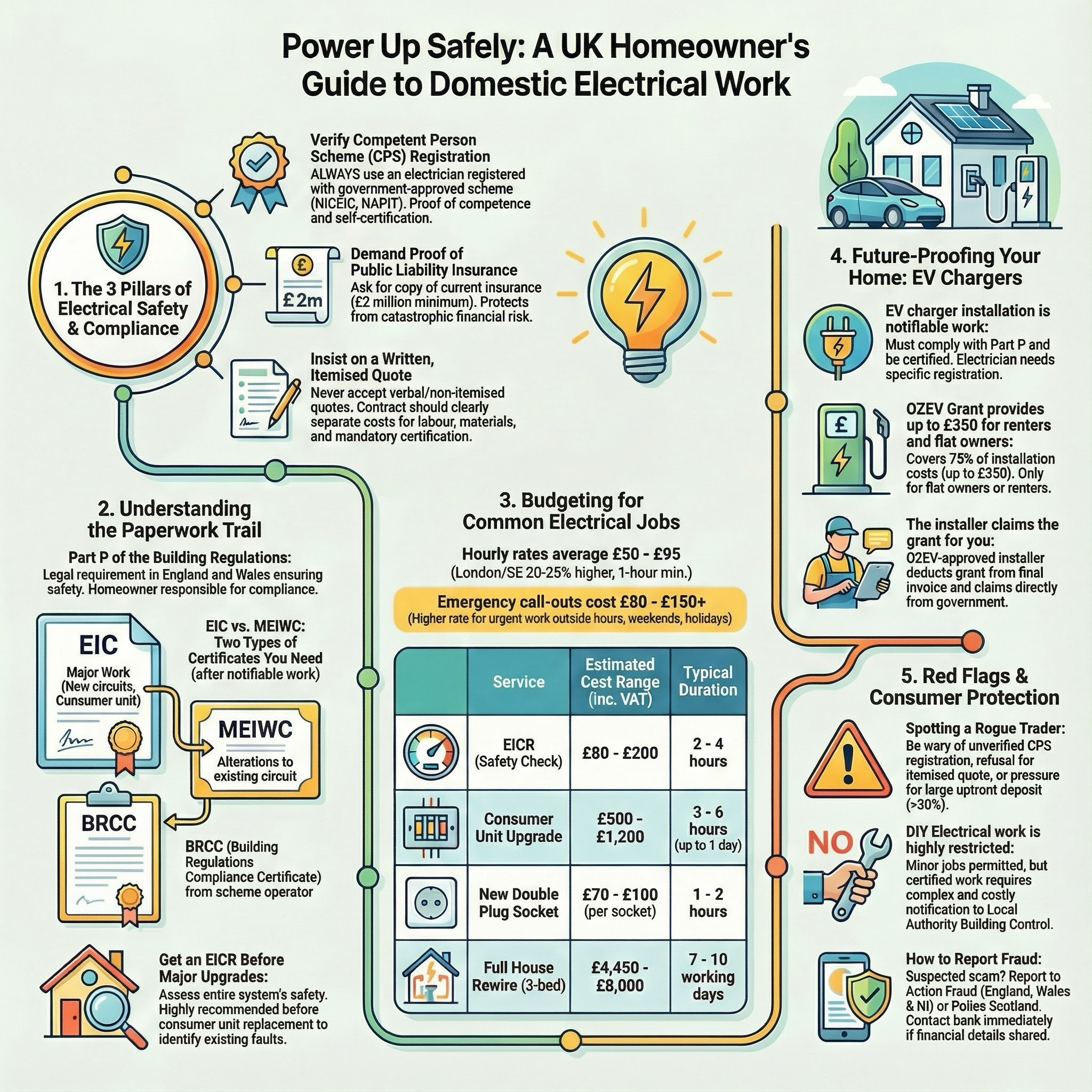
Part P electrical work must be certified by a registered electrician. NICEIC and NAPIT are the two big ones — verify online before they start.
Any new circuit or consumer unit change needs an Electrical Installation Certificate (EIC). Without it, you can't sell the house cleanly.
An Electrical Installation Condition Report on a house you're buying flags hidden rewire jobs. A C1 or C2 finding is a £2k–£8k negotiation lever.
Honest electricians lift a few floorboards before quoting a rewire. Anyone quoting a flat rate over the phone is guessing.
Indicative UK ranges and what affects price.
By job type
Quote spread is typically ± 18% — always get 3 quotes.
Electrician quick-view
Electrician explained
Emergency lighting — the lights that come on automatically when mains power fails — is mandatory in workplaces, HMOs, blocks of flats, and almost any non-residential building in the UK. Domestic single-family homes don't need it, but commercial premises do. Typical installation cost runs £600–£3,500 for a small commercial unit, depending on size and the number of fittings required.
The system is regulated by BS 5266-1 and the Building Regulations Approved Document B. It's notifiable work under Part P (in dwellings) and is part of the Fire Safety Order's risk-assessment scope for commercial buildings.
Emergency lighting comes in two functional categories:
Both must operate for at least 1 hour (3 hours in higher-risk premises like HMOs and care homes) on battery backup once mains fails.
| Project | Typical price |
|---|---|
| Single emergency LED bulkhead (supplied + fitted) | £90–£180 |
| Maintained "EXIT" sign | £100–£200 |
| Small office / shop (5–8 fittings) | £700–£1,400 |
| Medium commercial (15–25 fittings) | £1,400–£3,200 |
| HMO common parts (4–8 fittings) | £600–£1,400 |
| Annual test + 3-year discharge test (small site) | £100–£250 |
| Battery replacement (per fitting) | £25–£60 |
Two ways to power emergency fittings:
BS 5266-1 requires:
Failure to maintain emergency lighting is one of the most common Fire Safety Order non-compliances flagged in HMO inspections.
For a single-family dwelling, no — domestic homes are exempt from emergency lighting requirements. HMOs (3 or more unrelated occupants), small blocks of flats, and any commercial premises are required to have it.
Monthly short test (verify each fitting illuminates), annual full-duration discharge test (typically 3 hours). Both must be logged. Self-test fittings handle this automatically and report failures to a central panel.
The landlord, in any property under the Fire Safety Order or HMO licensing — including blocks of flats, HMOs, and any premises let to more than one household. A tenant raising concerns about emergency lighting failure can trigger a fire authority inspection.
Yes — most retrofits use self-contained LED fittings powered from the local lighting circuit, with internal batteries. Cabling is straightforward in most ceiling voids. Allow 1–3 days for a typical small commercial retrofit.
They share the local lighting circuit fuse — but the wiring needs to be configured so that the fittings' batteries charge from the unswitched (live) side of the circuit, not the switched side. A specialist will wire this correctly; a non-emergency-trained electrician sometimes wires it wrong.
Escape lighting is a subset of emergency lighting — the part that illuminates the route out of the building. Emergency lighting also covers anti-panic open-area lighting, high-risk task lighting (e.g., over machinery that needs safe shut-down), and standby lighting (for continued normal operation if appropriate).
Want a local pro to handle this? An electrician with emergency lighting and BS 5266 experience is the right call — many general electricians don't carry the right certification for system handover. Ask to see a recent example installation and the certification provided to the client.
This guide was written with AI assistance and is intended for general information only. Prices are estimates based on UK averages and may vary by region. Always get at least three quotes and consult a qualified professional before starting any work.
Ask follow-ups in plain English. The AI explains options, sequencing and what to ask the electrician — so you walk in informed.
A full house rewire or a consumer unit (fuse box) upgrade is one of the most critical safety investments a UK homeowner can make. As our reliance on electrical ...
READ GUIDE →GuideWhile many floor lamps are marketed as simple flat-pack items, high-end designer models, heavy arched lamps, and vintage restorations often require professional...
READ GUIDE →GuideGeneral electrical work encompasses everything from minor repairs and socket additions to installing new circuits for home improvements. For UK homeowners, ensu...
READ GUIDE →GuideElectric boilers are an increasingly popular choice for UK homeowners, particularly in modern flats or properties without a mains gas connection. While they are...
READ GUIDE →GuideReplacing a bathroom light switch is a common home improvement task that balances aesthetics with vital safety requirements. Given the high levels of moisture a...
READ GUIDE →GuideA blown fuse in your consumer unit (fuse box) is more than just a minor inconvenience; it is a safety mechanism designed to protect your home from electrical fi...
READ GUIDE →