Instant
01 · Ask
Ask the AI a follow-up
Got more questions about house rewiring and fuse box replacement? Describe the bit you're unsure about — the AI explains options, sequencing and what to ask the electrician.

Whole-house rewire plus new consumer unit — partial or full, with EICR and full certification.
You've read the brief on house rewiring and fuse box replacement. Now lean on us to find the right electrician — and stay in control of the job.
Got more questions about house rewiring and fuse box replacement? Describe the bit you're unsure about — the AI explains options, sequencing and what to ask the electrician.
Costs, timelines, pitfalls and the right questions to ask before any electrician starts on house rewiring and fuse box replacement.
Itemised quotes from up to 3 local electricians on house rewiring and fuse box replacement — so you can compare like-for-like, not lump sums.
Ready when you are
Enter your postcode and get free quotes from local pros.
Four moves that separate a smooth job from a nightmare.
Older properties may have asbestos in textured ceiling coatings (Artex) or floor tiles, which must be professionally tested before chasing or drilling.
Victorian or Edwardian tongue-and-groove boards are prone to splintering when lifted; factor in potential repairs.
Old, inaccessible junction boxes under floors can make "partial" rewires difficult and may necessitate a full rewire.
Rewiring is invasive. Unless "surface mounting" (which looks untidy), expect significant dust and the need for full redecoration.
Indicative UK ranges and what affects price.
By job type
Quote spread is typically ± 18% — always get 3 quotes.
Electrician quick-view
Electrician explained
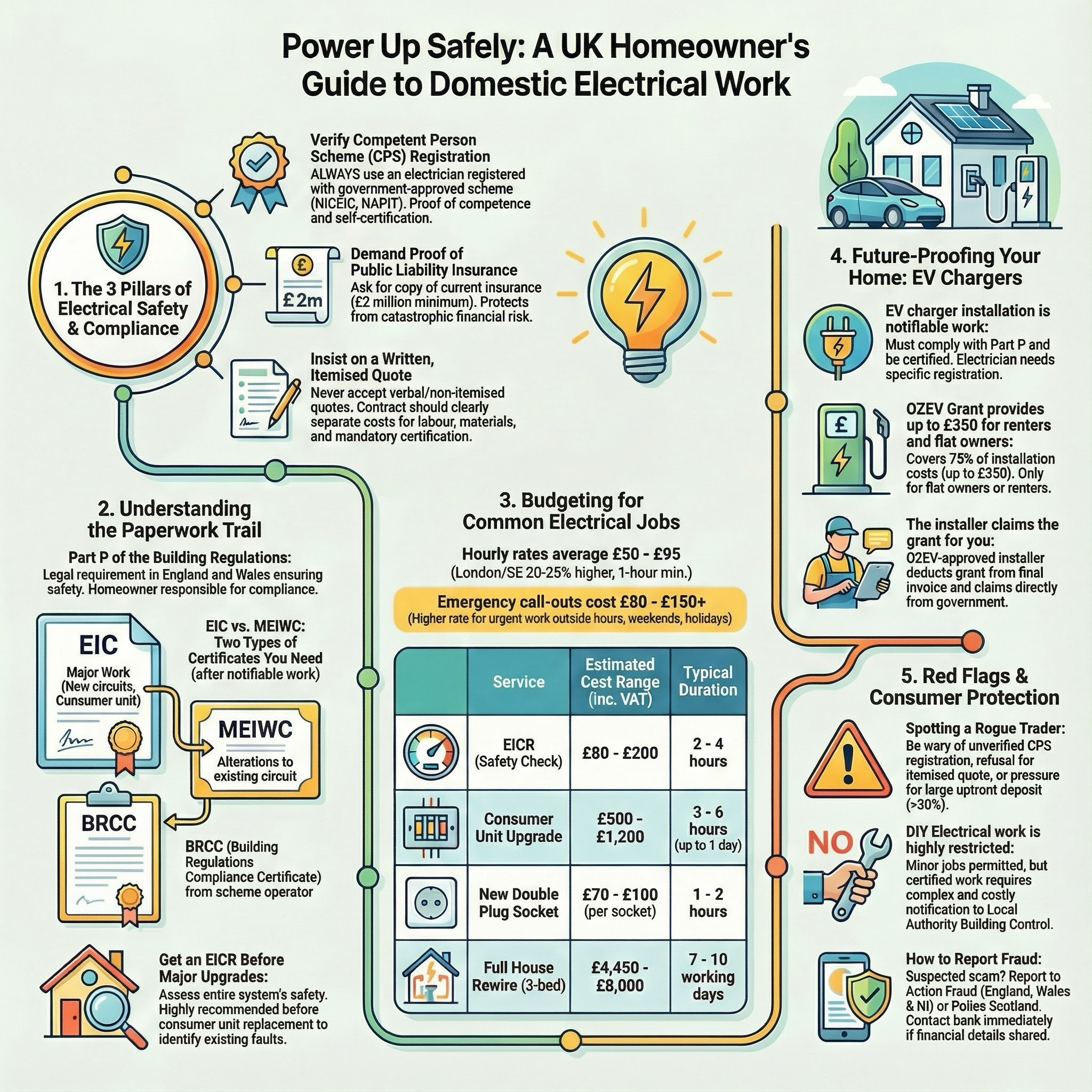
Whether you are renovating a Victorian terrace or simply updating an ageing 1970s system, modernising your electrics ensures your home meets current BS 7671 safety standards. This guide outlines what to expect regarding costs, timelines, and essential regulations.
| Item | Low £ | High £ | Notes |
|---|---|---|---|
| Consumer Unit Upgrade | £450 | £950 | Includes materials, labour, and certification. |
| 1-Bedroom Flat Rewire | £2,800 | £4,500 | Assuming the property is empty during works. |
| 3-Bedroom Semi-Detached Rewire | £4,500 | £7,500 | Costs rise if the property is occupied. |
| 4+ Bedroom Detached Rewire | £7,500 | £12,000+ | Complex layouts and high-spec fittings. |
| EICR (Initial Inspection) | £150 | £350 | Depending on the size of the property. |
Pricing is primarily driven by the size of the property and whether it is occupied. Working around furniture and residents significantly increases labour time, while high-end decorative sockets and smart home integrations will push material costs toward the higher end of the scale.
House rewiring is not a DIY project. In England and Wales, major electrical work is "notifiable" under Part P of the Building Regulations, meaning it must be carried out by a competent person who can self-certify the work.
Attempting to rewire a property yourself is not only extremely dangerous but can also invalidate your home insurance and make it impossible to sell the property in the future without a valid Electrical Installation Certificate.
Questions to ask:
You don't have to, but it is highly recommended. The process is extremely dusty, noisy, and involves lifting floorboards in every room. If you stay, the electrician will have to reinstate power every evening, which adds significant labour costs.
Most electrical installations have a lifespan of 25 to 30 years. If your home hasn't been touched since the 1990s, or if you still have a wooden-backed fuse box, it is time for an inspection.
A Residual Current Device (RCD) is a life-saving switch that trips the circuit in milliseconds if it detects a leak to earth (e.g., if you cut through a cable with a hedge trimmer). Modern consumer units use RCBOs to ensure that a fault in one circuit doesn't lose power to the whole house.
Usually, no. Most electricians will "patch" with a base coat of plaster (bonding), but few include a professional finish. Always clarify this in your quote to avoid unexpected costs for a plasterer.
Yes, but only if the existing wiring is in good condition. An electrician will perform an EICR first; if the old wires are crumbling or lack an earth, a new consumer unit will simply keep tripping, making a rewire necessary.
This guide was written with AI assistance and is intended for general information only. Prices are estimates based on UK averages and may vary by region. Always get at least three quotes and consult a qualified professional before starting any work.
Ask follow-ups in plain English. The AI explains options, sequencing and what to ask the electrician — so you walk in informed.
What Is Emergency Lighting? Emergency lighting is a safety system designed to illuminate escape routes, exits, and high-risk areas when the normal mains power f...
READ GUIDE →GuideWhile many floor lamps are marketed as simple flat-pack items, high-end designer models, heavy arched lamps, and vintage restorations often require professional...
READ GUIDE →GuideGeneral electrical work encompasses everything from minor repairs and socket additions to installing new circuits for home improvements. For UK homeowners, ensu...
READ GUIDE →GuideElectric boilers are an increasingly popular choice for UK homeowners, particularly in modern flats or properties without a mains gas connection. While they are...
READ GUIDE →GuideReplacing a bathroom light switch is a common home improvement task that balances aesthetics with vital safety requirements. Given the high levels of moisture a...
READ GUIDE →GuideA blown fuse in your consumer unit (fuse box) is more than just a minor inconvenience; it is a safety mechanism designed to protect your home from electrical fi...
READ GUIDE →