Instant
01 · Ask
Ask the AI a follow-up
Got more questions about ePC certificate? Describe the bit you're unsure about — the AI explains options, sequencing and what to ask the epc assessor.

Energy Performance Certificate by an accredited assessor — lodged with the government register.
You've read the brief on ePC certificate. Now lean on us to find the right epc assessor — and stay in control of the job.
Got more questions about ePC certificate? Describe the bit you're unsure about — the AI explains options, sequencing and what to ask the epc assessor.
Costs, timelines, pitfalls and the right questions to ask before any epc assessor starts on ePC certificate.
Itemised quotes from up to 3 local epc assessors on ePC certificate — so you can compare like-for-like, not lump sums.
Ready when you are
Enter your postcode and get free quotes from local pros.
Four moves that separate a smooth job from a nightmare.
If the assessor cannot see the insulation, they must enter "unknown," which defaults to a "worst-case" poor rating.
Without building regs certificates for extensions or new windows, the software assumes they meet the minimum standards of the year the house was built, which may be lower than reality.
Assessors must see the boiler's data plate; if they can't access the room, the assessment cannot be completed.
Portable electric heaters are ignored; the software assumes you use expensive peak-rate electricity if no fixed heating is found.
Indicative UK ranges and what affects price.
By job type
Quote spread is typically ± 18% — always get 3 quotes.
EPC Assessor quick-view
EPC Assessor explained
For homeowners, a high rating not only makes a property more attractive to buyers but is also essential for landlords to meet Minimum Energy Efficiency Standards (MEES). The assessment identifies where heat is being lost and offers a roadmap for reducing energy bills through targeted improvements.
| Property Type | Low £ | High £ | Notes |
|---|---|---|---|
| Studio or 1-Bed Flat | £60 | £85 | Simple layout; minimal rooms to survey. |
| 3-Bed Semi-Detached | £85 | £120 | Includes loft and multiple floor levels. |
| Large Detached (4+ Beds) | £120 | £180+ | Increased time for measurements and extensions. |
| Commercial EPC | £200 | £1,000+ | Based on square footage and complexity. |
Prices vary based on your location and the size of the property. While some estate agents offer EPCs as part of a package, booking directly with a local Domestic Energy Assessor (DEA) is often significantly cheaper.
You cannot produce a legal EPC yourself. In the UK, an EPC must be carried out by an accredited Domestic Energy Assessor (DEA) to be valid for property transactions.
While you cannot perform the assessment, you can "prep" the property by ensuring the assessor has access to the loft and any documentation for works that aren't visible, such as underfloor insulation or cavity wall fill.
Key Question: "Are you a direct assessor or an agency? Booking direct usually saves £20–£40 in commission fees."
Only if your current certificate is more than 10 years old or if you have made significant energy-saving improvements that you want to be reflected in the property's value or rental potential.
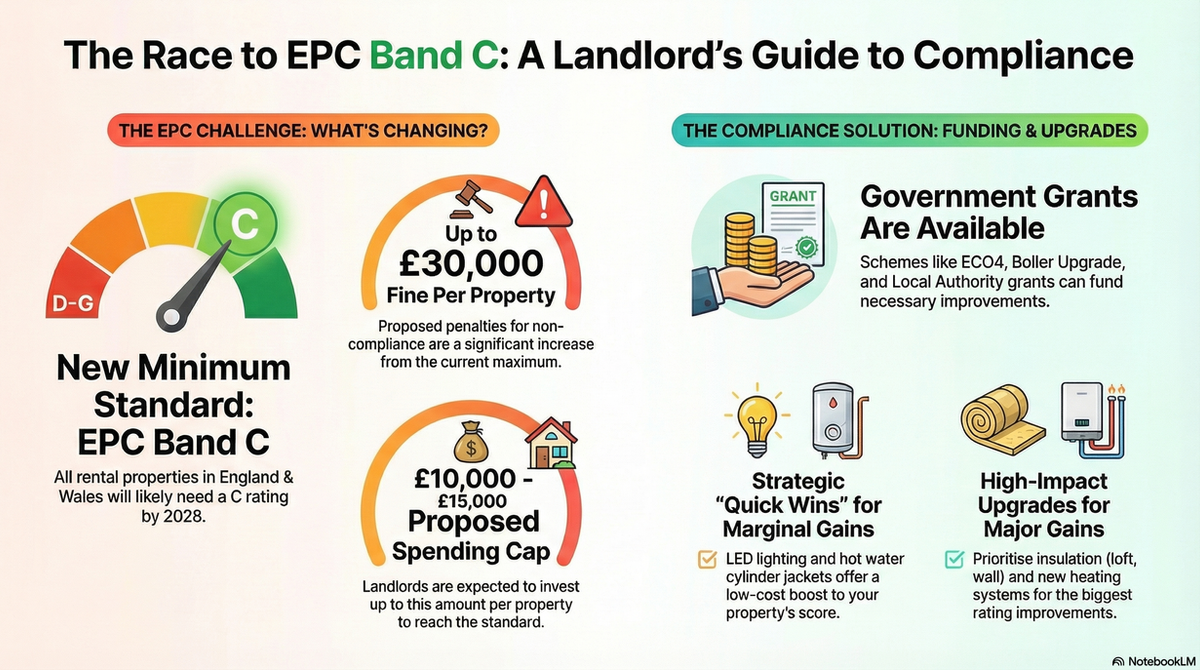
Currently, the Minimum Energy Efficiency Standard (MEES) is a rating of 'E'. Landlords cannot start or renew a tenancy if the property is rated F or G unless they have a registered exemption.
An EPC doesn't "pass" or "fail" in the traditional sense; it is a measurement of efficiency. However, for landlords, a rating below 'E' is effectively a failure to meet legal letting standards.
Yes. The assessor is required to visit every room to check for heating sources, lighting, and window types. They will also need to take photographs as evidence for their accreditation body.
The cheapest "quick wins" include switching all lightbulbs to LEDs, ensuring your hot water cylinder has a thick jacket (at least 80mm), and topping up loft insulation to 270mm.
This guide was written with AI assistance and is intended for general information only. Prices are estimates based on UK averages and may vary by region. Always get at least three quotes and consult a qualified professional before starting any work.
Ask follow-ups in plain English. The AI explains options, sequencing and what to ask the epc assessor — so you walk in informed.
An Energy Performance Certificate (EPC) is a legal requirement for almost every UK property being built, sold, or rented. It provides an objective rating of a h...
READ GUIDE →GuideFor UK landlords, an Energy Performance Certificate (EPC) is a non-negotiable legal requirement. It provides an efficiency rating from A (most efficient) to G (...
READ GUIDE →GuideA Commercial Energy Performance Certificate (EPC) is a legal requirement for almost all non-domestic buildings in the UK when they are sold, rented, or construc...
READ GUIDE →GuideAn Energy Performance Certificate (EPC) is a legally required document for almost every home in the UK that is being built, sold, or rented. It provides an obje...
READ GUIDE →GuideScope of Services • Review current sustainability practices and conduct data analysis • Analyse energy consumption, waste management and resource efficiency • A...
READ GUIDE →GuideAn Energy Performance Certificate (EPC) is a legal requirement for anyone selling or renting out a property in the UK. Beyond the legalities, a comprehensive en...
READ GUIDE →