Instant
01 · Ask
Sale, lettings or commercial?
Different EPCs for different uses. Describe what you need and the AI tells you which type and urgency.

What an EPC costs in 2026, how long it takes and how soon it's lodged after the visit.
Read the brief on accreditation schemes, MEES rules and improvement tips — then let three DEAs quote.
Different EPCs for different uses. Describe what you need and the AI tells you which type and urgency.
Elmhurst/Stroma accreditation, MEES rules (EPC E+ for lettings), 10-year validity, what a SAP rating means. Know the requirements.
Three accredited DEAs quote on the same property — turnaround, scheme, included advice — so you're not paying premium for the standard.
Ready when you are
Enter your postcode and get free quotes from local pros.
Four moves that separate a smooth job from a nightmare.
Only DEAs accredited by an approved scheme (Elmhurst, Stroma, RICS) can issue valid EPCs. Anyone else's report has no legal status.
Estate agents legally need a valid EPC at marketing stage. Order it as soon as you decide to sell — it takes 5–10 days to land.
Valid EPCs require a full site visit, room-by-room measurement and photos. A 'remote' EPC is not legally valid for sale or letting.
Loft top-up, low-energy bulbs and a smart meter can push a D up to a C — and buyers pay a premium for higher ratings.
Indicative UK ranges and what affects price.
By job type
Quote spread is typically ± 18% — always get 3 quotes.
EPC Assessor quick-view
EPC Assessor explained
An Energy Performance Certificate (EPC) is a legal requirement when you sell or rent a UK property. Cost is typically £60–£120 for a standard residential survey, with the certificate produced within 24–72 hours. Premium / urgent service can run £150–£200 with same-day turnaround.
EPCs are valid for 10 years. If your existing EPC is still in date and you've made no changes that affect energy performance, you don't need a new one to sell or let. Check at find-energy-certificate.service.gov.uk.
| Property type | Typical price |
|---|---|
| Studio / 1-bed flat | £60–£90 |
| 2-3 bed terrace or semi | £70–£120 |
| 4-5 bed detached | £90–£160 |
| Larger / unusual properties | £140–£250+ |
| Commercial EPC (separate scheme) | £150–£500+ |
| Same-day / urgent service (residential) | +£40–£80 |
Prices vary regionally; London assessors often charge at the upper end. Multi-property bookings (a landlord with several properties on the same street) often attract a discount per property.
An accredited Domestic Energy Assessor (DEA) typically takes 30–60 minutes for a 3-bed home. They'll:
The data is entered into RdSAP (Reduced Data Standard Assessment Procedure) software, which produces the certificate, energy rating (A–G), and recommended improvements.
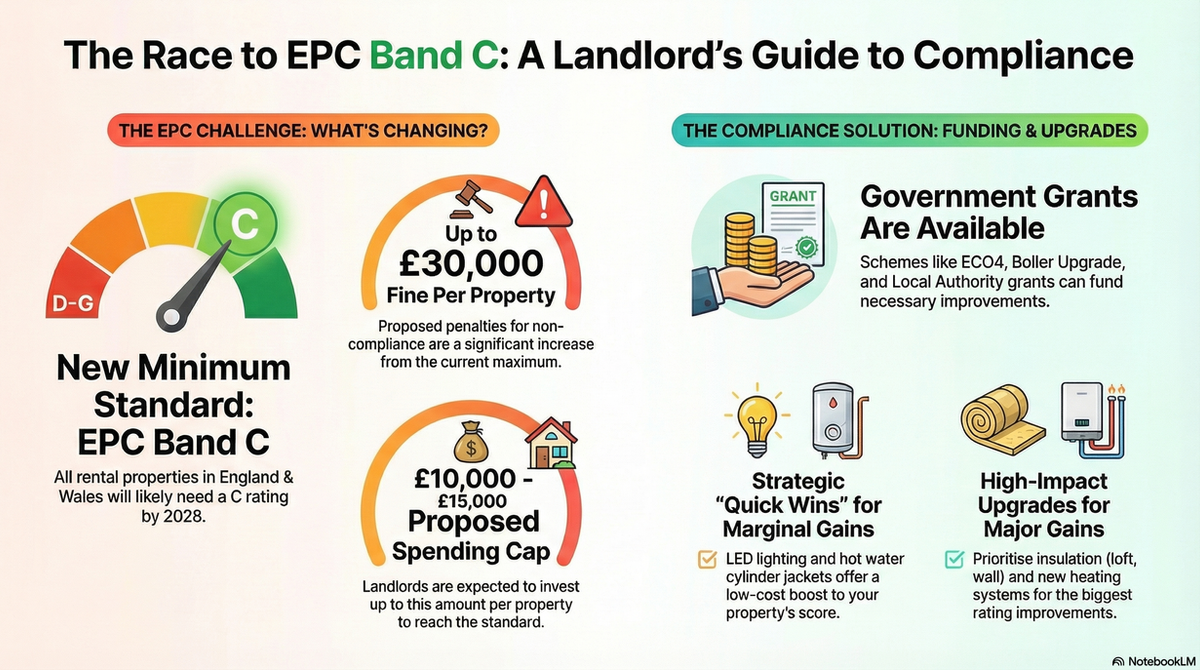
Since 2018, properties let in the private rented sector must have an EPC of E or better. The threshold is rising: from 2028 (proposed), all new tenancies need C or better; from 2030, all existing tenancies. Landlords with F/G properties cannot legally let them without exemption registration.
If your rental is currently E and you're approaching renewal, get your EPC reviewed early — improvements (insulation, boiler upgrade, LED lighting) take time to commission and certify.
find-energy-certificate.service.gov.uk by postcode. If yours is under 10 years old, you don't need a new one for sale.10 years from the date of issue. You can use the same EPC for multiple sales / lettings within that period unless major changes affect the energy rating (extensions, heating system swaps).
Not legally required, but if the extension significantly changes the property's footprint or energy profile, the existing EPC will be inaccurate at sale. Many buyers' solicitors flag this. A fresh EPC after substantial works is good practice.
Yes — request a re-assessment from a different accredited assessor, particularly if you have evidence of improvements that weren't recorded (cavity wall insulation, modern boiler, solar PV). Cost is the same as a regular EPC.
The A–G scale represents both energy efficiency (running costs) and CO2 emissions. A is the most efficient (typical: new-build with solar and heat pump); G is the least efficient (typical: pre-1900 solid-walled with old boiler and minimal insulation). Most UK homes are D or E.
Highly variable. Likely improvements: cavity wall insulation (£500–£1,500), loft insulation top-up (£300–£700), boiler upgrade (£2,500–£4,000), LED lighting (£200–£600), draught proofing (£150–£400). Typical total to lift E → C: £3,000–£8,000 for a 3-bed semi.
Yes — every new dwelling requires an EPC at completion. Most new builds achieve B or C ratings; new builds completed under the upcoming Future Homes Standard from 2025/26 will target A.
Want a local pro to handle this? An accredited Domestic Energy Assessor will visit, survey, and lodge your EPC quickly. Booking through a comparison aggregator is usually £20–£40 cheaper than direct, but local independent assessors often have stronger knowledge of the area's typical construction.
This guide was written with AI assistance and is intended for general information only. Prices are estimates based on UK averages and may vary by region. Always get at least three quotes and consult a qualified professional before starting any work.
Ask follow-ups in plain English. The AI explains options, sequencing and what to ask the epc assessor — so you walk in informed.
An Energy Performance Certificate (EPC) is a legal requirement for almost every UK property being built, sold, or rented. It provides an objective rating of a h...
READ GUIDE →GuideFor UK landlords, an Energy Performance Certificate (EPC) is a non-negotiable legal requirement. It provides an efficiency rating from A (most efficient) to G (...
READ GUIDE →GuideA Commercial Energy Performance Certificate (EPC) is a legal requirement for almost all non-domestic buildings in the UK when they are sold, rented, or construc...
READ GUIDE →GuideAn Energy Performance Certificate (EPC) is a legally required document for almost every home in the UK that is being built, sold, or rented. It provides an obje...
READ GUIDE →GuideScope of Services • Review current sustainability practices and conduct data analysis • Analyse energy consumption, waste management and resource efficiency • A...
READ GUIDE →GuideAn Energy Performance Certificate (EPC) is a legal requirement for anyone selling or renting out a property in the UK. Beyond the legalities, a comprehensive en...
READ GUIDE →