Instant
01 · Ask
Ask the AI a follow-up
Got more questions about garage Door Repair? Describe the bit you're unsure about — the AI explains options, sequencing and what to ask the garage doors.

Spring, cable, motor or panel fault — fixed without replacing the whole door.
You've read the brief on garage Door Repair. Now lean on us to find the right garage doors — and stay in control of the job.
Got more questions about garage Door Repair? Describe the bit you're unsure about — the AI explains options, sequencing and what to ask the garage doors.
Costs, timelines, pitfalls and the right questions to ask before any garage doors starts on garage Door Repair.
Itemised quotes from up to 3 local garage doorss on garage Door Repair — so you can compare like-for-like, not lump sums.
Ready when you are
Enter your postcode and get free quotes from local pros.
Four moves that separate a smooth job from a nightmare.
Often caused by rust or the door being operated while locked. The door will usually hang at an angle and become jammed.
Garage door springs have a "cycle life" (usually 10,000–20,000 opens). When they fail, the door will feel incredibly heavy or the motor will strain and stop.
On electric doors, if the "photo-eye" sensors are knocked out of line, the door will refuse to close or will instantly reverse.
Screeching or grinding usually indicates dry bearings or rollers that have developed "flat spots" and need replacing.
Indicative UK ranges and what affects price.
By job type
Quote spread is typically ± 18% — always get 3 quotes.
Garage Doors quick-view
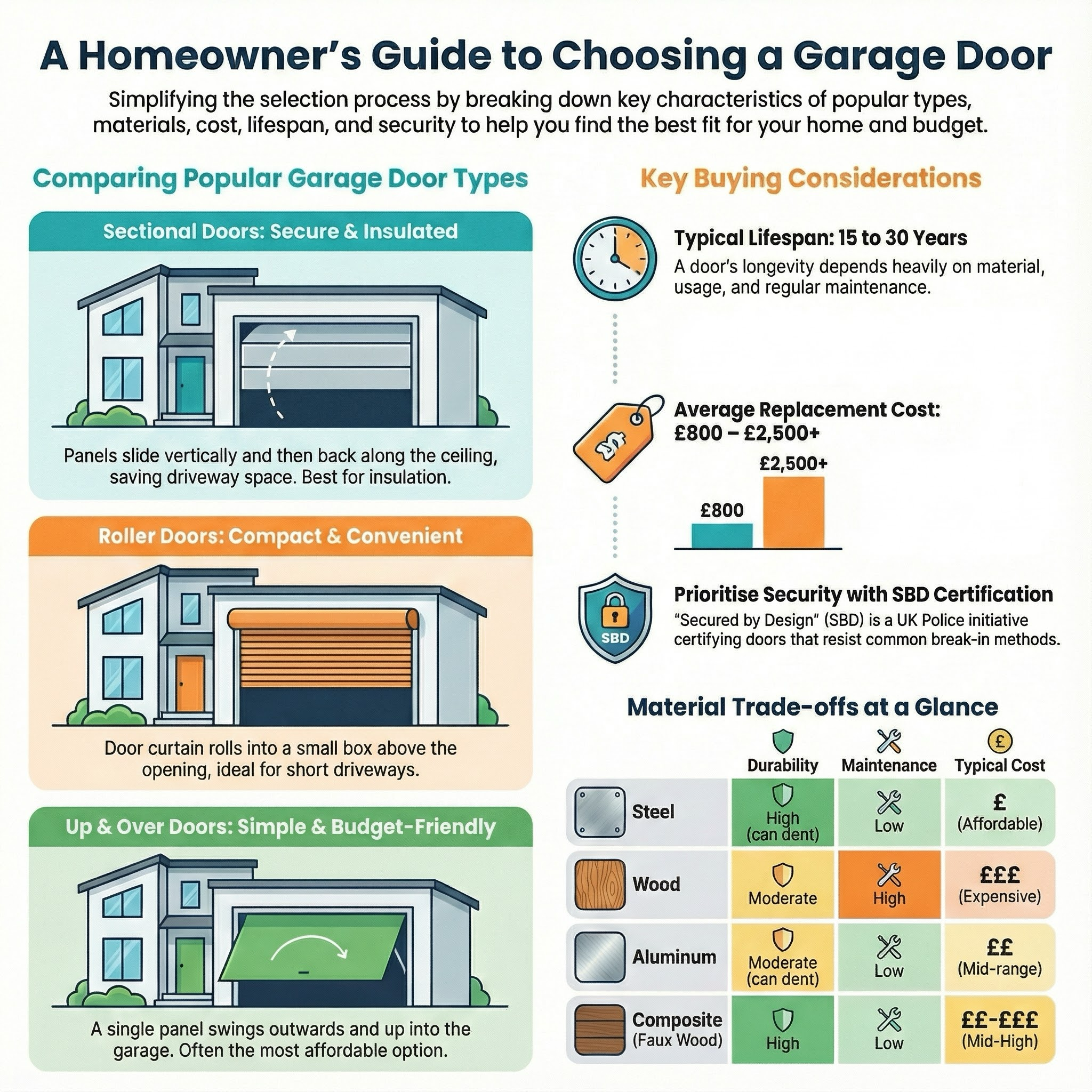
Garage Doors explained
Whether you have a traditional up-and-over, a modern sectional, or a space-saving roller door, most mechanical issues can be repaired by a specialist. Timely repairs prevent minor alignment issues from turning into expensive motor failures or structural damage.
| Item | Low £ | High £ | Notes |
|---|---|---|---|
| Call-out & Diagnosis | £60 | £110 | Usually covers the first 30-60 minutes of labour. |
| Cable Replacement (Pair) | £90 | £160 | Includes parts and labour for both sides. |
| Spring Replacement | £150 | £380 | Torsion springs are more expensive than extension springs. |
| New Electric Motor | £300 | £650 | Price varies by torque rating and brand (e.g., Hormann). |
| Roller/Hinge Swap | £80 | £150 | Includes high-quality nylon or steel replacements. |
| Full Annual Service | £85 | £140 | Preventative maintenance and minor adjustments. |
Prices are influenced by your location (London and the South East typically command higher rates) and the specific brand of your door. Premium German brands like Hormann or Garador may require more expensive, proprietary spare parts compared to generic UK models.
While basic lubrication and cleaning are safe DIY tasks, mechanical repairs should be left to professionals. Garage door springs are under immense tension; if they snap during a DIY repair, they can cause life-changing injuries or significant property damage.
Warning: Never attempt to adjust or remove a torsion spring or bottom bracket yourself. These components hold the full weight of the door and require specialist winding bars and training to handle safely.
Electric doors must also comply with UK safety regulations regarding force limits. A professional installer will use a force-testing jig to ensure the door won't crush an object or person, a check that is impossible to perform accurately without specialist equipment.
Garage door installations and major repairs are governed by several UK standards to ensure user safety. If your door is powered, it is legally classed as a "machine."
It is strongly recommended to replace springs in pairs. Springs are manufactured at the same time and undergo the same amount of stress; if one has snapped, the other is likely at the very end of its service life and will fail shortly after.
This is usually caused by the "close limit" being set too far, or an obstruction in the track. The motor senses resistance and assumes it has hit an object, triggering the safety reverse. A simple recalibration usually fixes this.
Most modern up-and-over or sectional doors can be automated with a retro-fitted boom-style operator. However, very old "side-hinged" doors or doors with significant structural damage may need a full replacement instead.
A professional service is recommended every 12 to 24 months. Regular maintenance ensures the safety features are working and can double the lifespan of the motor and springs.
If a door is heavy, the issue is almost always the springs, not the motor. A well-balanced garage door should be easy to lift with one hand when in manual mode. If it isn't, the springs need re-tensioning or replacing.
Stop using the door immediately. Do not attempt to pull it down or force it open, as this can bend the tracks or cause the door to fall out of the frame. Call a specialist to secure the door and replace the cables.
This guide was written with AI assistance and is intended for general information only. Prices are estimates based on UK averages and may vary by region. Always get at least three quotes and consult a qualified professional before starting any work.
Ask follow-ups in plain English. The AI explains options, sequencing and what to ask the garage doors — so you walk in informed.
A misaligned garage door is more than just a noisy nuisance; it is a significant security risk and a potential safety hazard. When a door is out of plumb, it pl...
READ GUIDE →GuideGarage door springs are the unsung heroes of your home’s exterior, doing the heavy lifting every time you leave for work or return home. Because these springs o...
READ GUIDE →GuideIndustrial garage doors, including roller shutters and sectional overhead doors, are heavy-duty systems designed for security and frequent use. For UK homeowner...
READ GUIDE →GuideScope of Works • Inspect garage opening and measure dimensions • Remove existing door (if applicable) and prepare the opening • Assemble and install the new gar...
READ GUIDE →GuideA faulty garage door is more than just a daily inconvenience; it is a significant security risk to your home and a potential safety hazard for your family. Whet...
READ GUIDE →GuideUpgrading to an electric garage door is one of the most practical home improvements for UK homeowners. Beyond the obvious convenience of opening your door at th...
READ GUIDE →