Instant
01 · Ask
Ask the AI a follow-up
Got more questions about patio Installation Cost &? Describe the bit you're unsure about — the AI explains options, sequencing and what to ask the patios.

What patios actually cost in 2026 — by material, size, sub-base and edge work.
You've read the brief on patio Installation Cost &. Now lean on us to find the right patios — and stay in control of the job.
Got more questions about patio Installation Cost &? Describe the bit you're unsure about — the AI explains options, sequencing and what to ask the patios.
Costs, timelines, pitfalls and the right questions to ask before any patios starts on patio Installation Cost &.
Itemised quotes from up to 3 local patioss on patio Installation Cost & — so you can compare like-for-like, not lump sums.
Ready when you are
Enter your postcode and get free quotes from local pros.
Four moves that separate a smooth job from a nightmare.
White salty stains appearing on natural stone. This is natural and usually fades, but can be exacerbated by poor mortar mixes.
Cracks appearing in the joints because the sub-base has shifted or was too thin.
Dark staining around the edges of slabs caused by moisture being absorbed from the mortar—often seen when the wrong type of sand or sealant is used.
Water pooling in the centre of the patio because the slight "fall" (gradient) was not calculated correctly.
Indicative UK ranges and a typical week-by-week schedule.
By job type
Quote spread is typically ± 18% — always get 3 quotes.
30 m² patio install · week by week
Schedule slips on dependencies — pad each phase by 10–20% for real-world delays.
Patios quick-view
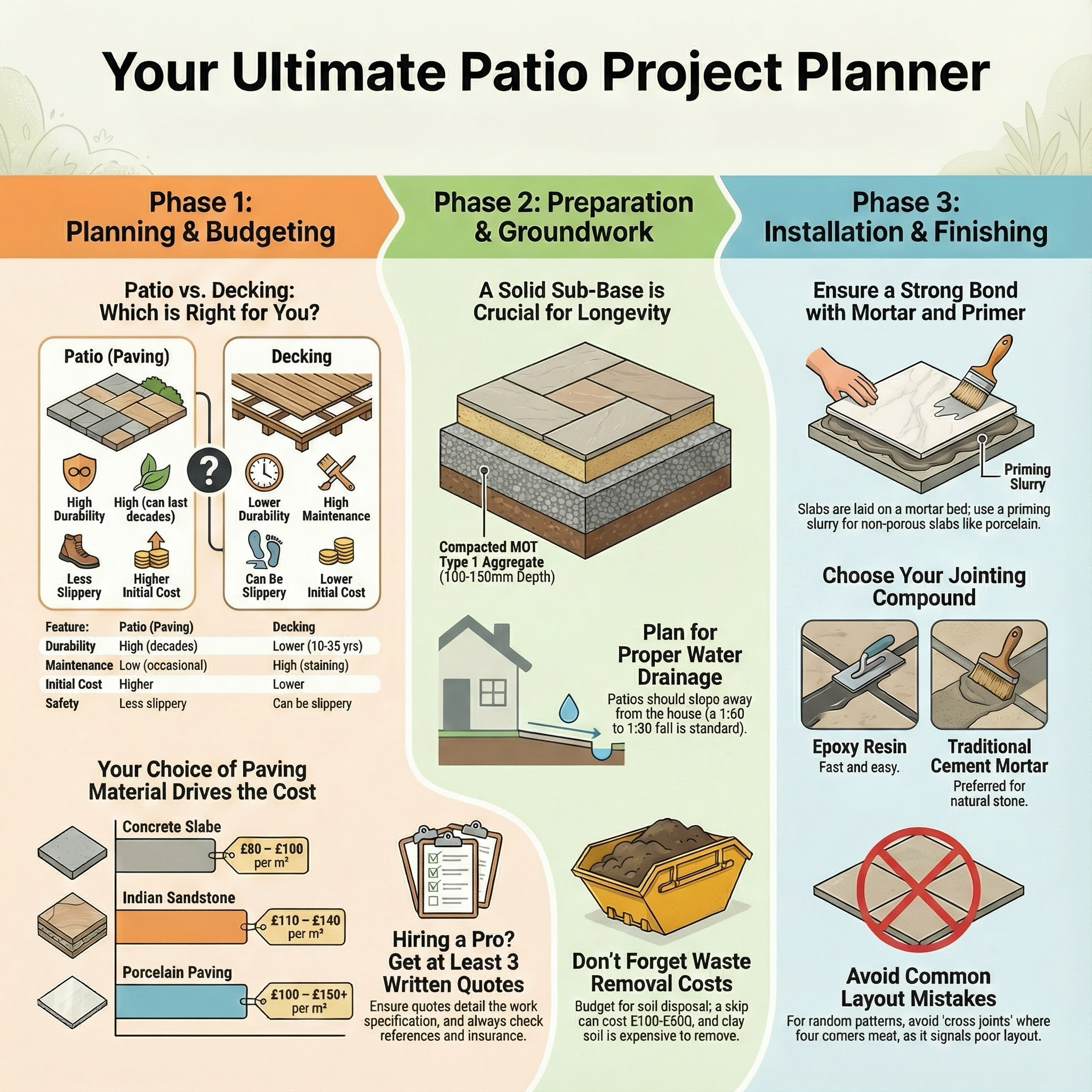
Patios explained
Whether you are looking for the rustic charm of Indian Sandstone or the sleek, low-maintenance finish of modern Porcelain, understanding the installation process and associated costs will help you manage your budget and ensure a high-quality finish.
The following prices include both labour and materials, based on 2025/26 UK averages. Prices include VAT and assume a standard level of ground preparation.
| Item / Material | Low £ (per m²) | High £ (per m²) | Notes |
|---|---|---|---|
| Basic Concrete Slabs | £70 | £100 | Budget-friendly, utility finish. |
| Indian Sandstone | £100 | £150 | Most popular natural stone; variable colours. |
| Porcelain Paving | £140 | £210 | Premium look, non-porous, requires primer. |
| Yorkstone (Reclaimed) | £180 | £280 | High-end, traditional British stone. |
| Waste Removal (Skip Hire) | £250 | £450 | Per 6-8 yard skip (may need multiple). |
Factors that will push your quote toward the higher end include poor site access (requiring manual hauling rather than a micro-digger), complex laying patterns (like herringbone or circular designs), and the need for significant drainage installations like Aco drains.
While laying a few stepping stones is a manageable DIY task, a full patio installation is a major engineering project. The physical demand of "muck away" (removing tonnes of soil) and the precision required for drainage falls make it a job for professionals. In the UK, a poorly installed patio can cause damp issues if it is laid above the Damp Proof Course (DPC) or if water drains toward the house. Hiring a professional ensures the sub-base is compacted correctly to prevent "dipping" in later years.
Note: If you choose to DIY, never use the "dot and dab" (spot bedding) method. In the UK climate, this creates voids where water collects, freezes, and eventually cracks your slabs.
It is generally not recommended. Laying over an old patio raises the height (potentially breaching the DPC) and relies on the old base being stable. If the old patio sinks, the new one will too. It is always better to dig out and start fresh.
A membrane should be placed between the soil and the MOT Type 1 sub-base. This prevents the stone from mixing with the soil while still allowing water to drain through. It does not go directly under the slabs.
Porcelain is much harder to cut, requiring specialist diamond blades and more time. It also requires a chemical bonding agent (slurry primer) on the back of every slab, as the material is non-porous and won't stick to standard mortar alone.
You should wait at least 24 hours before walking on it and at least 72 hours before placing heavy garden furniture or planters. The mortar needs time to reach full structural strength.
In most cases, no. Back garden patios fall under Permitted Development. However, if you live in a Listed Building or a Conservation Area, or if you are significantly raising the ground level (balconies/raised platforms), you should check with your local council.
This guide was written with AI assistance and is intended for general information only. Prices are estimates based on UK averages and may vary by region. Always get at least three quotes and consult a qualified professional before starting any work.
Ask follow-ups in plain English. The AI explains options, sequencing and what to ask the patios — so you walk in informed.
A well-installed patio is one of the most effective ways to add value and functional living space to a UK home. Given our unpredictable climate, a durable, leve...
READ GUIDE →GuideA well-designed patio is more than just a flat surface for a garden table; it is an extension of your home’s living space. In the UK, professional patio design ...
READ GUIDE →GuidePatio and Garden Maintenance Overview Refreshes patio surfaces, restores tidy garden hard‑landscapes and gets sliding/French doors running smoothly. Skill level...
READ GUIDE →GuideResin bonding is an increasingly popular choice for UK homeowners looking to revitalise tired concrete or tarmac patios without the upheaval of a full excavatio...
READ GUIDE →GuideEverything UK homeowners need to know about Indian sandstone patios — costs per m², install steps, sealing, and how to choose a trusted installer.
READ GUIDE →GuideYorkshire stone patios: reclaimed vs new, costs per m², install detail, and how to find authentic British flagstones in 2026.
READ GUIDE →