Instant
01 · Ask
Ask the AI a follow-up
Got more questions about clay Roof Tiles? Describe the bit you're unsure about — the AI explains options, sequencing and what to ask the roofer.

Hand-made or machine-made clay roof tiles — heritage classic with 80-100 year life. By a roofer.
You've read the brief on clay Roof Tiles. Now lean on us to find the right roofer — and stay in control of the job.
Got more questions about clay Roof Tiles? Describe the bit you're unsure about — the AI explains options, sequencing and what to ask the roofer.
Costs, timelines, pitfalls and the right questions to ask before any roofer starts on clay Roof Tiles.
Itemised quotes from up to 3 local roofers on clay Roof Tiles — so you can compare like-for-like, not lump sums.
Ready when you are
Enter your postcode and get free quotes from local pros.
Four moves that separate a smooth job from a nightmare.
Quality clay is frost-resistant; cheap clay can crack in UK frost. Buy named-brand UK or German clay.
Original clay tiles fade with patina. Salvage matching tile from manufacturers or salvage yards.
Pre-1990s clay tile profiles often discontinued. Closest-match new tile usually required.
Verify roof structure capacity before specifying.
Indicative UK ranges and a typical week-by-week schedule.
By job type
Quote spread is typically ± 18% — always get 3 quotes.
Semi-detached full re-roof · week by week
Schedule slips on dependencies — pad each phase by 10–20% for real-world delays.
Roofer quick-view
Roofer explained
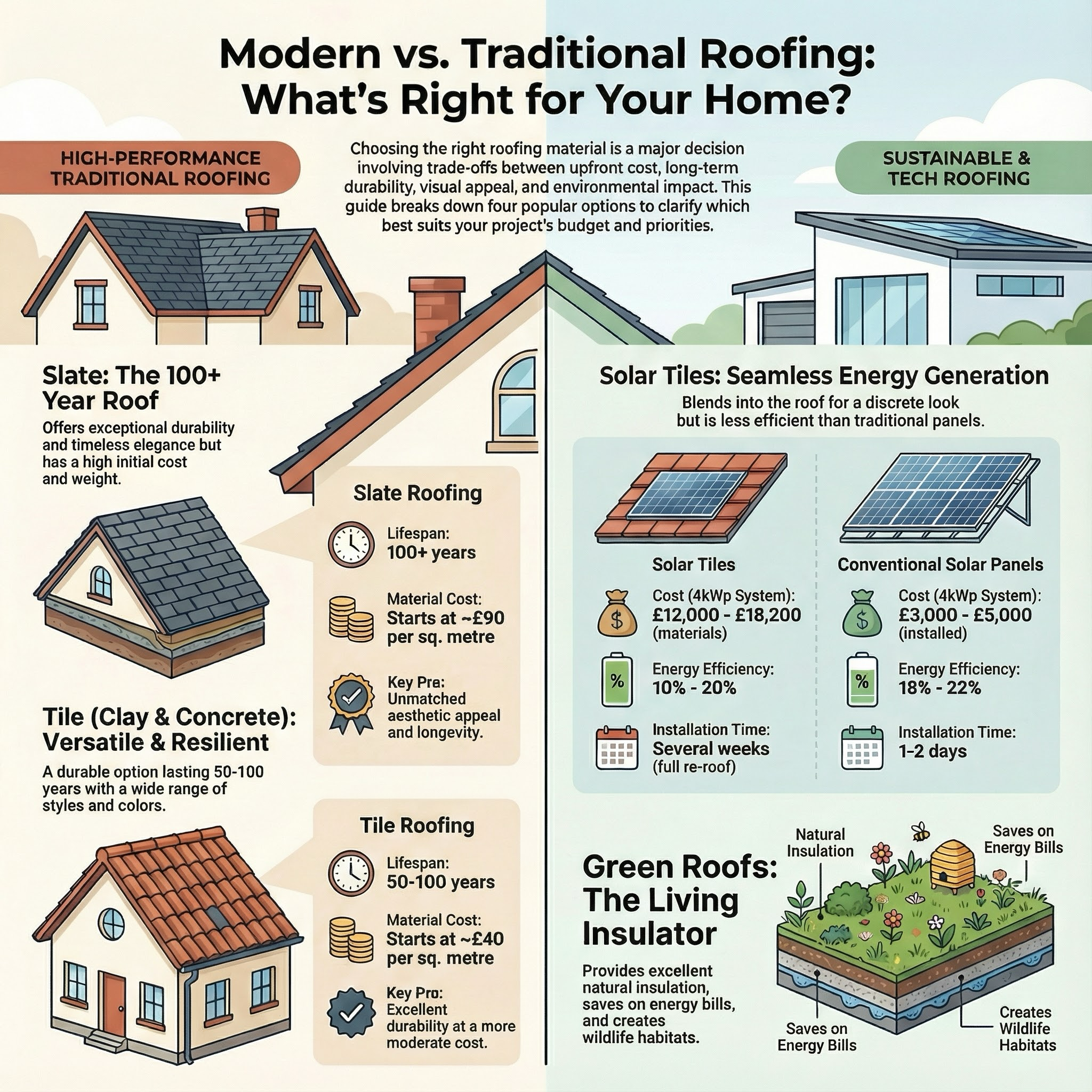
Clay roof tiles last 100+ years, hold colour permanently, and have the natural texture and patina that concrete tiles can't match. Expect to pay £60–£140 per m² fitted in the UK depending on profile and brand.
Standard tile install but slower than concrete due to handling care. Clay plain tiles (200 × 165mm) lay in a double-lap pattern — much smaller modules than interlocking concrete tiles. Pantiles (single-lap) lay faster but offer less double-coverage. Hand-made clay tiles have natural colour variation requiring careful blending.
| Item | Low (£) | High (£) | Notes |
|---|---|---|---|
| Clay plain tile per m² | 50 | 100 | Dreadnought, Sandtoft, Hornchurch |
| Clay pantile per m² | 45 | 90 | Sandtoft Bridgwater, Marley Lincoln |
| Handmade clay tile per m² | 80 | 180 | Lancaster, Spicer Tiles |
| Installation labour per m² | 30 | 60 | More skill than concrete |
| Terraced clay tile re-roof | 7,500 | 14,500 | 50–70 m² |
| Semi-detached clay re-roof | 11,000 | 22,000 | 80–120 m² |
| Heritage replacement (listed) | 15,000 | 40,000+ | Handmade tile, salvage |
Terraced clay re-roof: 7–10 days. Semi-detached: 10–14 days. Plain tile slower than pantile due to smaller module size.
Professional only. Clay tiles require careful handling (more breakage than concrete) and skilled detailing for heritage results.
NFRC member, ideally with heritage clay tile experience. Confirm tile brand and finish (smooth, sandfaced, antique). Get the colour mix in writing — multi-shade ranges need on-site blending.
Building Regs Part L thermal upgrade required. Listed buildings: clay tiles usually required. Some conservation areas favour clay over concrete.
Clay: more expensive (£60–£140/m²), 100+ year life, heritage feel, natural colour. Concrete: cheaper (£30–£70/m²), 60-year life, more profile choice.
Plain tile (small flat): heritage Victorian standard, more labour-intensive. Pantile (single-lap S-curve): faster install, common in East Anglia and Yorkshire. Both heritage-appropriate.
Dreadnought (Birmingham): UK heritage standard. Sandtoft: range of clay profiles. Hornchurch: handmade. Imerys/Imerys Roof Tiles: European premium.
Quality clay: 100–150 years. Many roofs in heritage UK towns are 100+ year old original clay still in service.
Yes — Lancaster, Spicer Tiles, Tudor Roof Tiles offer hand-made tiles for heritage projects. £80–£180/m². Beautiful natural variation.
Salvage gives instant heritage patina but variable quality. New gives consistency. Mix is common — new tiles on hidden slopes, salvage on visible.
This guide was written with AI assistance and is intended for general information only. Prices are estimates based on UK averages and may vary by region. Always get at least three quotes and consult a qualified professional before starting any work.
Ask follow-ups in plain English. The AI explains options, sequencing and what to ask the roofer — so you walk in informed.
Chimney stacks are among the most exposed elements of a UK property, constantly battling high winds, driving rain, and freeze-thaw cycles. Over time, the mortar...
READ GUIDE →GuideA leaking roof is more than just a nuisance; it is a direct threat to your home’s structural integrity. In the UK’s damp climate, even a minor drip can quickly ...
READ GUIDE →GuideInstalling a new chimney is a significant structural upgrade for any UK home, whether you are adding a traditional masonry stack or a modern twin-wall flue syst...
READ GUIDE →GuideReplacing a roof is one of the most significant investments a UK homeowner can make in their property. Beyond simply keeping out the rain, a new roof ensures st...
READ GUIDE →GuidePitched roof shingles, often made from bitumen (felt) or cedar, offer a lightweight and cost-effective alternative to traditional clay tiles or slate. In the UK...
READ GUIDE →GuideRoof tile repair is a critical maintenance task for UK homeowners, especially given our unpredictable weather. Even a single cracked or displaced tile can allow...
READ GUIDE →