Instant
01 · Ask
Ask the AI a follow-up
Got more questions about builders Waste Clearance? Describe the bit you're unsure about — the AI explains options, sequencing and what to ask the rubbish clearance.

Construction site rubble, packaging and offcuts — removed by licensed waste carriers.
You've read the brief on builders Waste Clearance. Now lean on us to find the right rubbish clearance — and stay in control of the job.
Got more questions about builders Waste Clearance? Describe the bit you're unsure about — the AI explains options, sequencing and what to ask the rubbish clearance.
Costs, timelines, pitfalls and the right questions to ask before any rubbish clearance starts on builders Waste Clearance.
Itemised quotes from up to 3 local rubbish clearances on builders Waste Clearance — so you can compare like-for-like, not lump sums.
Ready when you are
Enter your postcode and get free quotes from local pros.
Four moves that separate a smooth job from a nightmare.
Many older UK properties contain asbestos in floor tiles, cement roofing, or textured coatings (Artex). If builders waste is contaminated with asbestos, standard clearance firms cannot take it.
Skips or vans filled entirely with "heavy" waste like soil or concrete can exceed legal weight limits, leading to surcharges or the driver refusing to lift the load.
Narrow driveways, low bridges, or parking permit zones can prevent large vehicles from reaching your waste. Always inform the carrier of access issues beforehand.
Beware of extremely low quotes on social media. These often lead to fly-tipping, leaving the homeowner legally liable for the cleanup costs and fines.
Indicative UK ranges and what affects price.
By job type
Quote spread is typically ± 18% — always get 3 quotes.
Rubbish Clearance quick-view
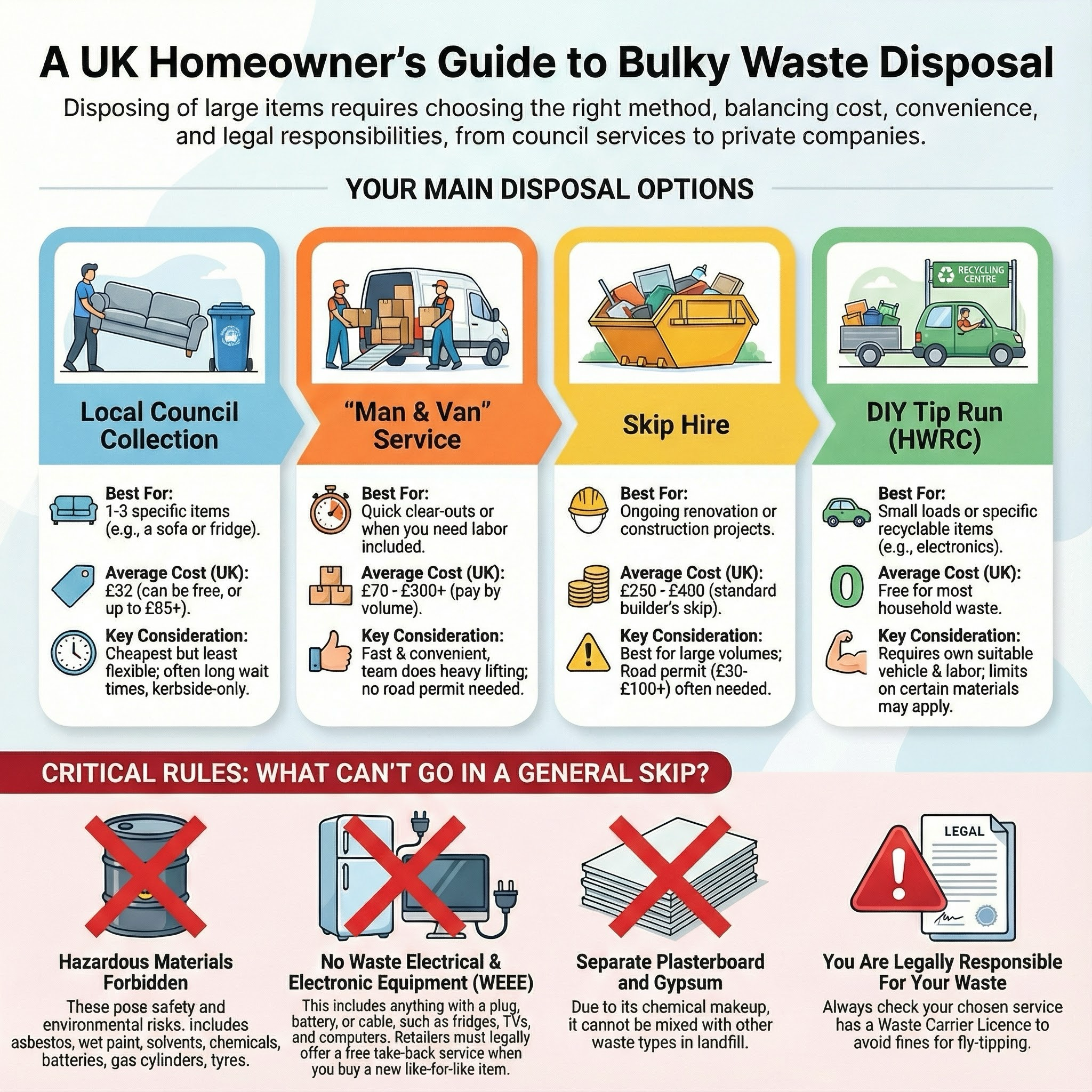
Rubbish Clearance explained
Whether you are finishing a kitchen extension or clearing a garden after a patio installation, hiring a professional waste carrier saves you multiple trips to the local tip. It also ensures that heavy materials are handled safely, reducing the risk of injury or damage to your property.
| Item / Service | Low £ | High £ | Notes |
|---|---|---|---|
| Minimum Call-out Fee | £80 | £160 | Covers arrival and first 15-30 mins of labour. |
| Small Load (approx. 2yd³) | £120 | £200 | Equivalent to roughly 20-25 rubble sacks. |
| Medium Load (approx. 6yd³) | £250 | £380 | Similar capacity to a standard "builders skip". |
| Large Load (approx. 12yd³) | £450 | £650 | High-volume van or large tipper truck. |
| Grab Lorry (per load) | £300 | £500 | Best for bulk soil, brick, and concrete (up to 16t). |
| Plasterboard Surcharge | £15 | £40 | Per bag or sheet; must be disposed of separately. |
Pricing is primarily driven by weight and the type of material being removed. "Inert" waste like brick and concrete is often cheaper to process than mixed "active" waste, while hazardous items or plasterboard will always incur a price premium due to strict UK processing regulations.
While taking a few bags of tiles to the local Household Waste Recycling Centre (HWRC) is possible, most UK councils have strict limits on "construction and demolition" waste. You may be charged for small amounts or turned away entirely if you arrive in a van or with a trailer without a pre-booked permit.
Hiring a professional is safer and ensures legal compliance. Under the UK "Duty of Care" laws, you are responsible for your waste until it reaches a licensed site; if a cheap, unlicensed collector fly-tips your rubbish, you—the homeowner—can be prosecuted and fined thousands of pounds.
Builders waste is subject to several strict regulations that affect how it is handled and priced.
No. Plasterboard must be kept separate from other waste. Most clearance companies will require it to be bagged or stacked separately, and you will likely pay a specific surcharge for its disposal due to UK environmental laws.
A Waste Transfer Note (WTN) is a legal document that proves your waste was handed over to a licensed carrier and taken to an authorised site. You should keep this for at least two years to protect yourself from fly-tipping prosecutions.
A grab lorry is usually better for large volumes of "loose" waste like soil or brick, as the team does the heavy lifting for you and the waste is gone in minutes. Skips are better if you are generating waste slowly over several days or weeks.
Most standard builders waste clearance firms will not take liquid waste, paints, or chemicals. These are classified as hazardous and require a specialist carrier with the correct permits to transport and treat them.
If the vehicle is just "waiting and loading" on the road, you may need to suspend a parking bay or ensure there are no yellow line restrictions. If you are hiring a skip to sit on a public road, you must obtain a skip permit from your local council.
This guide was written with AI assistance and is intended for general information only. Prices are estimates based on UK averages and may vary by region. Always get at least three quotes and consult a qualified professional before starting any work.
Ask follow-ups in plain English. The AI explains options, sequencing and what to ask the rubbish clearance — so you walk in informed.
Disposing of an old mattress or a bulky bed frame is one of the more challenging tasks for UK homeowners. Beyond the physical strain of navigating heavy, awkwar...
READ GUIDE →GuideManaging commercial waste is a significantly different beast compared to standard residential rubbish. Whether you are a landlord clearing a shop unit, a home-b...
READ GUIDE →GuideDisposing of an old sofa or armchair in the UK has become more complex due to recent environmental legislation. Bulky furniture is difficult to move, and many i...
READ GUIDE →GuideScrapping a car in the UK is a straightforward process, but it is governed by strict environmental and legal regulations. Whether your vehicle is a non-runner, ...
READ GUIDE →GuideAccumulating black bin bags is a common headache for UK homeowners, whether it’s due to a missed council collection, a deep spring clean, or the aftermath of a ...
READ GUIDE →GuideWhether you are decommissioning a commercial suite or simply reclaiming a spare bedroom from years of "home office" clutter, a professional office clean-out is ...
READ GUIDE →