Instant
01 · Ask
Single item or whole house?
One sofa, a garage clear, end-of-tenancy strip-out? Describe and the AI tells you which clearance type and price band.

Bespoke dining or coffee table — designed, made and delivered by a furniture maker.
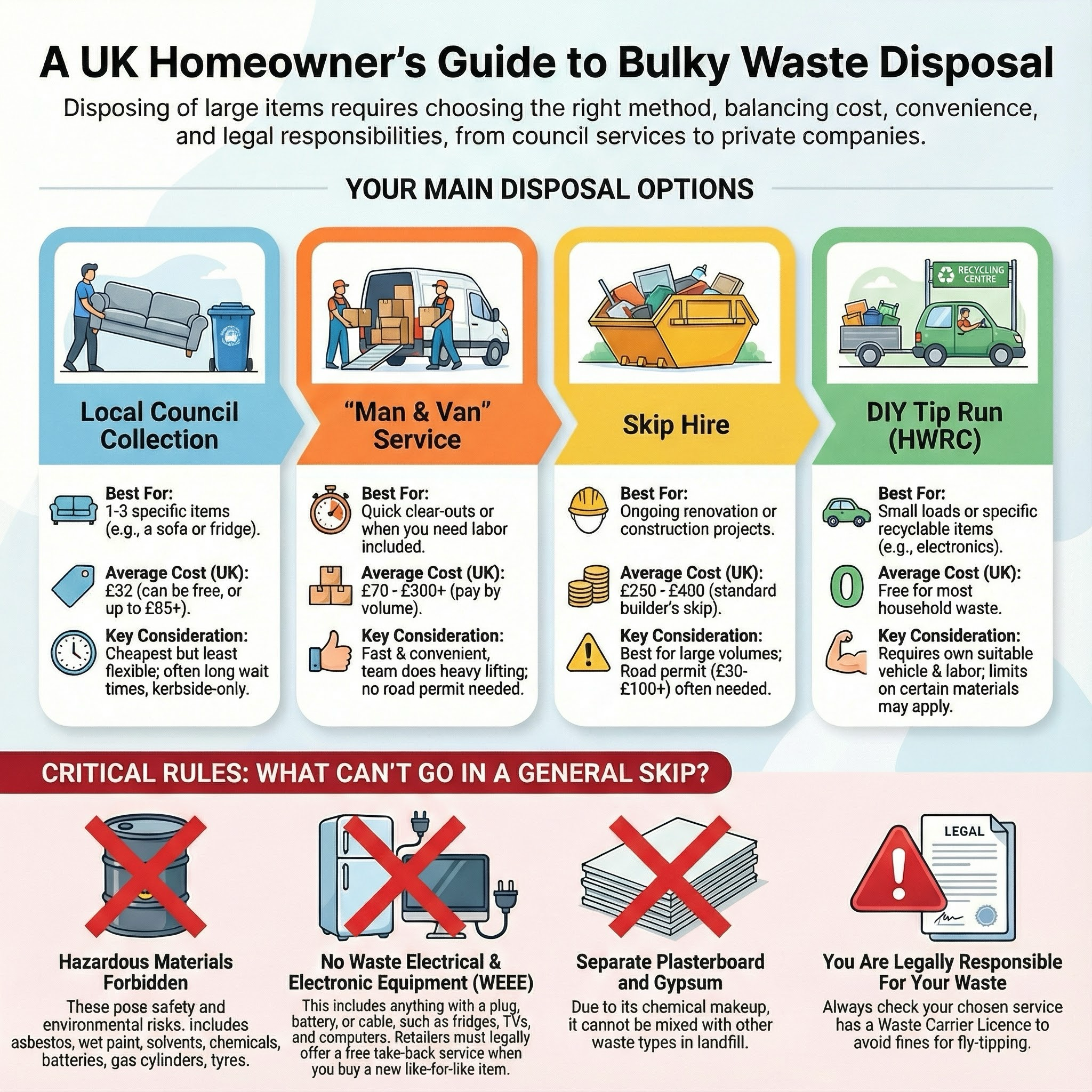
Read the brief on waste carrier licences, recycling and hazardous handling — then let Three local firms quote.
One sofa, a garage clear, end-of-tenancy strip-out? Describe and the AI tells you which clearance type and price band.
EA licences, transfer notes, recycling rates, hazardous separation. Know what makes a firm legit.
Three local firms quote on the same load — pricing model, recycling, transfer notes — so you compare cleanly.
Ready when you are
Enter your postcode and get free quotes from local pros.
Four moves that separate a smooth job from a nightmare.
All UK waste carriers need an Environment Agency licence. Fly-tipping under your name is the alternative — and you get fined.
Some 'clearance' firms charge per load; others charge per volume. Get the price model in writing before they start.
Asbestos, paint, batteries, electronics — separate disposal routes. A reputable clearance firm handles or refers; cowboys dump.
Reputable firms recycle 60–80% of clearance. Ask what's recycled and what's landfill — and what affects price.
Indicative UK ranges and what affects price.
By job type
Quote spread is typically ± 18% — always get 3 quotes.
Rubbish Clearance quick-view
Rubbish Clearance explained
Custom table building in the UK typically costs £500–£3,000+ for a bespoke piece, depending on size, materials, and design complexity. A simple oak dining table for 6 runs £600-£1,200; designer-quality tables (live-edge slabs, complex joinery, premium hardwoods) reach £2,000-£5,000+. The work spans carpentry, joinery, and finishing — usually one tradesperson covering all three.
Custom tables are most often commissioned for: dining rooms (sized to specific spaces), kitchens (matching cabinetry), garden tables (specialist outdoor), or as feature pieces (live-edge slabs, hairpin legs, mixed-material designs).
| Table type | Typical price |
|---|---|
| Simple pine farmhouse 6-seat | £500–£900 |
| Solid oak dining 6-seat | £700–£1,500 |
| Solid oak dining 8-seat | £1,000–£2,200 |
| Live-edge slab table (6-seat) | £1,500–£3,500 |
| Hardwood + steel hairpin design | £800–£1,800 |
| Garden / outdoor hardwood (8-seat) | £1,200–£3,000 |
| Coffee table (custom) | £250–£800 |
| Side / occasional table | £150–£500 |
| Designer / artist-led commission | £3,000–£15,000+ |
£600-£2,200 for typical solid oak 6-8 seat designs. Premium hardwoods (walnut, live-edge slabs): £1,500-£5,000. Designer / artist-led commissions can run £5,000-£15,000+.
4-12 weeks from order to delivery. Bottleneck is workshop queue; most quality makers have 4-8 week lead times before they can start. Add 2-4 weeks for the build itself plus finishing time.
Some makers welcome customer-supplied timber (especially family heritage pieces — oak from a fallen tree on your property, etc.). Discuss before; not all makers handle uncertain material specifications.
Local craft fairs, Etsy / Instagram for makers, Made in UK directories. View recent work in person where possible — photos flatter, but live wood texture and joinery quality only show up in person.
Properly built solid hardwood tables: 50-100+ years. Many become heirlooms. Solid timber can be sanded and refinished multiple times over its life — older tables often improve with age.
Discuss with the maker; they can match wood species and finish to existing pieces. Perfect match is impossible (different ages, different timbers); aiming for harmony rather than match is the realistic goal.
Want a local pro to handle this? A bespoke furniture maker or carpenter handles custom table commissions properly. Worth viewing their portfolio in person and discussing materials, joinery, and finish before committing — quality varies considerably even among experienced makers.
This guide was written with AI assistance and is intended for general information only. Prices are estimates based on UK averages and may vary by region. Always get at least three quotes and consult a qualified professional before starting any work.
Ask follow-ups in plain English. The AI explains options, sequencing and what to ask the rubbish clearance — so you walk in informed.
Disposing of an old mattress or a bulky bed frame is one of the more challenging tasks for UK homeowners. Beyond the physical strain of navigating heavy, awkwar...
READ GUIDE →GuideManaging commercial waste is a significantly different beast compared to standard residential rubbish. Whether you are a landlord clearing a shop unit, a home-b...
READ GUIDE →GuideDisposing of an old sofa or armchair in the UK has become more complex due to recent environmental legislation. Bulky furniture is difficult to move, and many i...
READ GUIDE →GuideScrapping a car in the UK is a straightforward process, but it is governed by strict environmental and legal regulations. Whether your vehicle is a non-runner, ...
READ GUIDE →GuideAccumulating black bin bags is a common headache for UK homeowners, whether it’s due to a missed council collection, a deep spring clean, or the aftermath of a ...
READ GUIDE →GuideWhether you are decommissioning a commercial suite or simply reclaiming a spare bedroom from years of "home office" clutter, a professional office clean-out is ...
READ GUIDE →