Instant
01 · Ask
Ask the AI a follow-up
Got more questions about decorating rubbish disposal? Describe the bit you're unsure about — the AI explains options, sequencing and what to ask the rubbish clearance.

Old paint, brushes, dust sheets and packaging — removed safely after a decorating project.
You've read the brief on decorating rubbish disposal. Now lean on us to find the right rubbish clearance — and stay in control of the job.
Got more questions about decorating rubbish disposal? Describe the bit you're unsure about — the AI explains options, sequencing and what to ask the rubbish clearance.
Costs, timelines, pitfalls and the right questions to ask before any rubbish clearance starts on decorating rubbish disposal.
Itemised quotes from up to 3 local rubbish clearances on decorating rubbish disposal — so you can compare like-for-like, not lump sums.
Ready when you are
Enter your postcode and get free quotes from local pros.
Four moves that separate a smooth job from a nightmare.
Plaster and old floor tiles are much heavier than they look; if your waste exceeds the weight limit of the van, costs will escalate quickly.
Tins that aren't sealed properly can leak during transit, damaging the vehicle or your driveway; always ensure lids are hammered down.
If plasterboard is mixed into a general waste bag, many firms will refuse to take it or charge a "contaminated load" fee.
If the clearance team has to carry heavy bags through a finished house or down multiple flights of stairs, expect higher labour charges.
Indicative UK ranges and what affects price.
By job type
Quote spread is typically ± 18% — always get 3 quotes.
Rubbish Clearance quick-view
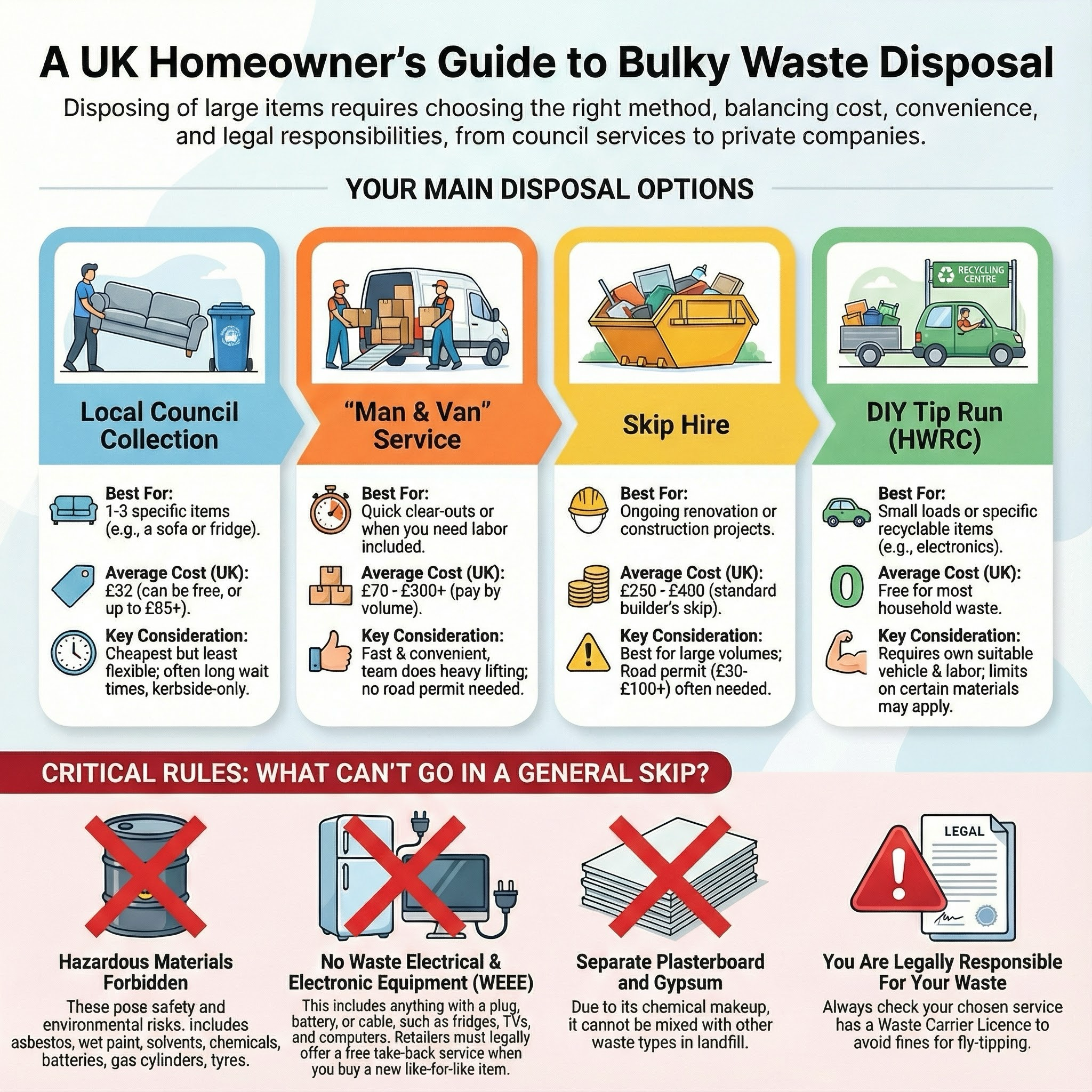
Rubbish Clearance explained
Professional rubbish clearance services specialise in the "muck away" stage of a renovation, ensuring that hazardous materials are segregated and that the bulk of your project's waste is diverted from landfills. This guide covers the costs, regulations, and practicalities of clearing decorating rubbish in the UK for 2025/26.
| Item | Low £ | High £ | Notes |
|---|---|---|---|
| Minimum Call-out Fee | £85 | £130 | Includes travel and first 30 mins of labour. |
| Small Load (approx. 2 cubic yards) | £110 | £160 | Roughly 15-20 black bags of wallpaper/light waste. |
| Medium Load (approx. 6 cubic yards) | £220 | £310 | Equivalent to a small skip; includes heavier debris. |
| Paint Disposal (per tin/litre) | £4 | £10 | Specialist surcharge for liquid paint and solvents. |
| Plasterboard Disposal (per bag/sheet) | £10 | £25 | Must be kept separate from general waste by law. |
Prices are primarily influenced by the volume and weight of the waste, but location also plays a significant role, with London and the South East typically seeing 15-25% higher rates. Be aware that most clearance companies now charge a specific surcharge for hazardous items like paint, as these cannot be sent to standard landfill sites.
You can take small amounts of decorating waste to your local Household Waste Recycling Centre (HWRC), but many councils now charge for "DIY waste" like plasterboard or timber. Furthermore, many tips refuse to take liquid paint unless it has been hardened with sand or a chemical hardener.
Hiring a professional is safer and more convenient for large volumes. Under UK law, you have a "Duty of Care" to ensure your waste is handled by a licensed carrier; if a "man-with-a-van" fly-tips your rubbish, you are legally liable for the fines, which can reach thousands of pounds.
Top Tip: Take a photo of the pile of rubbish and send it to the contractor via WhatsApp. This allows them to give you a much more accurate fixed quote and prevents price hikes on arrival.
No, liquid paint is classified as hazardous waste and cannot go in your general waste bin. You must either use a paint hardener and take it to a specialist recycling point or hire a licensed clearance service to remove it.
Plasterboard contains gypsum, which releases toxic gas if mixed with biodegradable waste in a landfill. Because it requires separate processing and recycling, disposal facilities charge a premium for it.
For heavy rubble, a skip is often cheaper. However, for decorating waste, a clearance service is usually better because they provide the labour, you don't need a permit for the road, and they can handle the paint tins that skip companies often ban.
Most stripped wallpaper is not recyclable because it is contaminated with paste, paint, or vinyl coatings. It generally goes to energy-from-waste plants or landfill as general municipal waste.
As long as the waste is accessible (e.g., on a driveway or in a garden), you don't usually need to be there. However, it is best to be present to sign the Waste Transfer Note and ensure all items are cleared to your satisfaction.
A Waste Transfer Note (WTN) is a legal document that proves you have passed your waste to a licensed carrier. It protects you from prosecution if the waste is later found fly-tipped.
This guide was written with AI assistance and is intended for general information only. Prices are estimates based on UK averages and may vary by region. Always get at least three quotes and consult a qualified professional before starting any work.
Ask follow-ups in plain English. The AI explains options, sequencing and what to ask the rubbish clearance — so you walk in informed.
Disposing of an old mattress or a bulky bed frame is one of the more challenging tasks for UK homeowners. Beyond the physical strain of navigating heavy, awkwar...
READ GUIDE →GuideManaging commercial waste is a significantly different beast compared to standard residential rubbish. Whether you are a landlord clearing a shop unit, a home-b...
READ GUIDE →GuideDisposing of an old sofa or armchair in the UK has become more complex due to recent environmental legislation. Bulky furniture is difficult to move, and many i...
READ GUIDE →GuideScrapping a car in the UK is a straightforward process, but it is governed by strict environmental and legal regulations. Whether your vehicle is a non-runner, ...
READ GUIDE →GuideAccumulating black bin bags is a common headache for UK homeowners, whether it’s due to a missed council collection, a deep spring clean, or the aftermath of a ...
READ GUIDE →GuideWhether you are decommissioning a commercial suite or simply reclaiming a spare bedroom from years of "home office" clutter, a professional office clean-out is ...
READ GUIDE →