Instant
01 · Ask
Ask the AI a follow-up
Got more questions about household rubbish and cardboard clearance? Describe the bit you're unsure about — the AI explains options, sequencing and what to ask the rubbish clearance.

Household rubbish plus packing cardboard removed off-site — by a licensed waste carrier.
You've read the brief on household rubbish and cardboard clearance. Now lean on us to find the right rubbish clearance — and stay in control of the job.
Got more questions about household rubbish and cardboard clearance? Describe the bit you're unsure about — the AI explains options, sequencing and what to ask the rubbish clearance.
Costs, timelines, pitfalls and the right questions to ask before any rubbish clearance starts on household rubbish and cardboard clearance.
Itemised quotes from up to 3 local rubbish clearances on household rubbish and cardboard clearance — so you can compare like-for-like, not lump sums.
Ready when you are
Enter your postcode and get free quotes from local pros.
Four moves that separate a smooth job from a nightmare.
Homeowners often underestimate how much space unflattened cardboard takes up, leading to unexpected price increases.
Cardboard soaked in oil, grease, or chemicals cannot be recycled and is charged at the higher "general waste" rate.
Items like tyres, mattresses, and monitors have high disposal costs at transfer stations; ensure these are declared upfront.
Scuffed walls or chipped doorframes during the removal of bulky items can occur if the team is rushed or uninsured.
Indicative UK ranges and what affects price.
By job type
Quote spread is typically ± 18% — always get 3 quotes.
Rubbish Clearance quick-view
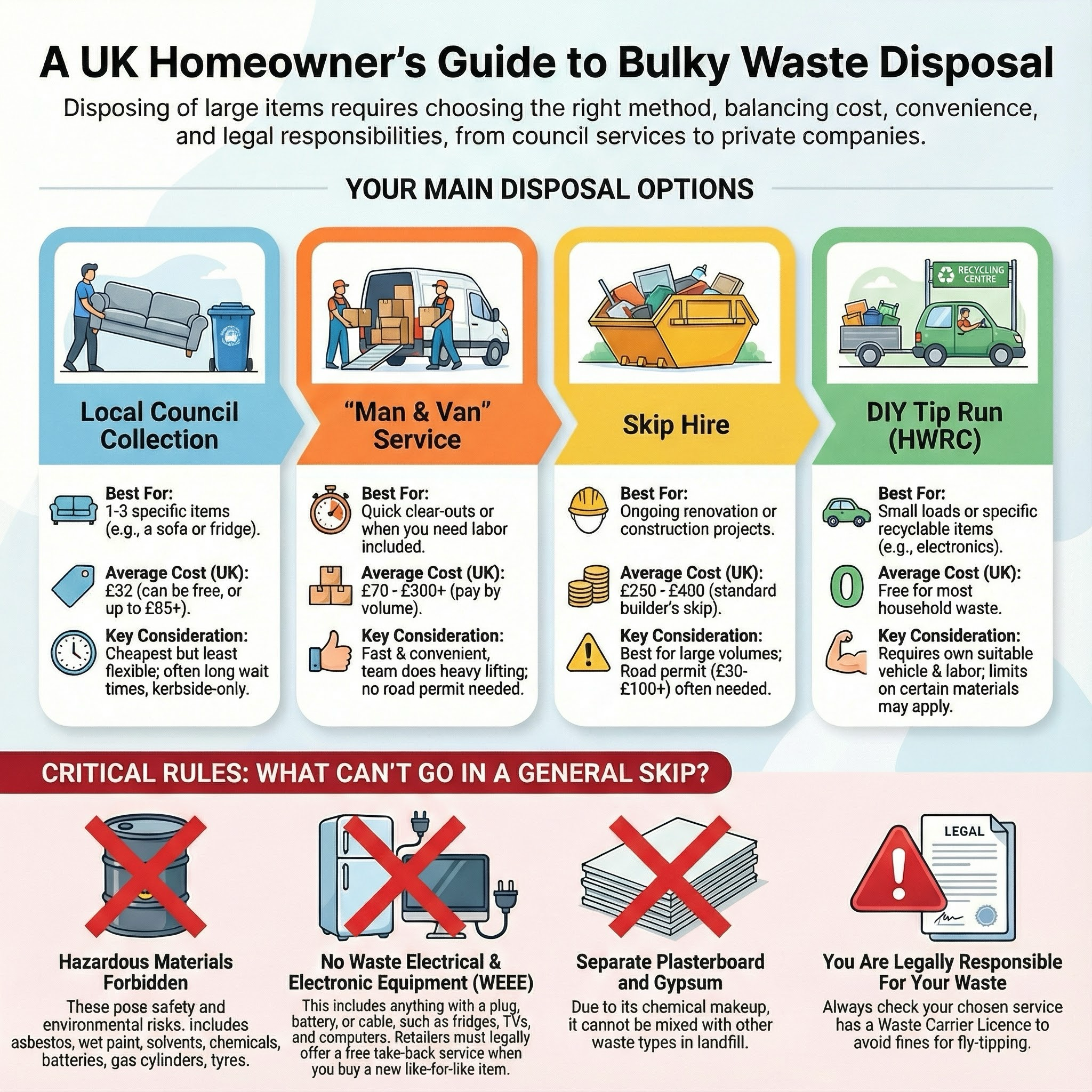
Rubbish Clearance explained
By hiring a specialist, you ensure that your rubbish is handled responsibly, with as much material as possible diverted from landfill. This guide outlines what to expect from a professional clearance service, the current UK market rates, and how to stay on the right side of environmental regulations.
Prices for waste clearance are typically based on the volume of the vehicle filled (e.g., 1/4 load, 1/2 load, or full load) and the weight of the materials. Cardboard is lightweight but bulky, whereas general household rubbish can be significantly heavier, impacting disposal fees at the weighbridge.
| Item / Service | Low £ | High £ | Notes |
|---|---|---|---|
| Minimum Call-out (Small Load) | £70 | £130 | Up to 2 cubic yards / 250kg |
| Half Van Load | £180 | £260 | Approx. 6-7 cubic yards |
| Full Van Load (Luton/Large Transit) | £350 | £550 | Approx. 12-14 cubic yards |
| Labour (per additional hour) | £45 | £85 | Usually for two-person teams |
| Surcharge: Mattress | £30 | £60 | Per item (recycling fee) |
| Surcharge: Fridge/Freezer | £40 | £90 | Hazardous waste handling fee |
Factors that increase the price include poor access (e.g., flats without lifts), the need for parking permits, and "heavy" waste like soil or rubble mixed with household items. Prices in London and the South East are generally 15-20% higher than the national average.
While you can take household waste to a local Household Waste Recycling Centre (HWRC) for free in a car, many councils restrict or charge vans and trailers. DIY clearance requires significant physical effort, a suitable vehicle, and time spent in queues at the tip.
Professional services are safer for heavy lifting and provide the necessary legal paperwork. However, you must ensure the trader is a registered waste carrier; otherwise, you could be held liable if your rubbish is fly-tipped.
The Duty of Care: Under UK law, you are responsible for ensuring your waste is disposed of by a licensed carrier. If your waste is found fly-tipped, you can face an unlimited fine, regardless of who you paid to take it away.
While not always mandatory, flattening boxes saves significant space in the vehicle. Since most firms charge by volume, pre-flattening your cardboard can save you a substantial amount of money.
Most professional clearance firms will take electrical items, but they may charge a small surcharge for items like fridges or computer monitors due to the hazardous gases and chemicals they contain.
Yes, but try to use clear bags for recyclables if possible. This allows the team to quickly identify what can be recycled, which may reduce your overall disposal costs.
Wet cardboard is much heavier and harder to recycle. If possible, keep it under cover until the clearance team arrives to avoid weight-based surcharges at the transfer station.
Ask for their Waste Carrier Licence number and check it against the Environment Agency’s online public register. A legitimate business will be happy to provide this information.
This guide was written with AI assistance and is intended for general information only. Prices are estimates based on UK averages and may vary by region. Always get at least three quotes and consult a qualified professional before starting any work.
Ask follow-ups in plain English. The AI explains options, sequencing and what to ask the rubbish clearance — so you walk in informed.
Disposing of an old mattress or a bulky bed frame is one of the more challenging tasks for UK homeowners. Beyond the physical strain of navigating heavy, awkwar...
READ GUIDE →GuideManaging commercial waste is a significantly different beast compared to standard residential rubbish. Whether you are a landlord clearing a shop unit, a home-b...
READ GUIDE →GuideDisposing of an old sofa or armchair in the UK has become more complex due to recent environmental legislation. Bulky furniture is difficult to move, and many i...
READ GUIDE →GuideScrapping a car in the UK is a straightforward process, but it is governed by strict environmental and legal regulations. Whether your vehicle is a non-runner, ...
READ GUIDE →GuideAccumulating black bin bags is a common headache for UK homeowners, whether it’s due to a missed council collection, a deep spring clean, or the aftermath of a ...
READ GUIDE →GuideWhether you are decommissioning a commercial suite or simply reclaiming a spare bedroom from years of "home office" clutter, a professional office clean-out is ...
READ GUIDE →