Instant
01 · Ask
Single item or whole house?
One sofa, a garage clear, end-of-tenancy strip-out? Describe and the AI tells you which clearance type and price band.

After buying or renting — clean, paint touch-ups, repairs and waste removal. Ready to live in within days.
Read the brief on waste carrier licences, recycling and hazardous handling — then let Three local firms quote.
One sofa, a garage clear, end-of-tenancy strip-out? Describe and the AI tells you which clearance type and price band.
EA licences, transfer notes, recycling rates, hazardous separation. Know what makes a firm legit.
Three local firms quote on the same load — pricing model, recycling, transfer notes — so you compare cleanly.
Ready when you are
Enter your postcode and get free quotes from local pros.
Four moves that separate a smooth job from a nightmare.
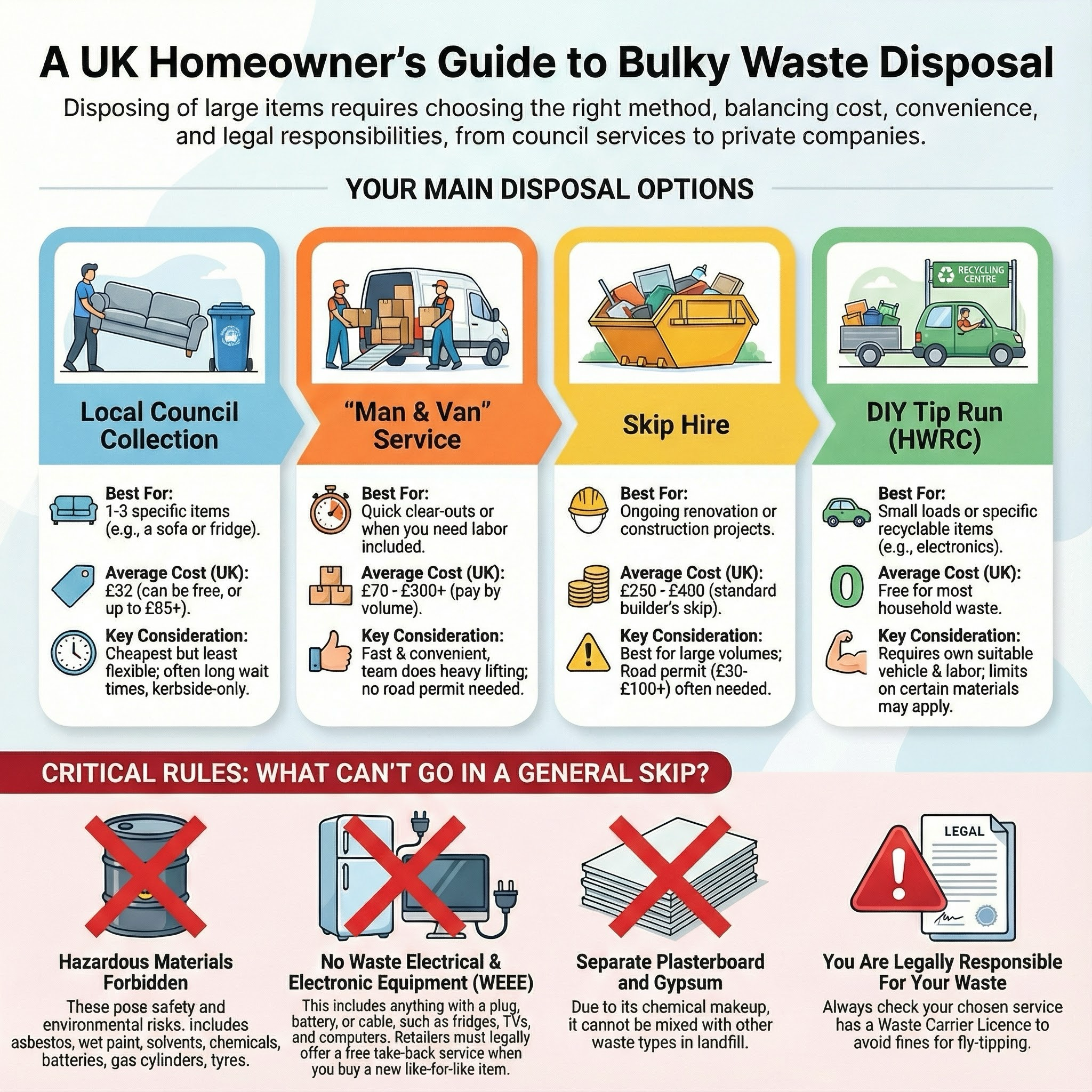
All UK waste carriers need an Environment Agency licence. Fly-tipping under your name is the alternative — and you get fined.
Some 'clearance' firms charge per load; others charge per volume. Get the price model in writing before they start.
Asbestos, paint, batteries, electronics — separate disposal routes. A reputable clearance firm handles or refers; cowboys dump.
Reputable firms recycle 60–80% of clearance. Ask what's recycled and what's landfill — and what affects price.
Indicative UK ranges and what affects price.
By job type
Quote spread is typically ± 18% — always get 3 quotes.
Rubbish Clearance quick-view
Rubbish Clearance explained
Setting up a new home in the UK after moving in typically costs £500–£3,000 in initial trades, deliveries, and services beyond the moving van itself. Common spend: locks changed (£100-£250), broadband install (£0-£100), appliance hookup (£100-£300), basic furniture assembly (£150-£500), and immediate maintenance / cleaning (£200-£600). Better to budget for these upfront than be surprised at completion.
For UK homeowners completing on a property, the first month after move-in is typically the most expensive non-purchase month of home ownership. Plan it.
| Service | Typical price |
|---|---|
| Lock change (front + back) | £150–£350 |
| Anti-snap cylinder upgrades | £100–£250 |
| Broadband installation | £0–£150 |
| Boiler service (if no recent records) | £90–£140 |
| EICR (electrical condition report) | £200–£400 |
| Pre-occupation deep clean | £150–£500 |
| Carpet clean | £60–£200 per room |
| Plumbing and gas safety check | £90–£200 |
| Furniture assembly (multiple items) | £200–£600 |
| Appliance install (washer, fridge, etc.) | £100–£250 each |
| TV / aerial setup | £60–£200 |
| Smart meter installation | Free (utility scheduled) |
| Council tax registration | Free |
Three things: locate water stopcock, locate consumer unit, test that all keys work for all locks. These three save you from being stuck in an emergency in the first 24 hours.
£500-£1,500 for typical move-in essentials (lock change, broadband, boiler service, basic deep clean, immediate small fixes). £2,000-£3,000 if you also include EICR, multiple appliance hook-ups, and any immediate redecoration.
Lock change and basic safety checks (boiler, smoke alarms, stopcock test) — don't delay. Cosmetic / decoration / non-essential setup can spread over months.
Electrical Installation Condition Report — confirms wiring is safe. Legally required for rentals every 5 years. Recommended for new homeowners if previous EICR is older than 5 years; £200-£400 typical.
Worth it for kitchens, bathrooms, and carpets — £150-£500 for a thorough professional clean. Even with conscientious previous owners, getting it done before you fully move in is much easier than after furniture is in place.
Anything not on the fixtures-and-fittings list belongs to you to dispose of. Quality items can be re-sold or given away (charity collection); rubbish needs licensed disposal. £100-£500 typical for handling significant left-behind items.
Want a local pro to handle this? A handyman, locksmith, and electrician are the three trades worth booking in the first week. Once they've done their checks, you have a properly safe and functional new home as your starting baseline.
This guide was written with AI assistance and is intended for general information only. Prices are estimates based on UK averages and may vary by region. Always get at least three quotes and consult a qualified professional before starting any work.
Ask follow-ups in plain English. The AI explains options, sequencing and what to ask the rubbish clearance — so you walk in informed.
Disposing of an old mattress or a bulky bed frame is one of the more challenging tasks for UK homeowners. Beyond the physical strain of navigating heavy, awkwar...
READ GUIDE →GuideManaging commercial waste is a significantly different beast compared to standard residential rubbish. Whether you are a landlord clearing a shop unit, a home-b...
READ GUIDE →GuideDisposing of an old sofa or armchair in the UK has become more complex due to recent environmental legislation. Bulky furniture is difficult to move, and many i...
READ GUIDE →GuideScrapping a car in the UK is a straightforward process, but it is governed by strict environmental and legal regulations. Whether your vehicle is a non-runner, ...
READ GUIDE →GuideAccumulating black bin bags is a common headache for UK homeowners, whether it’s due to a missed council collection, a deep spring clean, or the aftermath of a ...
READ GUIDE →GuideWhether you are decommissioning a commercial suite or simply reclaiming a spare bedroom from years of "home office" clutter, a professional office clean-out is ...
READ GUIDE →