Instant
01 · Ask
Ask the AI a follow-up
Got more questions about recycling Process Operator Overview? Describe the bit you're unsure about — the AI explains options, sequencing and what to ask the rubbish clearance.

What a recycling process operator does — sorting, baling, contamination management and traceability.
You've read the brief on recycling Process Operator Overview. Now lean on us to find the right rubbish clearance — and stay in control of the job.
Got more questions about recycling Process Operator Overview? Describe the bit you're unsure about — the AI explains options, sequencing and what to ask the rubbish clearance.
Costs, timelines, pitfalls and the right questions to ask before any rubbish clearance starts on recycling Process Operator Overview.
Itemised quotes from up to 3 local rubbish clearances on recycling Process Operator Overview — so you can compare like-for-like, not lump sums.
Ready when you are
Enter your postcode and get free quotes from local pros.
Four moves that separate a smooth job from a nightmare.
Some companies quote a low base price but add "supplementary fees" for mattresses, TVs, or fridges at the door.
Exceeding the weight limit of a van can lead to the company refusing to take the full load or charging extra.
If the crew has to carry items long distances or down several flights of stairs, expect higher labour costs.
Mixing plasterboard with general waste can result in the entire load being rejected at the transfer station.
Indicative UK ranges and what affects price.
By job type
Quote spread is typically ± 18% — always get 3 quotes.
Rubbish Clearance quick-view
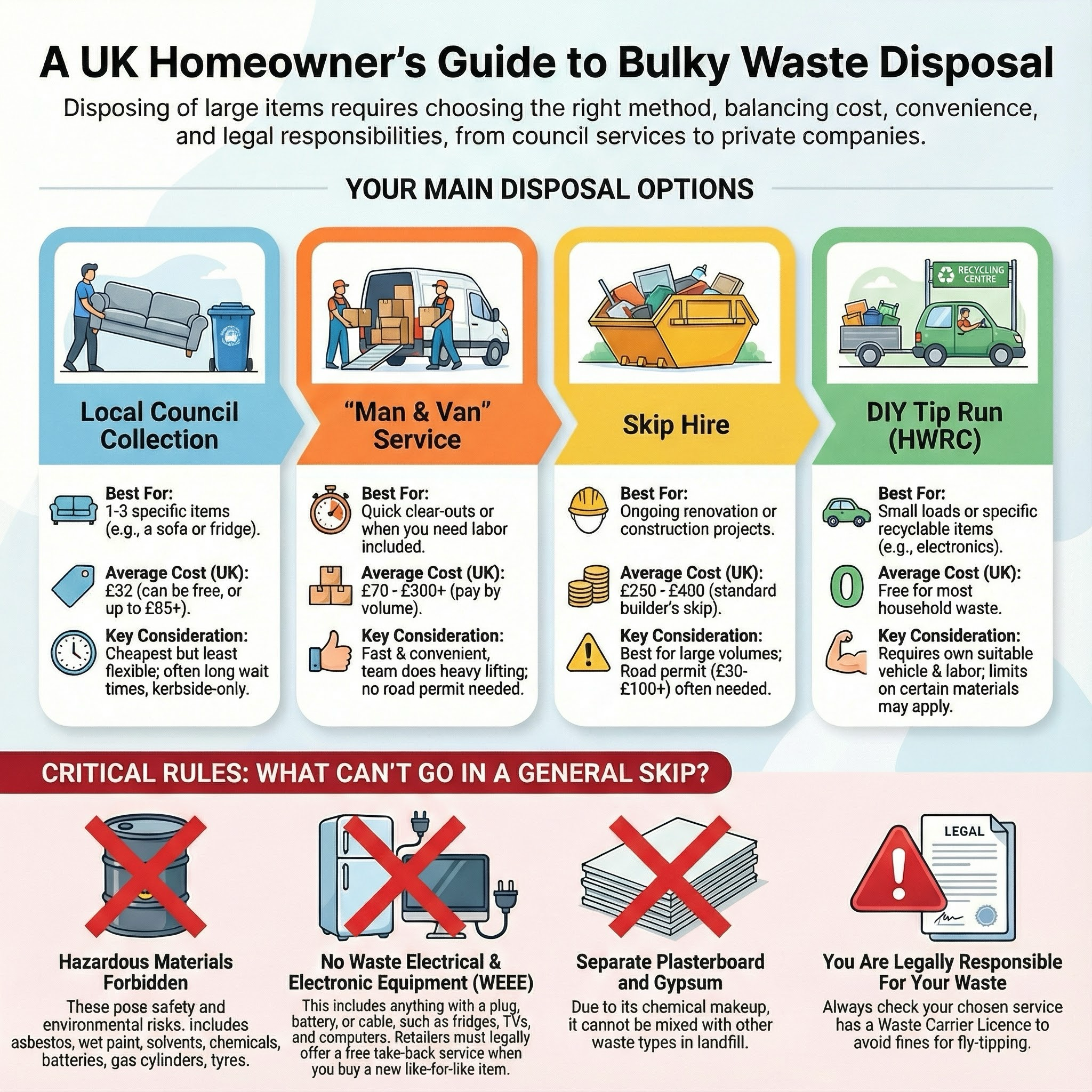
Rubbish Clearance explained
Hiring a professional waste clearance service or a recycling process specialist means your items are diverted from landfill wherever possible. This guide covers the costs, regulations, and practicalities of professional rubbish removal in the UK for 2025 and 2026.
Prices for waste clearance depend on the volume of rubbish (measured in cubic yards) and the weight of the materials. Heavy waste like soil or rubble is typically more expensive than bulky furniture.
| Item / Load Size | Low £ | High £ | Notes |
|---|---|---|---|
| Small Load (approx. 2 cubic yards) | £90 | £140 | Equivalent to 2 washing machines. |
| Medium Load (approx. 6 cubic yards) | £180 | £280 | Equivalent to a small builder's skip. |
| Large Load (approx. 10-12 cubic yards) | £350 | £500 | Ideal for full room clearances. |
| Full Van Load (approx. 14 cubic yards) | £550 | £750 | Maximum capacity for most transit vans. |
| Single Item (e.g., Mattress or Sofa) | £40 | £80 | Includes specific recycling surcharges. |
| Fridge/Freezer Disposal | £50 | £100 | Due to hazardous gas removal requirements. |
Labour is usually included in these prices, but "heavy" waste (brick, soil, concrete) is often capped by weight rather than volume. Always clarify if VAT is included in your initial quote.
While you can take household waste to your local Household Waste Recycling Centre (HWRC) for free, there are strict limits on "DIY waste" like tiles, plasterboard, and soil. Many councils now charge for these or require pre-booked slots.
The Homeowner's Duty of Care: Under UK law, you are responsible for your waste until it reaches a legal disposal point. If you hire an unlicensed "man with a van" and they fly-tip your rubbish, you can be prosecuted and fined thousands of pounds.
Don't be tempted by ultra-low prices on social media, as these often indicate illegal disposal methods. Look for the following:
Not necessarily, provided the waste is accessible (e.g., on a driveway or in a front garden). However, it is usually better to be present to sign the Waste Transfer Note and ensure only the correct items are taken.
A WTN is a legal document that tracks waste from the producer (you) to the carrier and finally to the disposal site. It is your proof that you have fulfilled your legal duty of care.
Most standard clearance companies cannot take asbestos, petrol, oil, or large quantities of paint. You will typically need a specialist hazardous waste contractor for these items.
A skip is often cheaper if you have a very large volume of heavy waste (like soil) and don't mind doing the heavy lifting yourself. However, you may need to pay for a skip permit if it's placed on a public road.
You can check the Environment Agency's public register online. Simply enter the company name or their registration number to verify their status.
This guide was written with AI assistance and is intended for general information only. Prices are estimates based on UK averages and may vary by region. Always get at least three quotes and consult a qualified professional before starting any work.
Ask follow-ups in plain English. The AI explains options, sequencing and what to ask the rubbish clearance — so you walk in informed.
Disposing of an old mattress or a bulky bed frame is one of the more challenging tasks for UK homeowners. Beyond the physical strain of navigating heavy, awkwar...
READ GUIDE →GuideManaging commercial waste is a significantly different beast compared to standard residential rubbish. Whether you are a landlord clearing a shop unit, a home-b...
READ GUIDE →GuideDisposing of an old sofa or armchair in the UK has become more complex due to recent environmental legislation. Bulky furniture is difficult to move, and many i...
READ GUIDE →GuideScrapping a car in the UK is a straightforward process, but it is governed by strict environmental and legal regulations. Whether your vehicle is a non-runner, ...
READ GUIDE →GuideAccumulating black bin bags is a common headache for UK homeowners, whether it’s due to a missed council collection, a deep spring clean, or the aftermath of a ...
READ GUIDE →GuideWhether you are decommissioning a commercial suite or simply reclaiming a spare bedroom from years of "home office" clutter, a professional office clean-out is ...
READ GUIDE →